


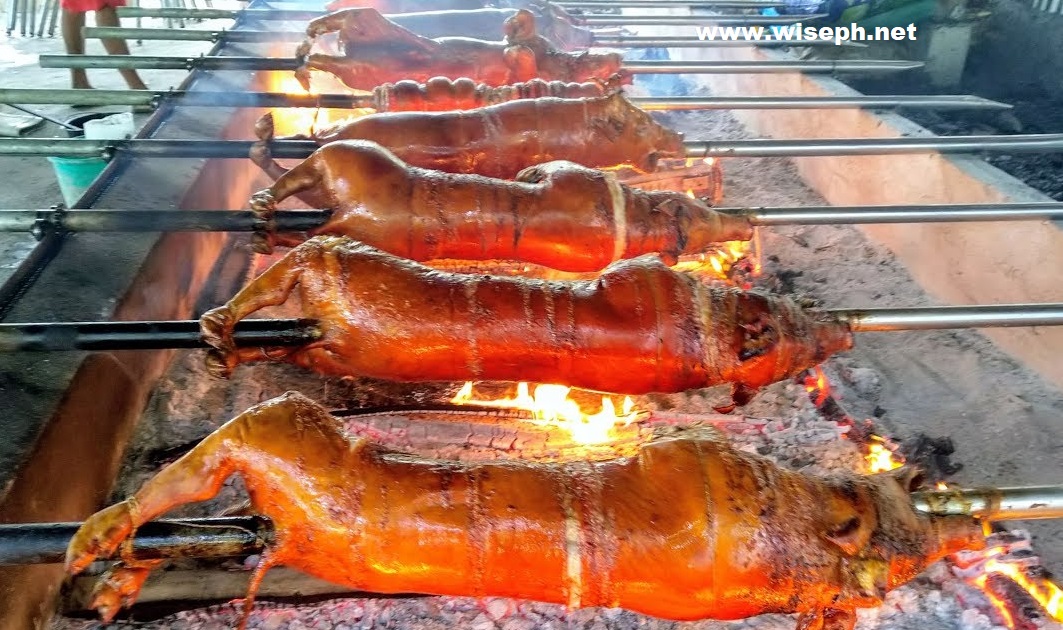
Lechon baboy is not really about the recipe.
Most articles write it up like a cooking guide, step-by-step instructions for a dish you make at home. But nobody makes lechon on a random Wednesday. You make it when there is a reason: a fiesta, a wedding, a birthday big enough to justify a whole pig. The experience starts hours before anyone eats — the charcoal going in at sunrise, the smell of roasting pork spreading through the neighborhood, people hanging around the fire taking turns pretending to help.
By the time the pig comes off the fire and someone makes that first loud chop, everyone is already there with a plate. That is lechon. Not a recipe. An event.
I have been part of a few lechon roastings over the years — fiestas, big birthdays. What I am sharing here is the real picture of how it is done, what separates Cebu from Manila style, and why the skin matters more than anything else on the plate.
What is Philippines lechon baboy?
Lechon baboy is a whole roasted pig cooked over live charcoal. It is the centerpiece of almost every major Filipino celebration. When lechon shows up, something is happening.
| Feature | Detail |
|---|---|
| Main ingredient | Whole pig, typically 20 to 30 kg |
| Cooking method | Slow-roasted over charcoal, 4 to 6 hours |
| Seasoning | Lemongrass, garlic, onion, salt stuffed inside |
| Quality indicator | Crispy golden skin, juicy smoky meat |
| Common dipping sauces | Mang Tomas liver sauce, toyomansi (toyo + kalamansi + sili) |
| Average cost | P7,000 to P20,000+, depending on size |
The seasoning inside a traditional lechon is simple. Lemongrass, garlic, onion, salt. That is mostly it. The flavor does not come from a complex marinade or injection. It comes from hours of slow heat, steady rotation, and the aromatics roasting from the inside while the fire works on the outside.
You can find lechon sold by the kilo in some carinderias on ordinary days, but that is the exception. Most Filipinos only eat fresh lechon during a genuine occasion. That context — the fiesta, the gathering, the waiting — is part of what makes it taste the way it does.
Cebu lechon vs. Manila lechon: what actually changes
Both versions use the same base: whole roasted pig over charcoal. The difference is what goes inside and how much the sauce matters.
Cebu lechon is stuffed heavily with lemongrass, garlic, onion, and spices. Those aromatics roast inside the pig for hours and push flavor into the meat from the inside out. You can eat Cebu lechon with no sauce at all and it is still fully satisfying. The roasting does all the work.
Manila lechon keeps it simpler inside, mostly just salt and basic aromatics. What completes it is the sauce. Mang Tomas liver sauce, thick and slightly sweet, is the standard pairing. Without it, Manila-style lechon feels like something is missing. The skin is still great, but the meat needs help.
If I had to choose, Cebu lechon wins. Kahit walang sawsawan, panalo na. The meat speaks for itself.
The same philosophy of letting the cooking do the work, without leaning on sauce for flavor, runs through Pampanga original sisig, where the char and the acid carry everything.
How lechon baboy is roasted: the real process
Lechon roasting is not something you do in an oven. It is outdoor work that takes most of the morning and a crew of people willing to take turns near a very hot fire.
Setup starts at sunrise. A long shallow pit or metal trough gets filled with charcoal. The pig — already cleaned, skewered on a bamboo pole, stuffed with aromatics — goes above the coals. The goal at the start is not a roaring fire. You want low, steady heat. Big flames at the beginning burn the skin before the inside is anywhere close to done.
There is always a designated taga-ikot, the person assigned to rotate the pig. It is manual the whole time. Two people usually take turns because it is tiring and hot near the coals. While turning, they baste the skin with oil or sometimes soft drinks to help it caramelize into that deep golden color.
You know it is ready by sound and color, not a clock. The taga-ikot taps the skin. A hollow, crisp knock means the skin has set properly. The color should be deep golden brown all around, no burnt patches. When both signals line up, the pig comes off. Then everyone who had been pretending not to wait suddenly appears with a plate.
The skin is the whole point
At every lechon gathering, the skin is gone first. Always. People angle for the skin pieces before anything else. The rest of the meat is secondary.
Good lechon skin is crackling crispy. You hear it when the pig is chopped — that loud, satisfying crack as the cleaver goes through. Each piece shatters when you bite it. The rendered fat just underneath is soft and rich, which gives you the contrast in every bite: the crunch, then the fat, then the smoky meat. All three happening at once.
The real mark of a well-roasted lechon: the skin stays crispy even after the pig cools down. If the skin goes soft and rubbery as it sits at room temperature, something went wrong during the roast. Usually the heat was uneven, or the skin was not dried properly before it went on the fire. Crispy skin that holds even cold is what separates a good lechon from a great one.
The same respect for bold, unapologetic flavor shows up in Ilocano sinanglaw, where a soured beef innards broth does not try to be subtle either.
Mistakes that ruin a whole pig
A few specific mistakes will wreck the entire lechon before it has a chance. There is no fixing them mid-cook.
Too much heat at the start. First-timers pile on charcoal thinking it speeds things up. The skin burns dark and bitter while the inside is still raw. Once the skin is charred, the lechon is done for. You cannot reverse that.
Uneven turning. The taga-ikot has to maintain a consistent rhythm the whole time. Too fast and the heat distribution is off. Forget one side for too long and part of the pig overcooks while another part is still underdone. Experienced roasters develop muscle memory for the rotation over years. There is no shortcut.
Wet skin going on the fire. If the skin still has moisture from cleaning, it will not crisp. It turns rubbery instead of crackling. Some roasters leave the pig out overnight specifically to let the surface air-dry completely. That preparation step is not optional if you want the skin to do what it is supposed to do.
How much does lechon cost in the Philippines?
A whole lechon costs between P7,000 and P20,000 or more. The price depends on the size of the pig, the region, and whether you are ordering from a local roaster or a premium Cebu-style shop.
| Pig weight | Approximate cost |
|---|---|
| 15 to 20 kg (small) | P7,000 to P10,000 |
| 20 to 25 kg (medium) | P10,000 to P14,000 |
| 25 to 30 kg (large) | P14,000 to P20,000 |
| Premium Cebu-style (branded shops) | P20,000+ |
These prices are not fixed. Rising oil prices affect lechon costs because fuel affects transport, feed prices, and charcoal supply. A P2,000 to P3,000 swing on the same weight pig is not unusual between regions or between a budget local roaster and a branded shop.
For most families, lechon is a once-in-a-while purchase tied to a specific occasion. The cost spreads across all the guests at the event, which is exactly how the dish was always meant to be eaten. It is not solo food. It is crowd food.
If you enjoy the fiesta table experience beyond just the lechon, Ilocano pinakbet is one of the dishes that always ends up alongside it at big northern gatherings. Explore the full range of regional dishes through Filipino delicacies from across the country.
Frequently asked questions about Philippines lechon baboy
What is lechon baboy made of?
Lechon baboy is a whole roasted pig. It is cleaned, stuffed with lemongrass, garlic, and onions, skewered on a bamboo pole, and slow-roasted over live charcoal for 4 to 6 hours. Served with Mang Tomas liver sauce or toyomansi (toyo, kalamansi, and sili).
What is the difference between Cebu and Manila lechon?
Cebu lechon is heavily stuffed with aromatics and spices, so the meat is flavorful on its own without sauce. Manila lechon is simpler inside and designed to be eaten with Mang Tomas liver sauce. Both have crispy skin, but Cebu lechon stands alone while Manila lechon is part of a bigger spread.
How long does it take to roast lechon baboy?
A whole pig takes 4 to 6 hours over charcoal. It is rotated by hand the entire time. Ready when the skin sounds hollow on a tap and has turned deep golden brown all around.
How much does a whole lechon cost in the Philippines?
Between P7,000 and P20,000 or more, depending on weight and seller. Small pigs (15 to 20 kg) start around P7,000. Premium Cebu-style from branded shops can go above P20,000. Prices move with fuel and feed costs.
What do you do with leftover lechon baboy?
The classic move is lechon paksiw — leftover pork braised in vinegar, soy sauce, sugar, and liver sauce. Rich, tangy, and many people say it is better the next day than the fresh lechon itself.











Comments 1