


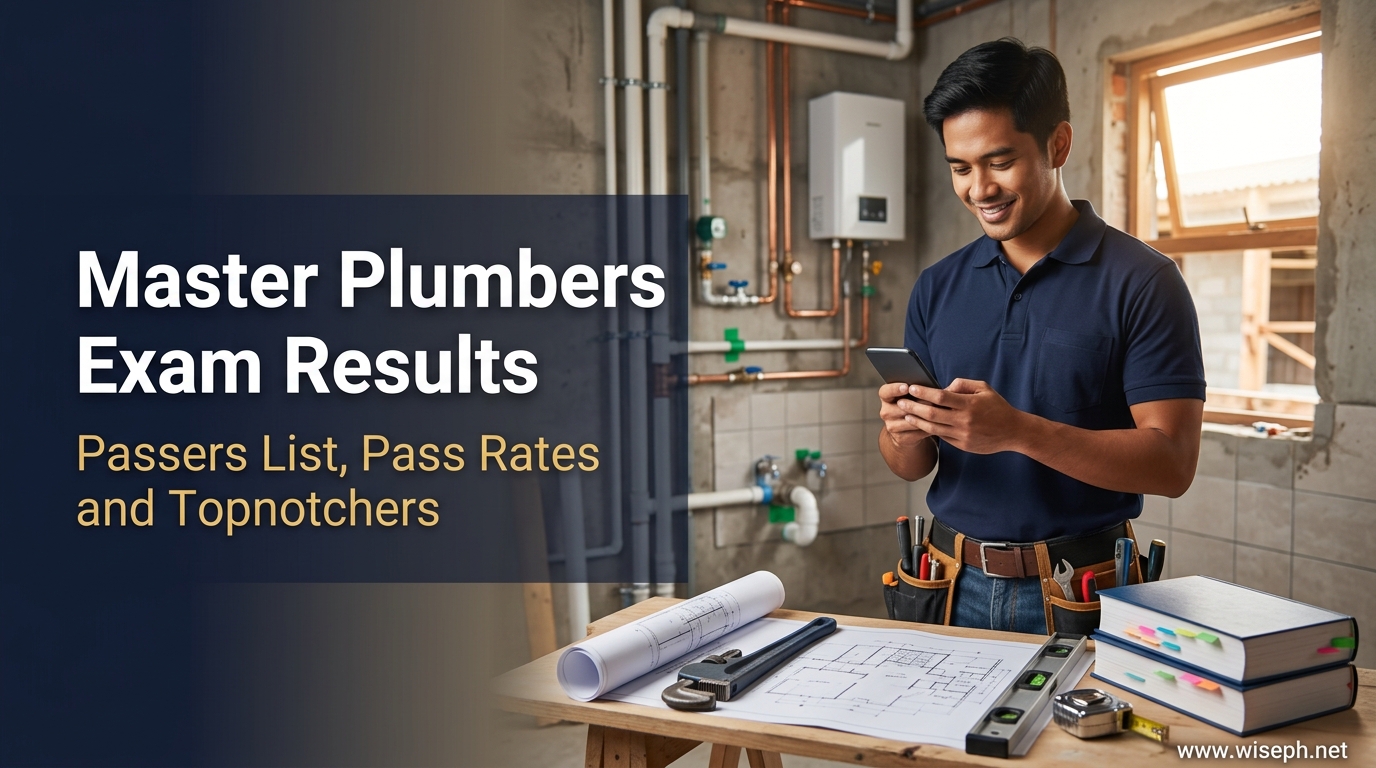
✅ Official results: released July 15, 2026
4,907 of 6,237 passed (78.68%).
| Batch | Examinees | Passers | Pass rate |
|---|---|---|---|
| July 2026 | 6,237 | 4,907 | 78.68% |
Latest results: July 2026 MPLE
On July 15, 2026, three working days after the last exam day, PRC posted the July 2026 MPLE results. That matches the speed of the February release. Testing took place in NCR, Baguio, Butuan, Cagayan de Oro, Cebu, Davao, Iloilo, Koronadal, Legazpi, Lucena, Pagadian, Rosales, Tacloban and Tuguegarao. Out of 6,237 takers, 4,907 passed. That is a 78.68% passing rate.
The Board for Master Plumbers gave the exam: Hon. Jaime Jajay E. Cruz, Chairman; Hon. Jason Magos and Hon. Samuel M. Paete, Members. Online registration for the PRC ID and certificate of registration starts September 1, 2026.
My older brother has been a licensed Master Plumber since 2019. He passed on his first try while working full-time as a plumber and reviewing at night. He now runs his own contracting team across Cavite, Laguna, and Batangas. Because of his license, he signs plans and pulls permits himself, which changed everything about the kind of work he can bid on and what clients are willing to pay him.
That experience showed me how much this license is worth. The MPLE scoring rules, pass rate history, and what comes next are all below.
What is the MPLE?
The MPLE is the PRC board exam that licenses master plumbers in the Philippines. A passing score gives you the legal right to sign plumbing plans, pull permits, and supervise installations independently. Without the license, you need to borrow or pay for another Master Plumber’s signature on every project submission, which adds cost and delay to every job.
The MPLE is a two-day, closed-book, paper-and-pencil test. It covers four subjects spread across both days under the Revised National Plumbing Code of the Philippines (2000 edition with subsequent updates). No reference materials are allowed inside the testing room.
| Subject | Weight | Day | Time |
|---|---|---|---|
| Plumbing Arithmetic | 10% | July 11 (Day 1) | 8:00 AM to 10:00 AM |
| Sanitation, Plumbing Design and Installation | 40% | July 11 (Day 1) | 11:00 AM to 5:00 PM |
| Plumbing Code | 10% | July 12 (Day 2) | 8:00 AM to 10:00 AM |
| Practical Problems and Experiences | 40% | July 12 (Day 2) | 11:00 AM to 5:00 PM |
When does PRC release MPLE results?
PRC typically releases MPLE results within 3 to 5 working days after the last exam day. For all PRC board exam results this year, visit our PRC board exam results page.
Once the list is out, PRC posts it on prc.gov.ph. We also update this page immediately with the downloadable PDF and the official passing rate. On results day, skip the LERIS portal. Thousands of examinees flood it at once and the server crashes within minutes.
What is the passing score for the MPLE?
To pass the Master Plumbers board exam, you need two things at the same time: a general weighted average (GWA) of at least 70% and no subject below 50%. Both conditions must be met. Fail either one and you fail outright, even if your overall average looks fine.
The 70% GWA is lower than the 75% standard most other Philippine board exams use, but the 50% floor makes it deceptively strict. Because Sanitation/Design/Installation and Practical Problems each carry 40% of the total score, one weak afternoon session drags the GWA down fast. There is no conditional status in the MPLE. No removal exam. If you fail, you register for the next cycle and retake the full two-day exam.
| Scenario | Arithmetic (10%) | Sanitation/Design (40%) | Plumbing Code (10%) | Practical Problems (40%) | GWA | Result |
|---|---|---|---|---|---|---|
| Clean pass | 78% | 76% | 80% | 75% | 76.2% | PASS |
| GWA fail | 60% | 65% | 72% | 68% | 66.6% | FAIL |
| Floor fail | 82% | 78% | 85% | 47% | 72.0% | FAIL (floor) |
MPLE pass rate history
Mid-year batches usually attract bigger crowds, often 5,000 or more examinees, and have historically posted lower passing rates than February cycles. July 2026 broke that pattern. 6,237 examinees sat the exam, the biggest batch in this page’s tracked history, and 78.68% still passed, beating every February cycle recorded here. Prior July cycles landed between 47% and 58%; this one cleared 78%.
| Cycle | Examinees | Passers | Pass rate |
|---|---|---|---|
| July 2024 | 6,191 | 2,936 | 47.42% |
| July 2025 | 5,145 | 2,971 | 57.75% |
| February 2026 | 3,287 | 2,030 | 61.76% |
| July 2026 | 6,237 | 4,907 | 78.68% |
How the latest batch compares
| Batch | Examinees | Passers | Pass rate |
|---|---|---|---|
| July 2026 | 6,237 | 4,907 | 78.68% |
| February 2026 | 3,287 | 2,030 | 61.76% |
| July 2025 | 5,145 | 2,971 | 57.75% |
| February 2025 | 3,340 | 1,475 | 44.16% |
| July 2024 | 6,191 | 2,936 | 47.42% |
The passing rate moved up 16.92 points from February 2026. It is the highest rate in our records since July 2024. A year earlier, July 2025 posted 57.75%. 2,950 more examinees took this batch than February.
The subjects that decide most results
My brother passed in 2019 on his first try, but he still remembers exactly where the exam nearly got him. He was working full-time as a plumber and reviewing at night, so every study hour had to count. When I asked which subjects gave him the hardest time, the answer was immediate: Practical Problems, then Sanitation/Design/Installation.
Why Practical Problems trips up first-timers
This 40% subject is not a standard multiple-choice test. You get floor plans and diagrams, and you have to draw complete plumbing layouts under time pressure: pipe sizing, drainage sizing, vent stack placement, trap protection, cleanouts, slope calculations, and fixture unit computations. My brother says he knew every formula and could cite the code from memory. Applying them quickly on a blank floor plan under time pressure was a completely different skill.
On timed practice runs, he kept making small errors: wrong vent termination height, trap placed on the wrong side, slope too flat on a long horizontal run. Those mistakes cost you points fast when the clock is running. His line that he still repeats to every mentee: “Theory is easy to review. Drawing a complete 3-storey sanitary system under time pressure is where most people lose.”
Why Sanitation/Design/Installation is a close second
This subject tests real judgment in system design: septic tank sizing and setback rules, grease traps for restaurants, rainwater drainage integration, swimming pool plumbing, and hospital plumbing requirements. The pipe sizing calculations are easy once you know them. Choosing the right system for a sloping Cavite lot or a flat Laguna commercial site takes judgment, not just memorization. My brother struggled specifically with designing systems for different building types, not with the math itself.
Where most first-timers get the study ratio wrong
Almost every review guide online pushes Plumbing Code memorization for the 10% subject. My brother says he spent too much time there in 2019 and only realized after passing that understanding the Code matters most in the context of the practical subjects, not as a standalone drill. A smarter ratio: 60 to 70% of your review time on timed drawing exercises and full sanitation system design, with the remaining time on code and arithmetic review.
His rule for both subjects: “Treat it like a design subject, not a memory subject. People who fail usually know the rules but can’t apply them quickly when they see an actual floor plan.”
The plumbing mistake that almost cost us ₱45,000
When we built our small house in Indang, Cavite last year, the contractor’s team roughed in the plumbing before my brother came to inspect. He spotted the problems immediately, before anything was backfilled.
What my brother caught on site
The septic tank sat only 1.2 meters from the foundation. Under the Revised National Plumbing Code, the minimum setback is 3 meters. The main drainage line used 2-inch pipe where a 4-bedroom house requires 4-inch. Slope was nearly flat in some sections; code requires at least a 2% grade. There were no vent stacks for any of the bathroom fixtures.
Left uncorrected, we would have had slow drains and frequent clogs from day one. Sewer gases would have backed into the house through unprotected traps. The undersized, poorly sloped pipes could have leaked at joints during rainy season and undermined the foundation over time. The septic tank, that close to the house and the deep well we planned to drill, could have contaminated the surrounding soil.
How we fixed it
My brother made the team redo the entire drainage system: relocate the septic tank to the proper distance, replace the main line with 4-inch pipe, correct all slopes, and add proper vent stacks and cleanouts throughout. It took five extra days and cost around ₱45,000 more. We were very glad he caught it before the concrete covered everything.
His comment: “Madaming ganito sa probinsya. Nakakapasa sa exam pero kapag nasa field na, tinatamad na sundin ang tamang design. Tapos kapag nag-problema na, sisisi sa ‘mahirap na tubig’ o ‘luma na ang bahay’.” A lot of this happens in the provinces. They pass the exam, then get lazy about following correct design on the actual job site. When problems come later, they blame the water quality or the age of the house.
This is why the MPLE puts 80% of the weight on Sanitation/Design and Practical Problems. The code exists for a reason, and licensed Master Plumbers are the ones responsible for making it stick on real job sites.
What the Master Plumber license actually unlocks
Before 2019, my brother earned around ₱18,000 to ₱25,000 a month as a journeyman plumber. In his first year or two after passing, that jumped to ₱35,000 to ₱55,000. Now, with a team of four to six people across CALABARZON, he earns ₱80,000 to ₱150,000 or more per month.
The bigger change was the type of work available. Before the license, he handled small repairs and minor residential installations. After, he could bid on full-house plumbing for subdivisions, townhouses, restaurants, offices, and clinics. Government and school projects opened up too. Developers and general contractors in CALABARZON look for a licensed Master Plumber before signing any plumbing package. His phone started ringing from a completely different tier of clients.
The license also let him sign his own plans and pull permits directly at the municipal engineering office. Before 2019, he had to pay or borrow another Master Plumber’s signature on every submission. That added cost and delay to every project and kept him dependent on someone else’s schedule. After passing, architects and engineers started referring clients to him directly.
What to do after passing the MPLE
Getting your name on the passers list is step one. You still cannot legally sign plans or pull permits until you complete the post-exam requirements. My brother has walked six to seven mentees through this process. The most common mistake is waiting too long to start.
Step 1: Attend the oathtaking
PRC schedules the oathtaking within one to three weeks after results. It may be a face-to-face mass ceremony or a virtual session. Attendance is required. Wear formal attire and bring a valid ID. After the oath, download and print the accomplished Oath Form from the PRC online portal.
Step 2: Register and claim your PRC ID
Go to online.prc.gov.ph after oathtaking to schedule your initial registration slot. Bring the accomplished Oath Form and Notice of Admission. You also need two passport-size photos on white background with name tag, two documentary stamps, and one short brown envelope. Online registration for the PRC ID and certificate of registration starts September 1, 2026. Registration is done online: bring a screenshot of your system-generated Registration Form and a valid government-issued ID when you register. Either way, you must still show up and sign the Roster of Registered Professionals in person. The PRC ID and Certificate of Registration typically arrive within one to four weeks. You cannot legally sign plans or pull permits until the PRC ID is in your hands.
Step 3: Join a professional organization
The two main organizations for licensed Master Plumbers are the Philippine Society of United Master Plumbers (PSUMP) and the National Master Plumbers Association of the Philippines (NAMPAP). Fees run around ₱600 to ₱1,200 per year. Benefits include CPD units, job referrals, and a Certificate of Good Standing that some permit offices ask for when submitting plans. Most new Master Plumbers join one within the first month after getting their PRC ID.
Total timeline from results to fully practicing: usually one to two months. My brother’s advice: “Don’t delay the oathtaking and registration. The sooner you finish, the sooner you can start earning with the license.”
Didn’t pass? Retake guide
My brother has mentored around six to seven people who failed their first MPLE attempt and passed on the retake. The pattern across nearly all of them was the same: they studied the Plumbing Code thoroughly but did not do enough timed, full-drawing practical exercises before the first exam.
For the retake, the ones who passed made one key shift. They flipped the study ratio. Instead of spending most review time on code and theory, practical drawing exercises took 60 to 70% of their sessions: residential, two-storey, and small commercial plans under timed conditions. My brother had them redraw the same problematic plans until they could complete each one cleanly and correctly without checking references. Daily, for three months straight.
One mentee scored only 38% in Practical Problems during the July 2024 exam. For his retake, he did nothing but practical drawings for three months. He passed the next cycle with a safe margin. PRC holds the MPLE twice a year, usually in February and July, so you have roughly six to seven months to rebuild your preparation. The next exam dates appear near the top of this page as soon as PRC publishes them. For other retake stories, see our real estate appraiser board exam guide and the teacher who tried 17 times.
MPLE results archive by batch
| Batch | Released | Passers | Pass rate |
|---|---|---|---|
| July 2026 | July 15, 2026 | 4,907 of 6,237 | 78.68% |
| May 2026 (special) | June 15, 2026 | 13 of 17 | 76.47% |
| February 2026 | February 25, 2026 | 2,030 of 3,287 | 61.76% |
| July 2025 | July 16, 2025 | 2,971 of 5,145 | 57.75% |
| June 2025 (special) | July 3, 2025 | 53 of 104 | 50.96% |
| February 2025 | February 26, 2025 | 1,475 of 3,340 | 44.16% |
| July 2024 | July 17, 2024 | 2,936 of 6,191 | 47.42% |
| June 2024 (special) | July 17, 2024 | 69 of 130 | 53.08% |
PDF downloads by batch
July 2026
May 2026 (special)
February 2026
July 2025
June 2025 (special)
February 2025
July 2024
June 2024 (special)
Frequently asked questions
When were the July 2026 MPLE results released?
PRC released the July 2026 MPLE results on July 15, 2026. 4,907 out of 6,237 passed (78.68%). That was three working days after the last exam day.What is the passing score for the Master Plumbers board exam?
To pass the MPLE, you need a GWA of at least 70% and no subject below 50%. Both conditions must be met at the same time. If either fails, you must retake the full exam in the next cycle. There is no conditional pass in the MPLE.
What happens if I fail one subject in the MPLE?
Failing any subject below the 50% floor means automatic failure, regardless of your GWA. There is no removal exam. You must register for and retake the full two-day exam in the next scheduled cycle.
How long does it take to get a PRC ID after passing the MPLE?
The full timeline is usually one to two months from results to active PRC ID. Oathtaking happens two to four weeks after results. PRC ID registration and release takes another one to four weeks. You cannot legally sign plans or pull permits until the PRC ID is issued.
Is the Master Plumbers board exam open book or closed book?
The MPLE is a closed-book exam. You cannot bring the Revised National Plumbing Code or any reference materials into the testing room. Everything must come from memory, drawing skill, and applied judgment under time pressure.
What to do next
Once the MPLE results drop, your path depends on where you land. Passers: complete oathtaking, register your PRC ID, and join PSUMP or NAMPAP within the first month. Retakers: take the break, audit which subject cost you points, flip your ratio toward timed drawing exercises, and target the next exam. For all PRC board exam results and licensing guides, visit our PRC board exam results page.