

✅ Official results: released August 25, 2026
4,204 of 5,634 passed (74.62%).
My cousin passed the medical technologists licensure exam in 2022 and has been working in a private hospital laboratory in Cavite ever since. I watched him go from reviewer to licensed professional, and I have seen what the license actually means inside a real lab: the pressure, the salary reality, and the career paths most new grads never consider. Bookmark this page: the results box above updates on its own as soon as PRC posts each batch.
Latest results: August 2026 MTLE
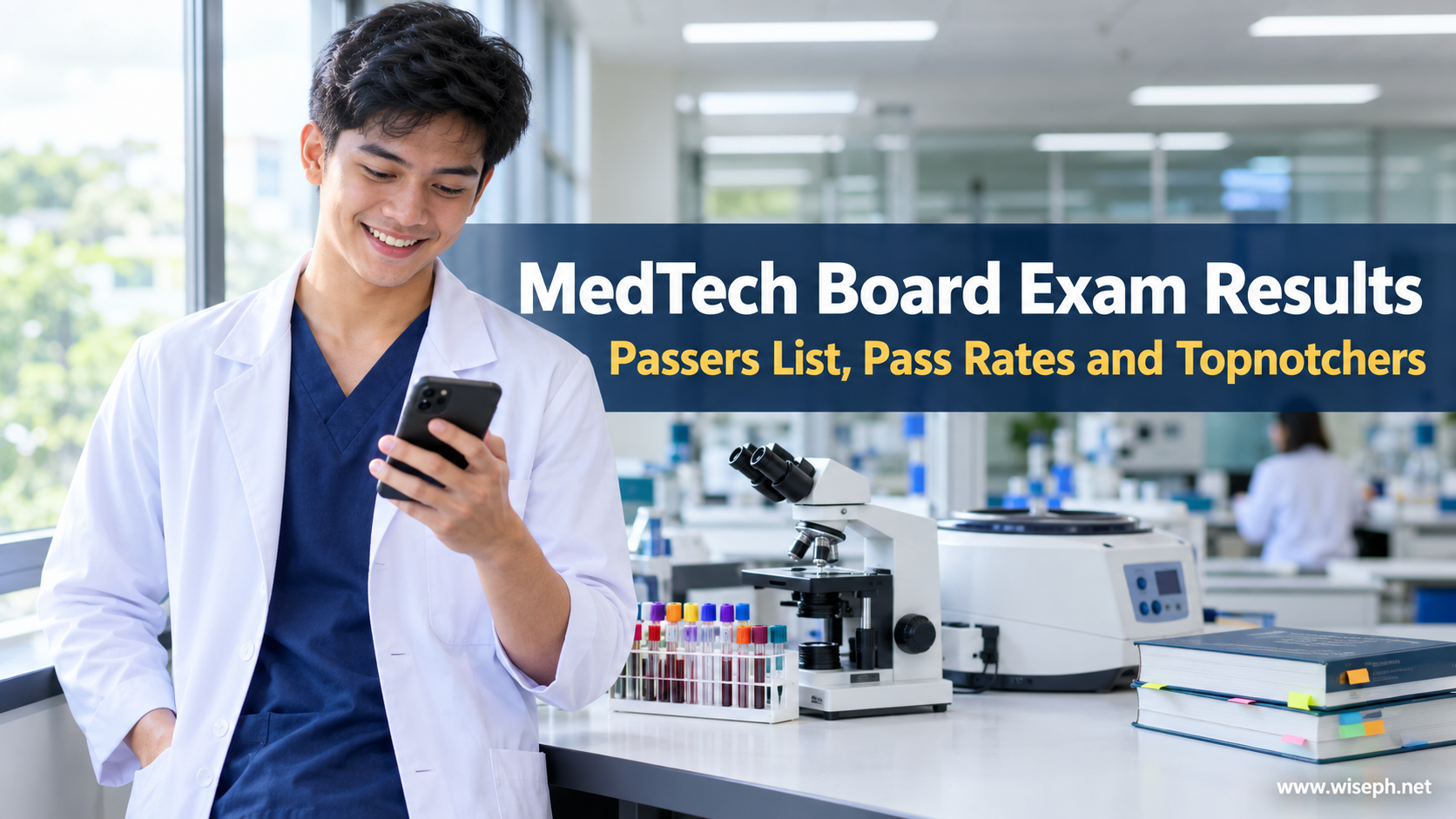
The August 2026 MTLE results came out on August 25, 2026, five working days after the last exam day. That is two days slower than March. Examinees took the test in NCR, Baguio, Butuan, Cagayan de Oro, Cebu, Davao, Iloilo, Koronadal, Legazpi, Lucena, Pagadian, Pampanga, Rosales, Tacloban, Tuguegarao and Zamboanga. The passing rate was 74.62%: 4,204 passers out of 5,634 examinees. PRC withheld the results of 1 examinee pending review of their cases.
Board of Medical Technology members: Hon. Marilyn A. Cabal-Barza, Chairperson; Hon. Leila Lany M. Florento and Hon. Maria Lourdes L. Gatbonton, Members. Online registration for the PRC ID and certificate of registration starts September 15, 2026. The oath-taking date will be announced later.
For all PRC board exam results this year, visit our PRC board exam results page.
The PRC releases results in two waves. Wave 1 is a PDF passers list on prc.gov.ph. Wave 2 is the LERIS update at online.prc.gov.ph, where individual subject ratings appear. On release day, skip LERIS entirely. Thousands of examinees hit it at the same time and the server goes down within minutes. Bookmark this page instead and download the official PDF directly to search your name offline with Ctrl+F.
How is the MTLE scored?
To pass the medical technologists licensure exam, two conditions must be met at the same time: a weighted general average of at least 75%, and no single subject below 50%. The MTLE has no conditional status. Fail either condition and you retake all subjects in the next cycle.
| Subject | Weight |
|---|---|
| Clinical Chemistry | 20% |
| Microbiology and Parasitology | 20% |
| Hematology | 20% |
| Blood Banking and Serology | 20% |
| Clinical Microscopy | 10% |
| Histopathologic Techniques, Cytotechnology, Medical Technology Laws and Ethics | 10% |
The four core subjects (Clinical Chemistry, Microbiology, Hematology, and Blood Banking) together account for 80% of your GWA. Strong scores there can carry a borderline average over 75%. However, the 50% floor applies to all six subject areas, including Clinical Microscopy (10%) and the Histopathology-Laws block (10%) that many first-timers underweight in their review.
Case 1: Outright pass
| Subject | Weight | Score | Contribution |
|---|---|---|---|
| Clinical Chemistry | 20% | 80% | 16.00 |
| Microbiology and Parasitology | 20% | 78% | 15.60 |
| Hematology | 20% | 82% | 16.40 |
| Blood Banking and Serology | 20% | 76% | 15.20 |
| Clinical Microscopy | 10% | 75% | 7.50 |
| Histopathology, Laws and Ethics | 10% | 77% | 7.70 |
| GWA | 78.40% (PASS) |
Case 2: Fail (GWA miss)
| Subject | Weight | Score | Contribution |
|---|---|---|---|
| Clinical Chemistry | 20% | 68% | 13.60 |
| Microbiology and Parasitology | 20% | 72% | 14.40 |
| Hematology | 20% | 74% | 14.80 |
| Blood Banking and Serology | 20% | 70% | 14.00 |
| Clinical Microscopy | 10% | 68% | 6.80 |
| Histopathology, Laws and Ethics | 10% | 73% | 7.30 |
| GWA | 70.90% (FAIL) |
No subject dropped below 50%, but a weak Clinical Chemistry score pulled the GWA to 70.90%. Decent scores everywhere but not strong enough in the four subjects where the real weight sits. That is how most people fail.
Case 3: Fail (50% floor knockout)
| Subject | Weight | Score | Contribution |
|---|---|---|---|
| Clinical Chemistry | 20% | 82% | 16.40 |
| Microbiology and Parasitology | 20% | 48% | 9.60 |
| Hematology | 20% | 79% | 15.80 |
| Blood Banking and Serology | 20% | 76% | 15.20 |
| Clinical Microscopy | 10% | 80% | 8.00 |
| Histopathology, Laws and Ethics | 10% | 77% | 7.70 |
| GWA | 72.70% (FAIL: 50% floor) |
A Microbiology score of 48% triggers the floor rule automatically. Even a strong Clinical Chemistry result and a near-passing GWA cannot override it. As a result, you retake the full exam in the next cycle with no carry-over.
August vs March: does the cycle matter?
The August MTLE cycle is consistently smaller than the March cycle. In March 2026, 9,317 examinees sat the exam. The August 2025 cycle had only 4,720, roughly half. A smaller batch does not mean a softer exam, though. The PRC does not adjust difficulty based on batch size.
| Cycle | Examinees | Passers | Passing rate |
|---|---|---|---|
| March 2026 | 9,317 | 7,838 | 84.13% |
| August 2025 | 4,720 | 3,360 | 71.19% |
| March 2025 | 7,659 | 6,147 | 80.26% |
| August 2024 | 5,574 | 3,872 | 69.47% |
| March 2024 | 9,068 | 7,309 | 80.60% |
| August 2023 | 5,401 | 3,982 | 73.73% |
| March 2023 | 6,165 | 4,714 | 76.46% |
| August 2022 | 3,582 | 1,796 | 47.63% |
| March 2022 | 2,752 | 1,268 | 46.08% |
March cycles have outperformed August ones across every recent cycle. March batches typically include more fresh graduates reviewing full-time, while August batches carry a higher proportion of retakers and working professionals who split review time with job responsibilities.
How the latest batch compares
Compared with March 2026, the passing rate went down 9.51 points. The average across these five batches is 75.93%, so this batch is below average. A year earlier, August 2025 posted 71.19%. 3,683 fewer examinees took this batch than March.
What my cousin’s first year in the lab actually taught us
My cousin passed the MTLE in 2022 and works in a private hospital laboratory in Cavite. My dad also goes through regular check-ups where MedTechs run almost every test the doctor orders. Watching both made one thing obvious: the board exam and the actual job are testing completely different things.
The real shock comes in the first six months on the job
My cousin said school and review taught him the theory. The lab taught him responsibility. In practice, every test result he releases directly affects a real patient’s diagnosis and treatment. Working under time pressure while maintaining 100% accuracy is a different kind of hard from studying for exams. He spent his first six months learning how to handle night shifts, stat requests, and difficult interactions with doctors who sometimes questioned results.
He put it plainly: “Passing the board made me legally allowed to work. But the first six months on the job felt like learning everything all over again. The board exam tests if you know the theory. The lab tests if you can be trusted with someone’s life every single day.”
What his review strategy looked like
He passed on his first attempt using this approach: 80% of prep time went to past board questions, not just reading reviewers but analyzing every wrong answer until he understood why. One-page correlation notes were his other main tool, linking lab findings to diseases (high BUN plus creatinine equals kidney failure, then what to expect in urine microscopy). He also ran full mock exams weekly for the last two months, and joined a small study group of four to five people for Clinical Chemistry and Microbiology to work through the hardest cases together.
His advice for MTLE takers: “Don’t just memorize. Understand why a test is ordered and what the result means for the patient. That is what the board is really testing.”
Read our guide on what a PRC license is if you want to understand exactly what the credential means for your career. MedTechs work alongside doctors more closely than most people outside the lab realize.
Topnotchers and top performing schools
The PRC publishes the full topnotchers list and performance of schools on the same day as results; the Top 10 and Performance of Schools buttons in the results box above open PRC’s own PDFs. For reference, the March 2026 top performer was Myles Chaesel Sunit Ejara from the University of the Immaculate Conception-Davao with a rating of 93.10%. Saint Louis University topped the performance of schools with a 100% passing rate across 362 examinees.
What to do right now if you passed
Your MTLE results confirm that you are now legally entitled to practice as a Registered Medical Technologist (RMT) in the Philippines. However, you cannot sign a single laboratory report until you complete two official steps: oathtaking and initial PRC registration. Follow this sequence.
Online registration for the PRC ID and certificate of registration starts September 15, 2026.- Register for oathtaking immediately. Go to online.prc.gov.ph and select “e-OATH” as the transaction. Print the Oath Form with your generated QR code. Face-to-face ceremonies are typically scheduled in major cities (Manila, Cebu, Davao) within one to three weeks after results. Wear formal attire: barong for men, formal dress for women.
- Complete initial registration right after oathtaking. Go back to online.prc.gov.ph and select “Initial Registration.” Upload your accomplished Oath Form, a valid ID or Notice of Admission, two passport-size photos with white background and name tag, documentary stamps, and a short brown envelope. You must also personally sign the Roster of Registered Professionals. Your PRC ID and Certificate of Registration are released within one to four weeks.
- Join PAMET as soon as you have your PRC ID. The Philippine Association of Medical Technologists, Inc. (PAMET) is the PRC-accredited professional organization for RMTs. New-member fees run around ₱450. Benefits include CPD units, networking, job referrals, seminars, and a Certificate of Good Standing that most hospitals and abroad employers require.
What he told me: “Don’t delay. Prepare your documents the same day results come out. The sooner you finish the oathtaking and registration, the sooner you start earning as a licensed MedTech.”
MedTech salaries in 2026: honest numbers from someone in the field
My cousin has been in a private hospital lab in Cavite since 2022. His actual salary progression matches what batchmates and colleagues across CALABARZON report.
| Experience | Position | Basic pay | Take-home |
|---|---|---|---|
| Fresh passer (2022) | Medical Technologist | ₱19,000 to ₱21,000 | ₱16,000 to ₱18,000 |
| 1 to 2 years (2023 to 2024) | Regular MedTech | ₱24,000 to ₱27,000 | ₱21,000 to ₱23,000 |
| 3 to 4 years (2025 to 2026) | Senior MedTech / Section Head | ₱32,000 to ₱36,000 | ₱27,000 to ₱31,000 |
Night shift differential adds ₱1,000 to ₱2,000 extra per month, on top of 13th-month pay and occasional performance bonuses. Smaller hospitals and diagnostic clinics in Cavite often start at ₱17,000 to ₱22,000 for fresh grads. Bigger hospitals in Imus or Bacoor pay slightly more.
He does not sugarcoat it: “The pay is decent for a fresh grad, but it does not fully match the pressure and responsibility we carry. After four years, I’m earning better than many other professions, but a lot of us feel underpaid relative to the accountability. That is why many MedTechs I know eventually go abroad, where the pay is three to five times higher for the same work.”
As a new RMT, understanding your mandatory contributions matters from day one. Read our guide on why SSS matters for new employees and consider opening a Pag-IBIG MP2 account from your first paycheck. A comparison of Pag-IBIG regular savings vs MP2 helps you decide where contributions go further. Once you have a few months of salary behind you, our guide on investing in the Philippine stock market covers what to do next. Also bookmark how to claim your SSS sickness benefit before you ever need it.
Career paths most new MedTechs overlook
Hospital lab work is where most new RMTs start. For many, it is not where they stay. My cousin has watched batchmates move into roles that pay more with less night-shift pressure, and most of them say they wished they had known sooner.
| Career path | Starting pay | Key advantage |
|---|---|---|
| Private hospital laboratory | ₱19,000 to ₱21,000 | Widest case variety, best for abroad prep |
| Diagnostic clinic or reference lab | ₱20,000 to ₱25,000 | Stable hours, no night shifts |
| Sales / technical rep (Abbott, Roche, Sysmex) | ₱30,000 to ₱45,000 + commission | Company car, regular hours, fastest early pay jump |
| Molecular diagnostics / research lab | ₱25,000 to ₱35,000 | Growing field, advanced testing (PCR, NGS) |
| Government / public health lab (DOH, RITM) | ₱22,000 to ₱28,000 | Stability, good benefits |
| Academia / review center instruction | Varies | Often combined with part-time lab work |
| Abroad (Saudi, US, Canada) | ₱80,000 to ₱180,000 equivalent | Largest pay jump, requires additional licensing |
Two paths most new MedTechs never seriously consider
My cousin specifically flags two underrated paths. First, sales and technical representative roles for lab equipment companies. Many new grads think “sales” means being pushy. In practice, these positions start at ₱30,000 to ₱45,000 plus commission, with a company car and regular office hours. Two of his batchmates who went that route now earn more than he does with less stress. Second, molecular diagnostics and research labs grew significantly after COVID. PCR and NGS testing pays better than routine lab work, and many of these labs do not require a master’s degree to enter.
What he keeps telling younger MedTechs: “The license opens more doors than most people realize. The ones who explore sales, molecular diagnostics, or government labs usually end up happier and better paid in the long run.”
Going abroad after the MTLE
Many Filipino RMTs eventually work overseas, where the same skills earn three to five times more. My cousin’s advice: gain at least one to two years of local hospital experience first. That experience strengthens your overseas application and gives you real skills under pressure. Here are the three most common destinations.
| Destination | Key certification | Estimated process time | Estimated cost |
|---|---|---|---|
| Saudi Arabia | SCFHS classification + Prometric exam | 4 to 8 months | ₱80,000 to ₱150,000 |
| United States | ASCP Board of Certification (MLS) | 12 to 24 months | ₱200,000 to ₱400,000+ |
| Canada | CSMLS national exam + PLA assessment | 12 to 18 months | ₱150,000 to ₱300,000 |
Saudi Arabia is the most common first destination. Requirements include your PRC license, one to two years of post-licensure experience, SCFHS professional classification, DataFlow primary source verification, and a Prometric exam (sometimes waived with strong experience). Benefits typically include tax-free salary, free housing, and return flights.
United States requires the ASCP Board of Certification as a Medical Laboratory Scientist (MLS). You start with educational equivalency evaluation and English proficiency testing. Visa sponsorship typically runs through H-1B or EB-3 green card pathways via a hospital employer. The ASCP exam is expensive and difficult. Most who pass first build two to three years of local experience and savings before sitting it.
Canada requires CSMLS national certification. Internationally educated MedTechs go through the Prior Learning Assessment (PLA) route before sitting the exam. Many applicants waste months by skipping the PLA step. Immigration runs through Express Entry or Provincial Nominee Programs.
My cousin’s general advice: start document preparation early. DataFlow verification alone can take months. Budget between ₱150,000 and ₱400,000 depending on the country, and research your employer carefully before signing anything. A valid Philippine passport is the first document you need before any overseas application begins.
If you need to retake
Take a complete one to two week break before opening any review material. Then do an honest audit of which subjects cost you points. Most people fail not because they studied the wrong subjects. They fail because they studied the right ones badly.
If you failed Clinical Chemistry or Microbiology, my cousin’s advice is straightforward: stop memorizing isolated facts. Build correlation notes instead. Link each lab test to the disease and to what you expect to find in other panels. Skip the cover-to-cover reading and go straight to clinical scenarios. Run timed mock exams every week for the last two months. That is what the MTLE actually rewards.
The story of the teacher who tried 17 times before passing the LET covers the mindset shift that matters most after a failed attempt. The lessons apply across every PRC board exam.
MTLE results archive by batch
PDF downloads by batch
August 2026
May 2026 (special)
March 2026
August 2025
March 2025
August 2024
June 2024 (special)
March 2024
Earlier batches
| Batch | Examinees | Passers | Pass rate |
|---|---|---|---|
| August 2023 | 5,401 | 3,982 | 73.73% |
| March 2023 | 6,165 | 4,714 | 76.46% |
| August 2022 | 3,582 | 1,796 | 47.63% |
| March 2022 | 2,752 | 1,268 | 46.08% |
Frequently asked questions
When were the August 2026 MTLE results released?
PRC released the August 2026 MTLE results on August 25, 2026. 4,204 out of 5,634 passed (74.62%). That was five working days after the last exam day.What is the passing score for the MTLE?
You need a weighted general average (GWA) of at least 75% and no single subject below 50%. A strong Clinical Chemistry score cannot save you if any other subject falls below the 50% floor. Both conditions must be met at the same time.
Is there a conditional status in the MTLE?
No. The MTLE is outright pass or fail. Fail either condition and you retake all six subjects in the next cycle with no carry-over from this attempt.
What six subjects does the MTLE cover?
The MTLE covers Clinical Chemistry (20%), Microbiology and Parasitology (20%), Hematology (20%), Blood Banking and Serology (20%), Clinical Microscopy (10%), and Histopathologic Techniques, Cytotechnology, Medical Technology Laws and Ethics (10%). The four core subjects account for 80% of your total GWA.
What should I do after passing the MTLE?
Register for oathtaking at online.prc.gov.ph, complete initial PRC registration to claim your ID and Certificate of Registration, then join PAMET. You cannot legally sign laboratory reports until both the oathtaking and PRC ID registration are complete.
What to do next
Once results are out, your next step depends on where you landed. Passers: attend oathtaking, register your PRC ID, join PAMET, and start the first job with eyes open about the salary reality and the career paths most new RMTs never consider. Retakers: audit your six subject scores honestly, build correlation notes instead of memorizing facts, and plan for the next cycle with a different method, not just more hours. For all PRC board exam results and professional guides, visit our PRC board exam results page.