


Week of October 13 to October 19, 2026Reported
| Brand | Diesel | Gasoline | Kerosene |
|---|---|---|---|
| All companies (DOE) | −₱3.01 | +₱1.56 | +₱1.77 |
Source: Department of Energy (DOE). Figures are per liter and may vary by station.
⏳ Next week's estimate (Tuesday, October 20)
Oil industry estimates usually come out on Thursday or Friday, after about four days of world oil trading. Early guesses made after just one day of trading often change. We post the oil industry's estimate here as soon as it comes out, then the final prices once the oil companies announce them.
Every Tuesday, fuel prices in the Philippines quietly reset. Most people find out at the pump, already mid-week, budget fixed, no room to adjust.
This page changes that. Above is this week’s oil price adjustment. Below is everything you need to understand what the numbers actually mean: why prices move the way they do, why good news takes a week to reach the pump, and what you can actually do before Tuesday arrives.
What is this week’s oil price in the Philippines?
Oil companies announce the weekly price adjustments every Monday, and the Department of Energy (DOE) Oil Industry Management Bureau (OIMB) monitors them. Changes take effect on Tuesday: at 6 AM at most stations, while some companies start as early as 12:01 AM. The figures at the top of this page are the per-liter adjustments announced by the major oil companies, such as Petron and Shell. We post each week as soon as the oil companies announce it, and we check every figure against the range in the DOE’s official Monday advisory once the DOE posts it.
Recent weekly oil price changes
| Week of | Diesel | Gasoline | Kerosene |
|---|---|---|---|
| Oct 13, 2026 | −₱3.01 | +₱1.56 | +₱1.77 |
| Oct 6, 2026 | −₱1.30 | +₱1.90 | +₱3.30 |
| Sep 29, 2026 | −₱7.60 | −₱0.30 | −₱5.90 |
| Sep 22, 2026 | +₱8.82 | +₱4.88 | +₱6.47 |
| Sep 15, 2026 | +₱4.31 | +₱5.68 | +₱4.62 |
| Sep 8, 2026 | +₱5.20 | +₱4.70 | +₱5.60 |
| Sep 1, 2026 | −₱3.90 | −₱0.32 | −₱3.84 |
| Aug 25, 2026 | +₱2.31 | +₱1.08 | +₱0.95 |
| Aug 18, 2026 | +₱3.84 | +₱2.49 | +₱5.01 |
| Aug 11, 2026 | −₱4.30 | −₱4.70 | −₱4.90 |
| Aug 4, 2026 | −₱0.60 | −₱0.73 | −₱2.09 |
| Jul 28, 2026 | +₱7.30 | +₱6.80 | +₱4.20 |
Show all 93 weeks
| Week of | Diesel | Gasoline | Kerosene |
|---|---|---|---|
| Jul 21, 2026 | +₱10.68 | +₱3.65 | +₱11.77 |
| Jul 14, 2026 | +₱4.60 | +₱1.00 | +₱2.30 |
| Jul 7, 2026 | +₱3.30 | +₱0.25 | +₱1.75 |
| Jun 30, 2026 | +₱0.84 | +₱1.65 | +₱1.22 |
| Jun 23, 2026 | −₱9.04 | −₱3.90 | −₱11.00 |
| Jun 16, 2026 | −₱3.71 | +₱1.68 | −₱0.50 |
| Jun 9, 2026 | +₱4.85 | +₱0.30 | +₱4.75 |
| Jun 2, 2026 | −₱9.26 | −₱4.76 | −₱10.86 |
| May 26, 2026 | +₱1.96 | +₱1.60 | +₱1.45 |
| May 19, 2026 | +₱2.50 | +₱1.25 | −₱1.00 |
| May 12, 2026 | −₱9.00 | +₱4.00 | −₱12.00 |
| May 5, 2026 | +₱3.60 | +₱3.00 | −₱0.50 |
| Apr 28, 2026 | −₱12.00 | +₱0.55 | −₱15.00 |
| Apr 21, 2026 | −₱26.20 | −₱3.20 | −₱0.95 |
| Apr 14, 2026 | −₱21.00 | −₱4.00 | −₱7.00 |
| Apr 7, 2026 | +₱21.00 | +₱7.00 | +₱18.00 |
| Mar 31, 2026 | +₱12.00 | +₱5.00 | +₱10.00 |
| Mar 24, 2026 | +₱17.80 | +₱10.70 | +₱21.90 |
| Mar 17, 2026 | +₱20.40 | +₱12.90 | +₱6.90 |
| Mar 10, 2026 | +₱17.50 | +₱7.00 | +₱32.00 |
| Mar 3, 2026 | +₱1.20 | +₱1.90 | +₱1.50 |
| Feb 24, 2026 | +₱1.20 | +₱0.60 | +₱1.20 |
| Feb 17, 2026 | +₱0.60 | +₱1.20 | +₱0.60 |
| Feb 10, 2026 | +₱1.00 | +₱0.60 | +₱0.60 |
| Feb 3, 2026 | +₱1.60 | +₱0.80 | +₱1.10 |
| Jan 27, 2026 | +₱1.40 | +₱0.40 | +₱0.80 |
| Jan 20, 2026 | +₱2.00 | +₱1.00 | +₱1.50 |
| Jan 13, 2026 | +₱0.20 | +₱0.30 | +₱0.30 |
| Jan 6, 2026 | +₱0.20 | −₱0.10 | +₱0.10 |
| Dec 30, 2025 | +₱0.60 | No change | +₱0.60 |
| Dec 23, 2025 | −₱1.30 | −₱0.80 | −₱1.60 |
| Dec 16, 2025 | −₱0.20 | +₱0.20 | −₱0.20 |
| Dec 9, 2025 | No change | +₱1.20 | No change |
| Dec 2, 2025 | −₱2.90 | +₱0.20 | −₱3.20 |
| Nov 25, 2025 | +₱0.60 | −₱0.20 | +₱1.30 |
| Nov 18, 2025 | +₱1.20 | +₱1.20 | No change |
| Nov 11, 2025 | +₱1.00 | +₱0.50 | +₱1.00 |
| Nov 4, 2025 | +₱2.70 | +₱1.70 | +₱2.10 |
| Oct 28, 2025 | +₱2.00 | +₱1.20 | +₱1.70 |
| Oct 21, 2025 | −₱0.70 | +₱0.10 | −₱0.60 |
| Oct 14, 2025 | No change | +₱0.30 | −₱0.20 |
| Oct 7, 2025 | +₱0.80 | +₱0.20 | +₱0.20 |
| Sep 30, 2025 | +₱0.90 | −₱0.20 | +₱0.90 |
| Sep 23, 2025 | +₱0.80 | +₱1.00 | +₱1.00 |
| Sep 16, 2025 | +₱0.50 | +₱0.10 | +₱0.10 |
| Sep 9, 2025 | +₱1.40 | +₱1.00 | +₱0.60 |
| Sep 2, 2025 | +₱1.00 | +₱0.70 | +₱0.70 |
| Aug 26, 2025 | +₱0.50 | +₱0.70 | +₱0.30 |
| Aug 19, 2025 | −₱0.80 | +₱0.60 | −₱0.90 |
| Aug 12, 2025 | −₱1.50 | −₱0.40 | −₱1.30 |
| Aug 5, 2025 | +₱1.20 | +₱1.90 | +₱1.00 |
| Jul 29, 2025 | +₱0.60 | −₱0.10 | +₱0.40 |
| Jul 22, 2025 | +₱1.10 | +₱0.40 | +₱0.70 |
| Jul 15, 2025 | +₱1.40 | +₱0.70 | +₱0.80 |
| Jul 8, 2025 | −₱0.10 | −₱0.70 | −₱0.80 |
| Jul 1, 2025 | +₱1.80 | +₱1.40 | +₱2.20 |
| Jun 24, 2025 | +₱2.60 | +₱1.75 | +₱2.40 |
| Jun 17, 2025 | +₱1.80 | +₱1.80 | +₱1.50 |
| Jun 10, 2025 | +₱0.95 | +₱0.60 | +₱0.30 |
| Jun 3, 2025 | +₱0.30 | +₱0.40 | −₱0.10 |
| May 27, 2025 | +₱0.10 | −₱0.20 | −₱0.40 |
| May 20, 2025 | +₱1.70 | +₱1.20 | +₱1.20 |
| May 13, 2025 | −₱0.90 | −₱0.30 | −₱1.25 |
| May 6, 2025 | −₱0.65 | −₱0.55 | −₱0.90 |
| Apr 29, 2025 | +₱0.80 | +₱1.35 | +₱0.70 |
| Apr 22, 2025 | +₱1.30 | +₱1.35 | +₱1.10 |
| Apr 15, 2025 | −₱2.90 | −₱3.60 | −₱3.30 |
| Apr 8, 2025 | No change | −₱0.10 | −₱0.50 |
| Apr 1, 2025 | +₱1.20 | +₱1.40 | +₱1.20 |
| Mar 25, 2025 | +₱0.40 | +₱1.10 | +₱0.40 |
| Mar 18, 2025 | −₱0.20 | No change | −₱0.40 |
| Mar 11, 2025 | −₱0.90 | −₱1.70 | −₱1.80 |
| Mar 4, 2025 | +₱0.80 | +₱0.80 | +₱0.10 |
| Feb 25, 2025 | +₱0.40 | +₱0.70 | +₱0.20 |
| Feb 18, 2025 | +₱0.80 | +₱0.80 | +₱0.10 |
| Feb 11, 2025 | −₱0.10 | −₱0.10 | −₱0.30 |
| Feb 4, 2025 | −₱1.15 | +₱0.70 | −₱0.90 |
| Jan 28, 2025 | −₱0.20 | −₱0.80 | −₱0.50 |
| Jan 21, 2025 | +₱2.70 | +₱1.65 | +₱2.50 |
| Jan 14, 2025 | +₱0.90 | +₱0.80 | +₱0.80 |
| Jan 7, 2025 | +₱1.40 | +₱1.00 | +₱1.00 |
The change you see each Tuesday is not a reaction to that day’s news. Instead, it follows the previous week’s world fuel prices and the peso-dollar rate. That one-week gap is one of the most misunderstood parts of how oil pricing works here.
How much is diesel and gasoline per liter in Metro Manila?
The weekly change tells you the direction. However, the price you actually pay depends on your city and your station, so here are the latest prices the Department of Energy recorded.
For the week of October 6 to 12, 2026, the Department of Energy recorded these pump prices at stations across 12 cities in Metro Manila (DOE price monitoring report). Most stations sit between the lowest and highest price.
| Fuel | Lowest | Highest |
|---|---|---|
| Diesel | ₱83.00 | ₱99.40 |
| Gasoline RON 91 (regular) | ₱78.60 | ₱96.50 |
| Gasoline RON 95 (premium) | ₱79.60 | ₱101.80 |
| Gasoline RON 97 | ₱84.28 | ₱105.90 |
| Gasoline RON 100 | ₱97.20 | ₱101.30 |
| Diesel Plus | ₱93.70 | ₱103.17 |
| Kerosene | ₱115.00 | ₱144.57 |
By city (lowest to highest price per liter)
| City | Diesel | RON 91 | RON 95 |
|---|---|---|---|
| Caloocan City | ₱83.00 to ₱97.30 | ₱78.60 to ₱93.80 | ₱79.60 to ₱98.80 |
| Makati City | ₱92.90 to ₱97.60 | ₱86.90 to ₱91.80 | ₱87.40 to ₱97.40 |
| Manila City | ₱89.63 to ₱96.70 | ₱83.60 to ₱91.33 | ₱86.39 to ₱98.30 |
| Marikina City | ₱89.90 to ₱94.40 | ₱79.80 to ₱89.60 | ₱80.30 to ₱93.80 |
| Muntinlupa City | ₱91.93 to ₱97.20 | ₱84.25 to ₱96.50 | ₱85.20 to ₱101.80 |
| Navotas City | ₱92.00 to ₱93.40 | ₱88.60 to ₱91.70 | ₱91.60 to ₱95.70 |
| Parañaque City | ₱92.50 to ₱98.32 | ₱81.80 to ₱94.80 | ₱82.90 to ₱97.80 |
| Pasay City | ₱89.70 to ₱98.50 | ₱80.06 to ₱95.30 | ₱80.56 to ₱101.20 |
| Pasig City | ₱90.05 to ₱99.40 | ₱80.00 to ₱92.20 | ₱81.00 to ₱97.90 |
| Quezon City | ₱86.70 to ₱96.90 | ₱79.50 to ₱92.90 | ₱80.00 to ₱98.10 |
| Taguig City | ₱91.30 to ₱98.89 | ₱81.80 to ₱91.98 | ₱82.80 to ₱99.98 |
| Valenzuela City | ₱88.60 to ₱97.00 | ₱80.11 to ₱91.50 | ₱80.61 to ₱97.40 |
What does this week’s oil price change cost you?
A few centavos per liter sounds small, but it adds up fast once you multiply it by your tank. Here is what this week’s change means for common fill-ups, plus what you now pay compared with January.
| Example | This week (week of October 13) | Over a month (4 fill-ups) | Since January 1 |
|---|---|---|---|
| Motorcycle, 5-liter fill-up | +₱7.80 | +₱31.20 | +₱357.95 |
| Car, 40-liter full tank | +₱62.40 | +₱249.60 | +₱2,863.60 |
| Diesel SUV or pickup, 60-liter tank | −₱180.60 | −₱722.40 | +₱3,889.80 |
| Kerosene, 1 liter | +₱1.77 | +₱7.08 | +₱61.99 |
Plus means you pay more, minus means you save. This week uses the change for the week of October 13, 2026; "since January 1" uses the DOE's year-to-date total through the week of October 6, 2026, so it does not include this week's change yet. Your station's figure may differ by a few centavos.
Try your own numbers
40 liters of gasoline a week: +₱62.40 this week, +₱249.60 over 4 weeks, +₱2,863.60 per weekly fill-up since January 1.
How much have fuel prices gone up this year?
One week’s rollback can feel like relief. However, the full-year picture tells you more about your budget, so here is the official running total from the Department of Energy.
From January 1 to the week of October 6, 2026, the Department of Energy's weekly Oil Monitor counts 40 price adjustments, leaving gasoline up a net ₱71.59, diesel up a net ₱64.83 and kerosene up a net ₱61.99 per liter.
Gasoline has gone up 2 weeks in a row. Diesel has come down 3 weeks in a row. Kerosene has gone up 2 weeks in a row.
What is the LPG price this month?
LPG moves once a month, not every Tuesday. Oil firms adjust cooking gas at the start of each month, following the Saudi Aramco contract price and the peso-dollar rate. Here is this month’s change from the Department of Energy.
Source: the Department of Energy's official advisory on October 5, 2026. This is a ceiling for the month: dealers may raise prices in steps and by less than this, so check the price at your dealer.
A quick guide to what moves fuel prices in the Philippines:
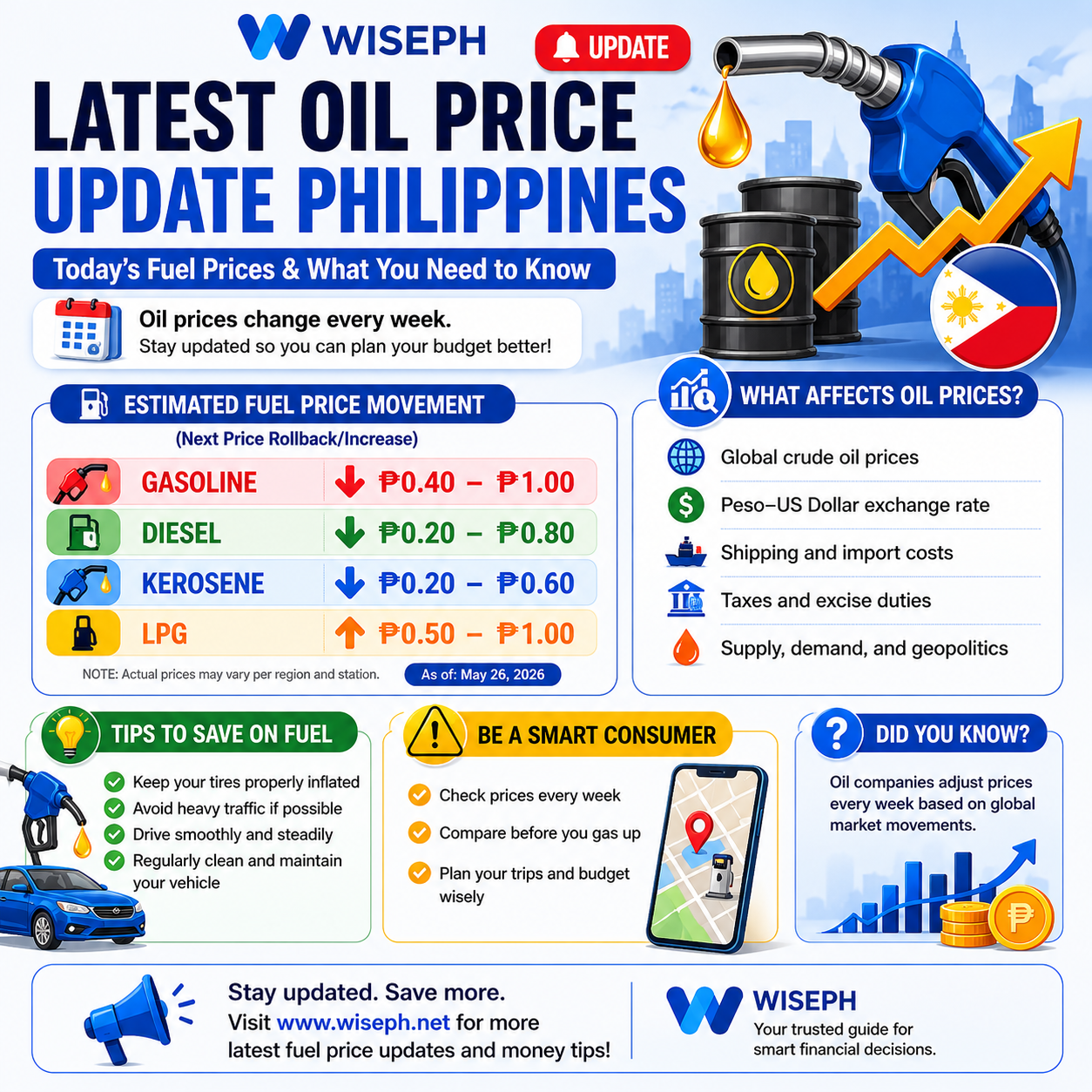
Quick visual guide showing how fuel prices change, the market factors behind them, and fuel-saving tips for motorists in the Philippines.
Why don’t prices drop right after good news?
When a ceasefire is declared or global oil prices dip, most readers expect prices to fall by next Tuesday. Sometimes they do, but not always. Each Tuesday’s change follows last week’s average world price of finished fuels: gasoline, diesel, and kerosene. The peso-dollar rate counts too. Crude oil and pump prices also do not always move together. Take the week of October 6, 2026. The Department of Energy’s figures show crude oil fell about $5.20 a barrel. Yet pump gasoline went up ₱1.90 a liter, because world gasoline prices rose that week.
| What happens | When you see it at the pump |
|---|---|
| World gasoline or diesel prices rise or fall | The following Tuesday |
| The peso weakens or strengthens against the dollar | The following Tuesday, in the same weekly change |
| Crude oil moves, but world fuel prices do not | Little or no change at the pump |
| Excise tax (TRAIN law) | A fixed amount per liter, already part of the price |
So what you pay this Tuesday reflects last week’s world trading, not today’s headlines. That is why good news takes about a week to show up, and why it sometimes does not show up at all. This year, the increases have far outweighed the rollbacks. By the week of October 6, the Department of Energy counted gasoline up a net ₱71.59 per liter since January 1.
Why do oil hikes hit Filipinos so hard?
The Philippines imports almost all of its fuel. Nearly every liter you pump was imported, priced in dollars, and shipped across international waters before traveling through local inter-island logistics to reach your station. That supply chain has a cost, and fuel also powers every step of it.
The archipelago multiplier
Here, a price increase travels. Fuel moves from tankers to ports, from ports to regional depots, from depots to trucks, sometimes crossing inter-island routes, before reaching a local station. Each leg burns fuel. Each leg passes the cost forward.
That is why a P2.00 per liter increase doesn’t stay at P2.00. It shows up in delivery fees, then in the price of goods, then in the fare your tricycle driver has to charge. In September 2026, the Philippine Statistics Authority (PSA) reported transport inflation at 14.6%. Food, housing and utilities, and transport together made up 78.1% of overall inflation that month.
The double hit: global price plus a weak peso
The Philippines pays for imported oil in US dollars. So when global crude rises, import costs rise. When the peso weakens against the dollar at the same time, which often happens during global uncertainty, the cost compounds. You pay more because oil is expensive, and more again because your currency buys less of it.
So a weaker peso alone can raise pump prices, even in a week when world fuel prices stay flat.
How do you read the DOE announcement correctly?
The DOE releases its weekly bulletin every Monday. The figure listed is a per-liter adjustment, not a total. Gasoline, diesel, and kerosene each move independently, so “oil prices went up” doesn’t mean all three moved the same amount, or even the same direction.
Still, the weekly bulletin trips most readers up in three ways.
The announcement is Monday. Prices change Tuesday. Not the same day. If you see the headline Monday morning and rush to the station, prices haven’t changed yet. Fill up Monday evening if you’re trying to beat an increase.
That P2.50 figure is per liter, not per fill-up. On a 30-liter fill-up, you pay P75 more than last week. However, most people see a small per-liter number and file it as minor. Multiply it by your actual fill volume and the number looks very different.
Diesel, gasoline, and kerosene don’t move as one. In the same week, diesel can roll back while gasoline goes up. If you drive a diesel vehicle and you’re reading the gasoline column, you’re tracking the wrong fuel. Each type follows its own global benchmark, specifically the Mean of Platts Singapore (MOPS), an internationally published trading index, not a number decided locally.
The real cost beyond the gas station
Commuters don’t just spend more. They change how they live.
Oil price hikes show up not just as budget line items. They show up as behavior changes most people don’t consciously track. Commuters start walking further before hailing a tricycle. They time departures to cut transfers. Some shift work schedules to avoid peak hours entirely. These aren’t just complaints; they’re adaptations.
Small business owners absorb the hit before consumers feel it
From what I’ve seen among readers who run food stalls, online shops, and sari-sari store supply chains: when delivery fees rise, they don’t immediately raise product prices. Instead, for a few weeks, they absorb the extra cost. Margins compress. Inventory shrinks. Only after weeks of absorption does the consumer start to feel it.
By the time a price increase reaches your regular store, the business owner has been eating the difference for a while. If you’re a sole proprietor tracking fuel-related delivery costs, it’s worth knowing these may be deductible. The 2026 BIR 1701A filing guide covers which business expenses apply.
For riders and drivers, income becomes unpredictable
Tricycle drivers and delivery riders operate on fixed or slow-moving fares while fuel costs move fast. A P2.00 per liter increase that barely registers for a car owner can meaningfully cut into a rider’s daily net income. As a result, many respond by filtering trips: shorter distances, batched deliveries, higher-value bookings only. It’s rational. It’s also exhausting to maintain week after week.
Cashless tools like the MySSS RCBC DiskarTech card can help riders separate and track fuel spending from other daily expenses, making weekly budget management easier to handle.
Three moves to make before Tuesday
Oil price changes follow a predictable weekly cycle. Once you know the timing, you can make smarter decisions consistently, not by driving less, but by being deliberate about when and how you fill up.
Fill up Monday evening, not when your tank hits empty
If a hike is coming and you’re at half a tank or below, fill up before Tuesday morning. You’re not reducing how much you drive. You’re buying at the previous week’s price before the adjustment applies. In a rollback week, do the opposite and wait until Tuesday.
In contrast, the costly mistake is waiting until the warning light forces your hand. At that point, you pay whatever the current price is, with no choice in the matter.
Set a weekly fuel budget, not a per-trip one
Thinking per transaction, “P150 today, okay na,” fails when prices spike two weeks running. Instead, a fixed weekly budget works better. Set a number (P1,000 for a rider, P600 for a commuter), then manage daily spending within it. Overspend Tuesday, cut back by Thursday. This forces early correction instead of a surprise at the end of the week.
Riders who use this system say it’s one of the few habits that actually changed how they feel about weekly price announcements. It’s not about the math. It’s about having a structure so the numbers feel less random.
Batch your trips deliberately, not loosely
Most people already know to combine errands. The difference is how intentional you are about it. Three separate trips versus one planned route burns a fraction of the fuel. After all, short individual trips are disproportionately wasteful because cold engine starts burn more fuel per kilometer than a warmed-up engine on a continuous run.
When savings from better fuel habits start to accumulate, consider redirecting even a small portion. The MP2 Pag-IBIG savings calculator can show you what consistent monthly contributions grow into over five years, even starting small.
The rollback trap: why “bawi mode” is costing you money
When the DOE announces a rollback, the instinct is relief, then spending. Extra trips get made. Monitoring stops. Discipline loosens. The behavioral shift is immediate, but the math doesn’t support it.
Hikes have simply come more often than rollbacks. From mid-July to early October 2026, the Department of Energy’s weekly reports show gasoline went up in 9 weeks and down in only 4. A P3.00 hike followed by three weeks of P0.50 rollbacks is still a net P1.50 increase. If you’ve relaxed spending habits during those rollback weeks, the savings buffer you built during the high-price period is already gone.
One or two rollback weeks is not a trend
Global oil markets respond to geopolitics, seasonal demand, OPEC output decisions, and currency swings. Also, none of these follow a predictable direction. After a cluster of small rollbacks, a new trigger can push prices sharply upward again within weeks. Readers who manage fuel costs consistently aren’t the ones who react to individual announcements. They keep the same habits whether the DOE announced a hike or a rollback.
Put rollback savings to work
When fuel costs drop P150-200 in a given week versus the week before, don’t absorb that back into casual spending. Redirect it. Even small monthly contributions to a Pag-IBIG MP2 account earn tax-free dividends, and that money compounds while fuel prices cycle through their next round of increases.
Frequently asked questions
When do oil price changes take effect in the Philippines?
Oil companies announce adjustments every Monday. New prices take effect on Tuesday, at 6 AM at most stations, while some companies start as early as 12:01 AM. If you want to beat an upcoming increase, fill up Monday evening.
Why did prices stay high even though global oil dropped?
Philippine pump prices follow last week’s world prices of finished fuels like gasoline and diesel, plus the peso-dollar rate, not crude oil alone. So a drop in crude can take a week to show up, or not show up at all. For the week of October 6, 2026, crude fell about $5.20 a barrel, yet pump gasoline rose ₱1.90 a liter because world gasoline prices went up.
Does a per-liter increase mean I only pay that amount more total?
No. The figure applies to every liter you pump. On a 30-liter fill-up, a P2.50 per liter increase means you pay P75 more than last week. Multiply the per-liter change by your fill volume to get the real impact.
Do gasoline, diesel, and kerosene always move together?
No. In any given week, one fuel type may rise while another rolls back. Always check the adjustment for your specific fuel type. Diesel drivers should not assume a gasoline rollback applies to them.
How do I stay updated on weekly oil price changes in the Philippines?
Bookmark this page. Every Tuesday it shows the new adjustment as soon as the oil companies announce it, and checks it against the DOE’s official range once the DOE posts it. The same page also tracks Metro Manila pump prices, the year-to-date trend, LPG, and what each change costs you per tank, so you don’t need to piece it together from several sites.
Oil prices in the Philippines follow a pattern. Delayed, currency-sensitive, and import-dependent. That won’t change soon. But once you understand the system, you stop reacting every Tuesday and start preparing on Monday.
Bookmark this page and check back weekly. The figures at the top update every week with the new adjustment. Share it with anyone who watches prices at the pump and wonders why the news and the numbers never quite match up.











Comments 9