

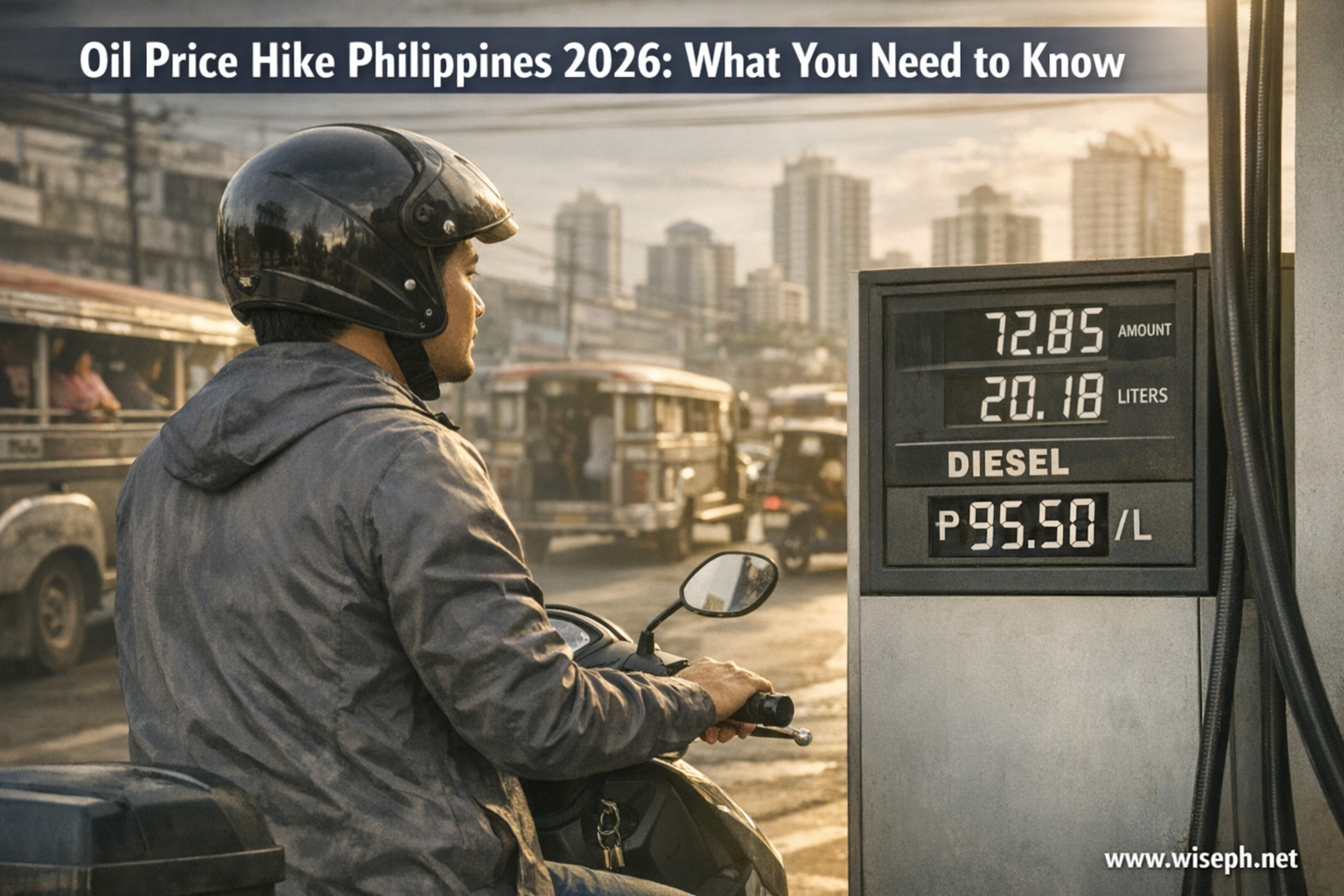
Every time I fill up my scooter and the meter climbs past where it used to stop, the same thought hits: “Magkano na naman dagdag sa gastos ko this week?” That question is exactly what thousands of readers send me every time oil prices spike. This post answers it directly: why prices went up, who benefits, what the government did, and what you can do to protect your budget. For the most current pump price changes, check the latest oil price update in the Philippines every week.
Why did oil prices suddenly spike in the Philippines?
The sharp spike in March–April 2026 came from one source: the Iran conflict. US and Israeli strikes on Iran in late February disrupted the Strait of Hormuz. That chokepoint carries nearly 20% of the world’s oil supply. Once that route was choked, global Brent crude shot past $100 and climbed toward $160 a barrel. As a result, the Philippines felt it almost immediately.
We import 98–99% of our crude oil, most of it from the Middle East. There is no buffer. When global prices jump, our pump prices follow within days, not weeks. In single weeks during March, for example, diesel jumped P15–P24 per liter. That is not gradual. It is a supply shock at full speed, moving through an economy with no domestic oil to cushion it.
| Cause | What happened | Impact on pump prices |
|---|---|---|
| Iran conflict (Feb–March 2026) | US and Israeli strikes; Strait of Hormuz disrupted | Immediate supply shock; Brent crude up 50–60% |
| 98–99% import dependence | Philippines has no domestic crude buffer | Global price movements hit pump prices in days |
| Peso weakening | Oil priced in USD; peso decline multiplied the cost | Additional peso burden on top of crude increases |
| TRAIN Law excise taxes | Fixed taxes per liter do not adjust when prices fall | Keeps pump prices high even after global rollbacks |
Why are fuel prices rising in the Philippines?
Three factors hit at the same time in early 2026. Together, they explain why our pump price increases were steeper than in most other countries.
First, import dependence. The Philippines produces almost no crude oil domestically. As a result, every price movement on the Dubai crude market lands directly at our gas stations. Countries with domestic reserves or strategic stockpiles absorb some of the shock. We absorb all of it.
Second, the peso. Oil is priced and traded in US dollars. When the peso weakens against the dollar at the same time global crude prices rise, Filipino consumers pay double: once for the crude price increase and again for the exchange rate. Both moved against us in March 2026.
Third, the TRAIN Law. Republic Act 10963, known as the Tax Reform for Acceleration and Inclusion (TRAIN) Law, added fixed excise taxes per liter: P6.00 on gasoline, P4.50 on diesel. These taxes do not move with global prices. Consequently, even when Brent crude drops and the DOE orders a rollback, the TRAIN taxes stay in place. That is a major reason why pump prices never fall as far or as fast as they rose.
How much did oil prices increase in March–April 2026?
The increases came in rapid waves from late February to early April, followed by the government-directed rollback on April 14.
| Fuel type | Peak increase (cumulative) | April 14 rollback | Net change |
|---|---|---|---|
| Diesel | +P15 to +P24 per liter (single weeks) | –P21 to –P23 per liter | Still above pre-crisis levels |
| Gasoline | Multiple consecutive weeks of hikes | –P4 to –P6 per liter | Still above pre-crisis levels |
| Kerosene | Multiple consecutive weeks of hikes | –P8 to –P11 per liter | Still above pre-crisis levels |
The April 14 rollback was the largest single-day fuel price reduction in recent Philippine history. Even so, pump prices after the rollback were still higher than before the Iran conflict began. The Department of Energy (DOE) also warned of further adjustments depending on how the Strait of Hormuz situation develops.
What does an oil price hike actually cost you?
The pump price is just the beginning. Oil price shocks spread through the economy in layers. Most people feel the second and third layers harder than the first because those layers arrive without headlines.
On transport: commuters in Manila, Cebu, and Davao reported spending ₱300–₱500 more per week just to get to work. Specifically, jeepney and tricycle fares jumped ₱10–₱20 per ride overnight. Meanwhile, drivers saw their daily take-home drop from roughly ₱1,500 to barely ₱300. Fuel costs consumed most of their collections.
On food: Philippine Statistics Authority (PSA) data for March 2026 showed food inflation at 3.7% for the bottom 30% income households. Specifically, the breakdown by item shows the scale of the damage. Rice rose 3.4%, corn 12.5%, vegetables 8.9%, and fruits and nuts 6.4%. Families of five in provincial areas reported their weekly food budget ballooning by ₱1,000–₱1,500. Trucks and delivery vehicles run on diesel, so every increase at the pump moves through to the palengke within days.
On electricity: Meralco raised residential rates by P0.6427 per kWh in March 2026 and another P0.5335 per kWh in April, driven largely by higher fuel costs in power generation. A typical household consuming 200 kWh a month saw their April bill increase by approximately ₱107 compared to February. Overall, the headline inflation rate hit 4.1% in March, the highest in almost two years. Transport costs were up 7.2% year on year, with bottom-30% household inflation reaching 4.2%.
Who benefits from higher oil prices in the Philippines?
Higher oil prices hurt most Filipinos. However, two groups collect bigger numbers during a crisis: the major oil companies and the national government.
Oil companies. Petron, Shell, Chevron, and the other major players buy crude in advance. During the March 2026 spike, senators publicly criticized these companies for selling pre-war fuel at inflated post-war prices. That stock was purchased before the Iran conflict at much lower rates. As a result, every liter sold generated windfall profit. Diesel jumped P15–P24 in single weeks, and consumers absorbed the full price. Even after the April 14 rollback, the companies came out ahead. Their margins never shrank; they passed the full spike to consumers at every step.
The government. Under the TRAIN Law, VAT and excise taxes are collected on every liter sold. When pump prices rise, tax revenue rises with them. During the March–April 2026 crisis, fuel tax revenue reportedly increased around 15%. This happened while the President was declaring a national energy emergency and distributing subsidies. In other words, the government collected extra billions from the same price hikes it was trying to offset. Ordinary Filipinos paid both the higher pump prices and the taxes embedded in them.
What did the government do about the April 2026 oil crisis?
The Marcos administration moved quickly once the Strait of Hormuz disruption hit supply lines. Specifically, the response covered emergency procurement, targeted subsidies, and legal pressure on oil companies.
| Date | Action | What it meant in practice |
|---|---|---|
| March 24, 2026 | EO 110: national energy emergency declared | Activated UPLIFT program for transport, food, and livelihood assistance |
| March 25, 2026 | RA 12316 signed | President given authority to suspend fuel excise taxes for up to three months |
| Late March 2026 | ₱20B Malampaya fund released | Emergency diesel procurement; first 329,000-barrel shipment from Malaysia arrived ~April 11 |
| April 13, 2026 | Excise tax on LPG and kerosene removed | Immediate relief for households dependent on LPG for cooking |
| April 14, 2026 | Massive pump price rollback directed by DOE | Diesel –P21 to –P23/liter; gasoline –P4 to –P6; kerosene –P8 to –P11 |
| Ongoing | DA quick-response fund (₱1B) | Half for fisherfolk fuel subsidies; half for farmers’ fertilizer assistance |
Transport groups called the package a “band-aid.” The root problem, 98% import dependence, was not addressed by any of these measures. Subsidies reached large operators faster than small ones. Most readers I hear from say the rollback gave some breathing room. However, it did not reverse the damage to weekly budgets already done in March.
Why don’t prices drop as fast as they rise?
This is the pattern that frustrates people most. Hikes arrive overnight. Relief barely comes at all. There are three reasons, and each one is structural rather than accidental.
The TRAIN Law floor. Excise taxes under RA 10963 are fixed per liter regardless of global crude prices. When Brent crude drops, only the crude component of your pump price can fall. The TRAIN taxes stay regardless. Consequently, even with a large DOE-directed rollback, the pump price cannot fully return to where it started before the crisis.
The LTFRB process. Jeepney and tricycle fares can only change after formal approval from the Land Transportation Franchising and Regulatory Board (LTFRB). Operators raise fares informally and immediately when diesel spikes. However, getting those fares officially lowered after a rollback requires a formal petition, hearings, and an approval process. That process takes weeks or months. Riders rarely see the official rollback in their daily fare.
Price stickiness in the market. Businesses and sari-sari stores bought inventory and restocked trucks at peak fuel prices. They cannot reprice goods below what they paid to deliver them. Similarly, sellers in the palengke do not drop prices after a DOE announcement. Instead, they wait until their own costs actually fall. The result is what most readers feel: hikes are instant, but relief takes months. Sometimes it never fully arrives.
How to reduce the impact on your budget
You cannot control global crude prices or the peso exchange rate. However, you can control how much of the shock lands in your pocket.
- Batch your errands. Consolidate trips to the market, office, and school into single outings. Each avoided trip saves both fare and time.
- Shift to jeepneys and UV Express over ride-hailing. During oil spikes, ride-hailing surge pricing compounds the pump price increase. Fixed-route PUVs are cheaper and more predictable.
- Buy dry goods in bulk when prices are stable. Rice, canned goods, and cooking oil bought before price hikes stretch your budget through the spike period.
- Check DOE’s weekly price bulletin. Knowing which fuel type and which stations are cheapest in your area saves real money over a month.
- For small business owners: renegotiate delivery frequency rather than delivery price. Fewer, larger orders cut transport cost per unit even if the per-liter rate stays high.
- Track your monthly utility bills. If Meralco rates rise in the same month as a fuel spike, compare your kWh usage against the previous month. Shifting high-consumption appliances to off-peak hours reduces total billing.
Beyond immediate budget moves, consider setting aside even a small amount each month into a savings vehicle that compounds over time. An MP2 savings account earns higher dividends than a regular savings account and is backed by the government. When fuel prices normalize, the compounding continues regardless of what happens at the pump. In other words, the savings grow whether oil prices are high or low.
For self-employed workers and small business owners affected by higher fuel costs, also review your deductible expenses before filing. Filing your 2026 annual income tax return correctly means you are not overpaying BIR in an already tight year.
Frequently asked questions about the oil price hike in the Philippines
Why is the price of oil going up in the Philippines in 2026?
The main cause was the Iran conflict in early 2026, which disrupted the Strait of Hormuz and pushed global Brent crude up 50–60% in a matter of weeks. The Philippines imports 98–99% of its crude oil with no domestic production. Those global price moves reach Philippine gas stations within days. Furthermore, the weakening peso and TRAIN Law excise taxes made the impact steeper than in most other countries.
Why was there a sudden hike in oil prices in March 2026?
US and Israeli strikes on Iran in late February 2026 choked the Strait of Hormuz, the route for roughly 20% of global oil supply. The resulting supply shock sent Brent crude past $100 per barrel. Philippine diesel prices jumped P15–P24 per liter in single weeks. The speed was unusual even by Philippine standards. The disruption was sudden, and our import dependence left no buffer.
Why are fuel prices rising in the Philippines?
Three factors hit simultaneously: a global supply shock from the Iran conflict, a weakening peso that made dollar-priced crude more expensive, and TRAIN Law excise taxes that prevent prices from falling as far as they rose. Even when global crude drops and the DOE orders a rollback, those fixed taxes keep the floor elevated. Prices cannot fully return to where they started before the crisis.
Who benefits from higher oil prices in the Philippines?
Oil companies collected windfall profits by selling pre-war inventory at post-war pump prices during the March spike. The national government also collected more; fuel tax revenue reportedly rose around 15% — while simultaneously distributing subsidies funded in part by the same tax windfall.
What can I do to reduce the impact of oil price hikes on my budget?
Cut transport costs first: batch your errands, use jeepneys over ride-hailing, and check the DOE weekly price bulletin. For food, buy dry goods in bulk before prices spike further. Track your Meralco bill monthly, shifting high-consumption appliances to off-peak hours reduces total billing when rates rise alongside fuel costs.
For the latest weekly pump price movements and the most up-to-date DOE price advisory, check the latest oil price update in the Philippines. Prices shift every Tuesday. Knowing the weekly change before you fill up is the simplest way to stay ahead of your fuel budget.