

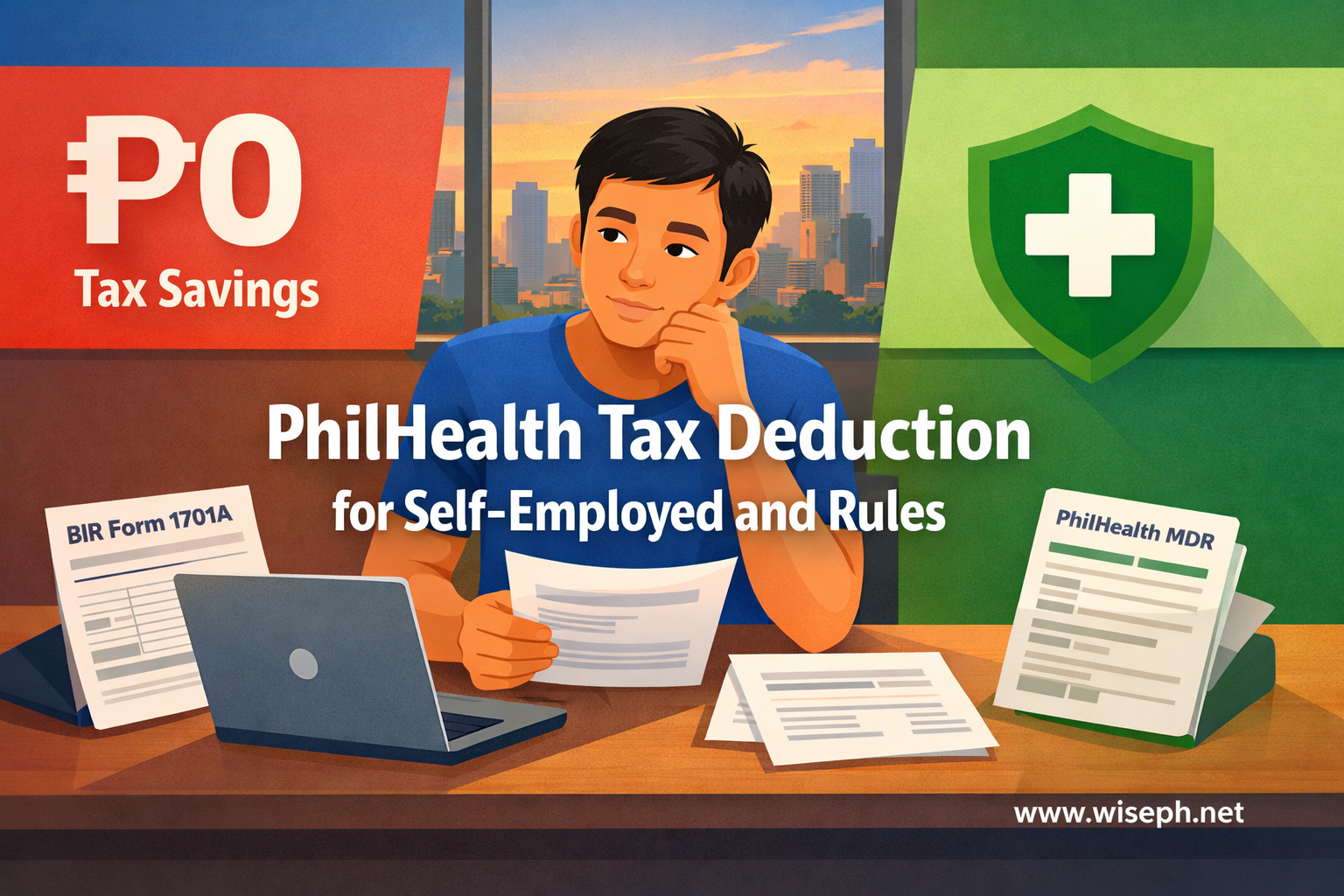
There is a myth spreading through every Filipino freelancer group and YouTube comment section: pay your PhilHealth as a self-employed person, then deduct the full amount on BIR Form 1701A because it is a mandatory government contribution.
It sounds logical. It is mostly wrong.
I looked into this as an OFW hospital worker paying PhilHealth voluntarily from Dubai. My readers keep asking about it, and what I found is that the PhilHealth tax deduction for self-employed Filipinos is more limited than most guides admit. Here is the honest version, with actual peso numbers and the audit risk you need to know about.
The short answer for self-employed Filipinos
Self-employed Filipinos do not get an automatic tax deduction for PhilHealth contributions. The PhilHealth tax deduction self-employed filers can claim is either zero or uncertain, depending entirely on the filing method. That employee-side mechanism simply does not carry over.
| Employee | Self-employed | |
|---|---|---|
| Who pays | Employee and employer share the cost | You pay 100% yourself |
| Tax treatment | Exclusion from gross income | No automatic exclusion |
| Where it appears | BIR Form 2316 (non-taxable column) | No clean line on BIR Form 1701A |
| Actual tax benefit | Automatic and guaranteed | None under 8% rate; uncertain if itemizing |
For contribution rates, payment schedules, and full membership rules, start with the PhilHealth rules for self-employed members.
Why employees and self-employed are treated differently
For regular employees, the mandatory PhilHealth share is removed from gross compensation income before tax is computed. BIR calls this an exclusion, not a deduction. It appears on BIR Form 2316 as non-taxable compensation. You never see it as a separate line item because it was already taken off the top before the math started.
For self-employed individuals, however, that mechanism does not exist. You are a Direct Contributor. You pay the full 5% yourself, with no employer splitting the cost. The payment comes from your own funds, not a payroll system. So BIR treats it differently.
The mandatory label helps establish that you are legally required to pay. But it does not automatically grant you the same favorable treatment that employees receive. Most guides assume “mandatory” means the same thing across all membership types. It does not.
The ₱30,000 reality check
Take a freelance graphic designer or nurse earning ₱600,000 in gross receipts for 2026, filing under the 8% flat rate.
What PhilHealth costs for the year
At roughly ₱50,000 average monthly income, the 5% contribution rate works out to ₱2,500 per month. For the full year, that is ₱30,000 paid entirely out of pocket, with no employer sharing the load.
What that ₱30,000 saves in taxes
Under the 8% option on BIR Form 1701A:
- Gross receipts: ₱600,000
- Less standard deduction: ₱250,000
- Taxable base: ₱350,000
- Tax due: 8% × ₱350,000 = ₱28,000
The ₱30,000 in PhilHealth contributions does not reduce the ₱350,000 taxable base further. The 8% rate gives you one deduction: the ₱250,000 standard amount and nothing else.
Tax savings from PhilHealth: zero.
| Item | Amount |
|---|---|
| PhilHealth annual cost | ₱30,000 |
| Tax savings | ₱0 |
| Medical cost protection (potential) | ₱100,000 to ₱500,000+ |
That last row is the whole point. A single hospitalization without PhilHealth can wipe out months of income. With active membership, however, case rates can cover much of the bill, sometimes most of it. Programs like the PhilHealth Z Benefit package handle catastrophic illnesses that can otherwise cost ₱500,000 or more out of pocket. For a clear breakdown of actual payouts, read how much PhilHealth covers in a private versus public hospital.
Think of the ₱30,000 as a health insurance premium. The tax angle is secondary at best.
What your tax method actually determines
Your filing method on BIR Form 1701A determines whether a PhilHealth deduction is even possible. The answer changes for each path, so check your situation against the table below before assuming anything.
| Tax method | PhilHealth deductible? | Risk level |
|---|---|---|
| 8% flat rate | No. Only the ₱250,000 standard deduction applies. | None; nothing to claim |
| Graduated + Optional Standard Deduction (OSD) | No. OSD at 40% of gross income replaces all itemized deductions. | None; OSD covers everything |
| Graduated + Itemized Deductions | Possible, but BIR can and does disallow it. | Medium to high |
Most self-employed Filipinos earning under ₱3 million choose the 8% rate for its simplicity. For them, the PhilHealth deduction question is already settled. See the BIR Form 1701A filing guide for help choosing between the 8% and graduated options.
The legal basis, and why it is still a gray area
For those on graduated rates with itemized deductions, a genuine legal argument for the PhilHealth tax deduction for self-employed individuals does exist. Both sides are worth understanding before you decide what to do.
Why some accountants allow the claim
BIR Form 1701 has a dedicated line under Ordinary Allowable Itemized Deductions labeled “SSS, GSIS, PhilHealth, HDMF and Other Contributions.” The line is there by design. Accountants who allow the claim also cite NIRC Section 34, which permits deductions for expenses that are ordinary and necessary in carrying on a trade or profession. PhilHealth is legally mandatory for self-employed individuals under Republic Act 11223, so the argument is that it qualifies.
Why many accountants still advise against it
BIR’s stricter position is that these contributions are personal in nature. You are not deducting a business operating cost. It is a personal health expense, in BIR’s view. The employee-share exclusion is specifically tied to compensation income, and self-employed individuals do not have that mechanism.
If BIR disallows the deduction during an audit, the consequences include:
- Deficiency tax on the disallowed amount
- 25% surcharge
- Interest on the underpayment
There is no Revenue Memorandum Circular that explicitly confirms self-employed mandatory contributions are fully deductible as itemized deductions. The form has the line, but enforcement varies by examiner. BIR has never clearly resolved that, which is why practitioners disagree.
If your accountant includes the deduction with clean documentation, that is a professional judgment call they can defend. If you are going it alone and assuming BIR will not question it, however, that is a different kind of risk.
SSS and Pag-IBIG get the same treatment
SSS and Pag-IBIG contributions sit in the same uncertain position as PhilHealth for self-employed filers. All three are legally mandatory once your income qualifies, and you pay 100% of each one yourself with no employer share. None of them automatically unlock the employee-style income exclusion.
| Contribution | Self-employed tax treatment |
|---|---|
| PhilHealth | Gray area; no automatic deduction for self-employed |
| SSS | Same gray area; same logic applies |
| Pag-IBIG regular savings | Same gray area as PhilHealth |
| Pag-IBIG MP2 dividends | Fully tax-free under RA 9679 (clear, reliable, legally guaranteed) |
That last row matters. If you want a government savings program with a clear and reliable tax benefit, Pag-IBIG MP2 is the one to know. Dividends are legally exempt from income tax by specific statute, so there is no gray area and no risk of disallowance. The MP2 tax benefits guide has the full breakdown with actual numbers.
The audit trap most self-employed walk into
This one trips people up more than the deduction question itself.
Many self-employed Filipinos declare the minimum income bracket to PhilHealth to keep premiums as low as ₱500 per month. Then they report ₱600,000 or more in gross receipts on BIR Form 1701A. That gap is exactly the kind of inconsistency that flags a return during review.
BIR can request PhilHealth records. An MDR showing ₱10,000 in declared monthly income while your ITR shows ₱600,000 in gross receipts is a red flag. BIR then starts questioning your income reporting across the board, not just the PhilHealth line. Scrutiny of your entire return follows, along with possible disallowance of other deductions and an additional tax assessment.
Three related mistakes that compound the problem:
- Keeping your PhilHealth membership category as “employed” even after going fully self-employed
- Saving only screenshots of payment references instead of confirmed official postings
- Declaring different income levels across PhilHealth, SSS, and Pag-IBIG (BIR sometimes cross-references all three agencies)
The fix: declare a PhilHealth income in the same ballpark as what you report to BIR. It does not need to match to the peso, but it should be defensible. Also update your membership category to Direct Contributor at any PhilHealth branch or through the member portal. If contributions have lapsed or your records are out of order, read what happens when PhilHealth contributions lapse before your next filing deadline.
For OFWs: why this debate does not apply to you
If you earn income entirely from abroad and do not file a Philippine ITR, the PhilHealth tax deduction question simply does not apply. Without Philippine-sourced income, there is no Philippine taxable income to reduce. Without an ITR, there is no form to claim a deduction on.
As an OFW myself, I spent time researching a deduction I could never claim. I was not required to file in the first place. For OFWs, the real priorities look different:
- Coverage for dependents back home is usually the main reason OFWs pay. One hospitalization without active PhilHealth can erase several months of remittances.
- Continuous membership protects benefit eligibility. Gaps in payment can complicate future claims for you or your family members.
- Clean records matter even without an ITR. You will need your MDR and contribution history for benefit claims, loan applications, and other situations where proof of active membership is required.
You can also pay PhilHealth contributions online through accredited channels from abroad. For the parallel SSS situation as an OFW, the SSS for OFW guide covers similar membership and payment decisions in detail.
Documents to keep regardless of whether you claim
Whether or not you ever try to claim PhilHealth as a deduction, these records still protect you at tax time and when you actually need to use your benefits.
| Document | Why it matters | Where to get it |
|---|---|---|
| Official Receipts or payment confirmations | Primary proof that money was paid and received by PhilHealth | GCash, Maya, online banking, or PhilHealth branch receipt |
| Member Data Record (MDR) | Shows your membership category, declared income, and contribution record | Download free from the PhilHealth member portal |
| Contribution history (posted, not just submitted) | Lists exact payments by month for the taxable year; confirms posting, not just PRN generation | PhilHealth member portal or branch printout |
| Statement of Premium Account (SPA) | Shows posted payments by period; useful for coverage verification | Generate your SPA online |
| Bank statements (supporting) | Corroborates that payments came from your account | Your bank app or online banking history |
Also, check your PhilHealth contributions online to confirm payments are posted, not just submitted. A PRN reference number without a posted status is proof only that you generated a payment slip. It is not proof that PhilHealth received your money. BIR knows the difference.
The one habit that protects you more than any deduction
After every PhilHealth payment, or at least once a quarter, download and save your updated MDR and contribution history from the PhilHealth member portal.
That single habit does more than chasing a deduction that may or may not stick.
Here is why:
- Your MDR shows your registered category, your declared income, and your payment history. When those three things align with what you filed on BIR Form 1701A, you are in a very defensible position if BIR ever reviews your return.
- Hospitals ask for an updated MDR at admission. Having it saved on your phone or in Google Drive means faster processing when you are already dealing with a stressful medical situation.
- Gaps show up immediately when you check regularly. A missing posting in January is far easier to fix than one you discover in March while filing and processing a claim at the same time.
Most self-employed Filipinos treat PhilHealth like a utility bill. They pay, they forget, and they keep a screenshot of the reference number. Then a hospitalization happens, or BIR asks a question, and the scramble starts.
A gray-area deduction might save a few thousand pesos if it goes through. Clean, updated records protect you from problems that cost many times that. The PhilHealth tax deduction self-employed filers can expect is limited at best, but your records are always defensible. Start with your MDR. Download it today, then set a reminder to do it again after your next payment.
Frequently asked questions about PhilHealth tax deductions
Is PhilHealth tax deductible for self-employed in the Philippines?
The PhilHealth tax deduction for self-employed filers is not automatic. Employees get a built-in exclusion from gross income; self-employed filers do not. Under the 8% flat rate, PhilHealth contributions give you zero additional tax savings. Under graduated rates with itemized deductions, some accountants include them as a deduction, but BIR can disallow the claim. The real value of paying PhilHealth is the health coverage itself, not a tax break.
Can I claim PhilHealth on BIR Form 1701A?
Only if you are using graduated rates with itemized deductions. BIR Form 1701 does have a dedicated line for SSS, GSIS, PhilHealth, HDMF and Other Contributions under Ordinary Allowable Itemized Deductions. But if you are on the 8% flat rate or the OSD, that line does not apply to you and you cannot stack PhilHealth on top of those options.
Does the 8% flat tax rate allow a PhilHealth deduction?
No. The 8% rate gives you the ₱250,000 standard deduction and nothing else. PhilHealth, SSS, and Pag-IBIG contributions do not reduce your taxable base further. Since most self-employed Filipinos earning under ₱3 million use the 8% rate, the deduction is already settled for the majority of readers: there is nothing to claim.
What documents do I need if I claim PhilHealth as an itemized deduction?
At minimum: Official Receipts or confirmed payment records, your updated MDR showing Direct Contributor status, contribution history with posted (not just submitted) payments, and bank statements. Even with clean documentation, BIR may still disallow the deduction. Consult a CPA who handles self-employed clients before claiming.
Is voluntary PhilHealth payment tax deductible for OFWs?
No, and for most OFWs the question does not apply. If your income is earned entirely abroad and you do not file a Philippine ITR, there is no Philippine taxable income to reduce and nowhere to claim a deduction. Focus on keeping your membership active for your family’s coverage back home, not on tax savings.
Still unsure about your PhilHealth status or contribution history? Start by checking your contributions online to see exactly where you stand before the next filing deadline.