


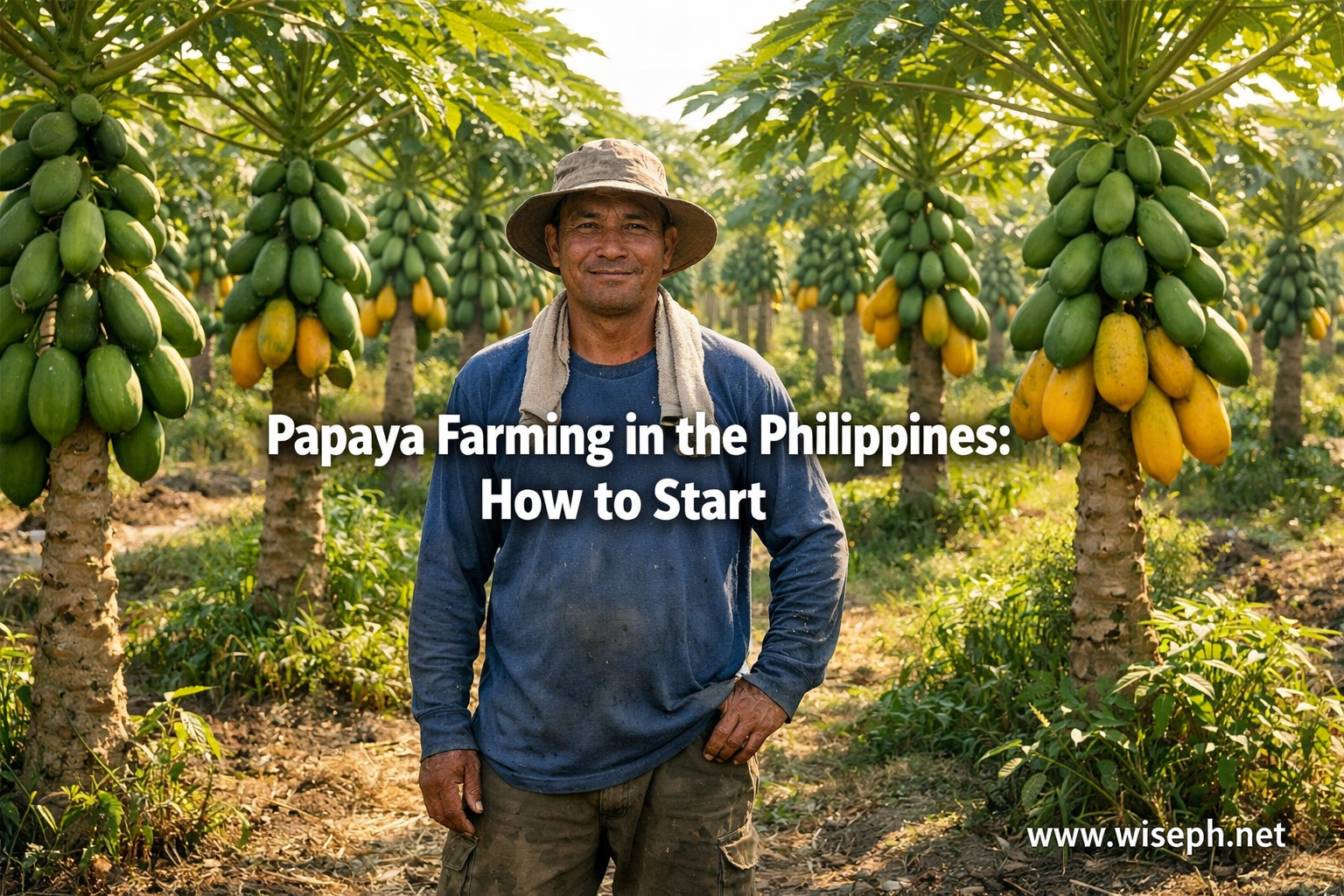
Papaya grows fast. Under the right conditions, a seedling planted today is fruiting in under a year. That speed draws a lot of beginners into papaya farming. It is also what makes the first few months so critical.
I started with a backyard setup, just 5 to 10 trees, to test how they would perform in our soil and weather. What I learned is that papaya is forgiving when everything goes right and unforgiving when anything goes wrong. That observation shaped everything in this guide.
Is papaya farming a good business in the Philippines?
Yes, for the right location with good drainage and a reliable market outlet. Papaya is a recognized high-value crop that produces year-round once established. First harvests arrive as early as 8 to 9 months after transplanting. The national average yield runs 10 to 21 t/ha, with well-managed farms in Mindanao reaching 30 to 40 t/ha.
The risk is real too. Papaya ringspot virus (PRSV) has historically wiped out papaya production in parts of Southern Tagalog. Poor drainage kills plants fast. Beginners who plant the wrong variety in the wrong soil often spend more on seedlings and inputs than they ever earn back.
For more agri-business ideas in the Philippines, the WisePH agri-business section covers what actually works at different capital levels.
Which papaya variety is best for commercial planting?
For fresh fruit sales, Sinta and Red Lady are the most reliable commercial choices. Sinta is a Philippine-bred hybrid developed by UPLB with moderate PRSV tolerance, sweet flesh, and firm fruit that ships well. Red Lady has high PRSV resistance and can produce 50 to 120 fruits per plant per season.
The Philippines recognizes seven commercial varieties: Cavite Special, Morado, Solo, Sinta, Cariñosa, Red Lady, and Red Royale. The best pick still depends on your buyers, your region, and whether PRSV pressure is high in your area.
I started with Sinta because it was developed for Philippine conditions. For a beginner building a fresh-market setup, Sinta or Red Lady is a safer bet than varieties with no PRSV tolerance at all.
| Variety | PRSV tolerance | Fruit weight | Best for |
|---|---|---|---|
| Sinta | Moderate | 1.2–2.0 kg | Local fresh market |
| Red Lady | High | 1.5–2.0 kg | Local + export fresh market |
| Cavite Special | Low | 3–5 kg | Large-fruit buyers |
| Solo | Low | 0.5–1.0 kg | Export, premium buyers |
However, for papain extraction, the choice shifts entirely. A UPLB study found Papaya Uwak had the highest papain activity, while Cavite Special produced the most latex per fruit. If papain is your target market, variety selection needs its own research based on your buyer’s specs.
How much does it cost to start a papaya farm?
For half a hectare, budget ₱80,000 to ₱130,000. For one hectare, plan ₱150,000 to ₱250,000. Seedlings, fertilizer, land prep, and labor are the four main cost drivers. The biggest single line item is seedlings, currently listed at ₱75 per piece for Red Lady at Philippine nurseries.
Standard planting distance in the Philippines is 2 to 3 meters between plants, giving roughly 1,100 to 1,340 plants per hectare. For half a hectare at standard spacing, that is 550 to 670 seedlings. At ₱75 each, seedlings alone cost ₱41,250 to ₱50,250 before a single bag of fertilizer.
| Expense | 0.5 ha | 1 ha |
|---|---|---|
| Seedlings (~₱75/piece) | ₱41,250–₱50,250 | ₱82,500–₱100,500 |
| Fertilizer (basal + first months) | ₱10,000–₱20,000 | ₱20,000–₱40,000 |
| Land prep, mulch, stakes | ₱8,000–₱20,000 | ₱15,000–₱35,000 |
| Labor (transplanting, first 90 days) | ₱10,000–₱20,000 | ₱20,000–₱40,000 |
| Pesticides, tools, contingency | ₱5,000–₱15,000 | ₱10,000–₱25,000 |
| Total estimate | ₱80,000–₱130,000 | ₱150,000–₱250,000 |
Fertilizer prices shift with freight and fuel. With the rising cost of farm inputs affecting supply prices across the country, check current quotes from your local agri-supply before locking in your budget.
How to set up your papaya farm step by step
Step 1: Fix drainage before anything else
Specifically, papaya roots cannot survive waterlogged soil. Poor drainage is the single most common reason new papaya farms fail before the first harvest. Raised beds, drainage canals, or a naturally sloping site all work. If your land holds water after heavy rain, fix that first.
Step 2: Source certified, PRSV-tolerant seedlings
Buy from a reputable nursery, not random market sellers. For commercial planting, prioritize PRSV-tolerant varieties. Also, confirm seedlings are healthy, free of visible discoloration or spots, and from a named source you can trace.
Step 3: Follow standard spacing
Plant at 2 to 2.5 meters between plants in a row, 2.5 to 3 meters between rows. This gives roughly 1,100 to 1,600 plants per hectare and allows enough airflow to slow disease spread. Crowding trees to squeeze in more plants hurts fruit quality and makes pest management harder.
Step 4: Apply basal fertilizer before transplanting
The DA papaya production guide recommends basal fertilizer at transplanting, followed by staged applications through the early months. Skipping the basal application or using the wrong formulation stresses the plant during its most vulnerable stage.
Step 5: Transplant in late afternoon, water immediately
Moreover, transplanting in the late afternoon reduces heat stress on newly moved seedlings. Water right after. The first few days after transplanting determine whether the root system establishes properly or shuts down under stress.
Step 6: Secure buyers before the first harvest
At 8 to 9 months, fruit arrives fast. If you have no buyer lined up, consequently you sell at whatever price the nearest trader offers. Talk to market vendors, restaurants, and local distributors before planting, not when your trees are loaded with fruit.
How much can you realistically earn from papaya farming?
At a yield of 15 t/ha/year and a farmgate price of around ₱12/kg, a one-hectare farm earns roughly ₱180,000 gross per year. After first-year production costs of ₱150,000 to ₱250,000, net income on year one can be thin or negative. Nevertheless, year two is where papaya farming typically starts paying back.
The math improves as yield climbs. Well-managed farms have reported 25 to 30 t/ha, pushing gross to ₱300,000 to ₱360,000/ha at the same farmgate price. Selling direct to retailers or restaurants at ₱25 to ₱35/kg, instead of through traders, can roughly double the margin on the same volume.
| Setup | Yield (t/ha) | Farmgate (₱/kg) | Gross/ha | Approx. net yr 1 |
|---|---|---|---|---|
| Average farm | 15 | ₱12 | ₱180,000 | Break-even to small loss |
| Well-managed | 25 | ₱12 | ₱300,000 | ₱50,000–₱100,000 |
| Direct to retail | 15 | ₱25 | ₱375,000 | ₱100,000–₱200,000 |
Once the farm produces consistent monthly income, consider setting aside a portion into tax-free MP2 savings to grow capital outside the farm. MP2 dividends are tax-free and compound annually.
Five mistakes that kill papaya farming profits early
Most failed papaya farms do not fail because the fruit did not sell. They fail because the plants never made it to steady production.
1. Planting on waterlogged land. Papaya roots cannot survive prolonged waterlogging. One bad rainy season on poorly drained land can kill a large portion of the stand before a single harvest. Fix drainage first, even if it costs more upfront.
2. Using weak or non-tolerant seedlings. PRSV has wiped out papaya production in parts of Southern Tagalog. Planting non-tolerant varieties in PRSV-affected areas is a high-risk move, especially for beginners with limited capital to absorb total crop failure.
3. Wrong spacing. Standard Philippine recommendations sit at 1,100 to 1,340 plants per hectare at 2.5 to 3 meters. Similarly, crowding trees at 1.5-meter intervals reduces airflow, speeds up disease spread, and cuts fruit quality. The extra trees rarely justify the extra losses.
4. No postharvest handling plan. Papaya is bruise-sensitive. The production guide is specific: fruit goes into padded containers after harvest. Rough handling turns saleable fruit into downgraded or rejected stock that sells for less than cost of production.
5. Expecting profit in year one. The first year of papaya farming is mostly investment and establishment. As a result, beginners who build income projections around ideal year-one returns usually run out of operating cash before year two, when the farm starts paying back properly.
What government support is available for papaya farmers?
Support exists but it is mostly loans, training, and occasional seedling assistance, not direct cash grants. The best starting point is ATI training, which covers variety selection, spacing, fertilization, pest management, and postharvest handling.
ATI (Agricultural Training Institute) runs high-value crops training programs that include papaya production. Therefore, complete this before spending on land prep or seedlings. For financing, the ACPC Agri-Negosyo Loan Program funds capital requirements for individual small farmers and agri MSEs. ACPC’s KAYA loan also targets young agripreneurs aged 18 to 30. LANDBANK’s High Value Crops and Value Chain Lending is the most relevant bank program, as papaya is classified under DA high-value crops.
| Program | What it funds | Who qualifies |
|---|---|---|
| ATI HVC Training | Technical skills | Open to all farmers |
| ACPC Agri-Negosyo Loan | Capital, inputs | RSBSA-registered farmers |
| ACPC KAYA Loan | Capital, inputs | Agripreneurs aged 18–30 |
| LANDBANK HVC-VC Lending | Up to 80% of project cost | Small farmers, agri MSEs |
Your first 90 days: what to get right
The first 90 days after transplanting are about establishment, not yield. According to the DA/BPI papaya production guide, the crop needs good drainage, consistent watering, mulch to conserve moisture, and staged fertilizer applications from transplanting onward.
Drainage check after the first heavy rain
Check your drainage canals or raised beds after the first major rainfall event. If water pools near the base of plants for more than a few hours, address it immediately. Otherwise, waterlogging in week one can set the whole stand back by weeks, or kill plants outright.
Pests and disease do not announce themselves
Instead, start scouting in week two, not when you see visible damage. The production guide recommends sticky traps, regular monitoring, rotating pesticide modes of action, and non-chemical methods first where possible. In fact, catching an infestation early costs far less than treating a spread one.
Track every peso spent from day one
Furthermore, keep a simple daily log of inputs, labor, and plant losses. By day 90, your actual cost per plant tells you whether the farm is on track for the income projection you planned. Most beginners skip this step and cannot explain why year one was unprofitable.
If you want to explore other farm businesses alongside papaya, the hito farming guide, crayfish farming guide, and agarwood farming guide are practical reads for the same audience.
FAQ
What is the best papaya variety for farming in the Philippines?
For most small commercial setups, Sinta and Red Lady are the top choices. Sinta is a Philippine-bred hybrid with moderate PRSV tolerance, firm flesh, and fruit that ships well. Red Lady has high PRSV resistance and can produce 50 to 120 fruits per plant per season.
How much does it cost to start a papaya farm in the Philippines?
A half-hectare setup costs roughly ₱80,000 to ₱130,000, covering seedlings, fertilizer, land prep, and labor. A full hectare runs ₱150,000 to ₱250,000. At ₱75 per piece, seedlings are the single largest upfront cost.
How long before papaya starts bearing fruit?
Sinta papaya begins producing 8 to 9 months after transplanting. Some varieties can flower as early as 6 months from sowing, with fruits maturing 4 to 5 months after flowering. Exact timing depends on variety, soil, and weather conditions.
Can I start papaya farming on a small backyard lot?
Yes. A backyard setup with 5 to 10 trees is a realistic starting point. I started that way, testing soil and drainage before scaling. The key is good sun exposure, proper drainage, and a PRSV-tolerant variety from the beginning.
What is the biggest risk in papaya farming?
PRSV and poor drainage. Papaya ringspot virus has wiped out entire growing areas in the Philippines. Similarly, waterlogged soil kills papaya roots fast. Fix drainage first and plant tolerant varieties. Those two steps alone eliminate most of the risk beginners face.
Start with drainage. Then seedlings. Then market.
Overall, papaya farming rewards preparation more than scale. The most profitable papaya farms are not the largest. They are the ones with the best drainage, the right seedlings, and a market lined up before the first harvest arrives.
In short, if ₱150,000 and half a hectare is what you are starting with, spend the first portion on drainage and certified seedlings. Keep a cash buffer for the 90-day establishment period. Treat year one as a learning investment, not a profit target. Year two is where the farm starts making sense financially.