


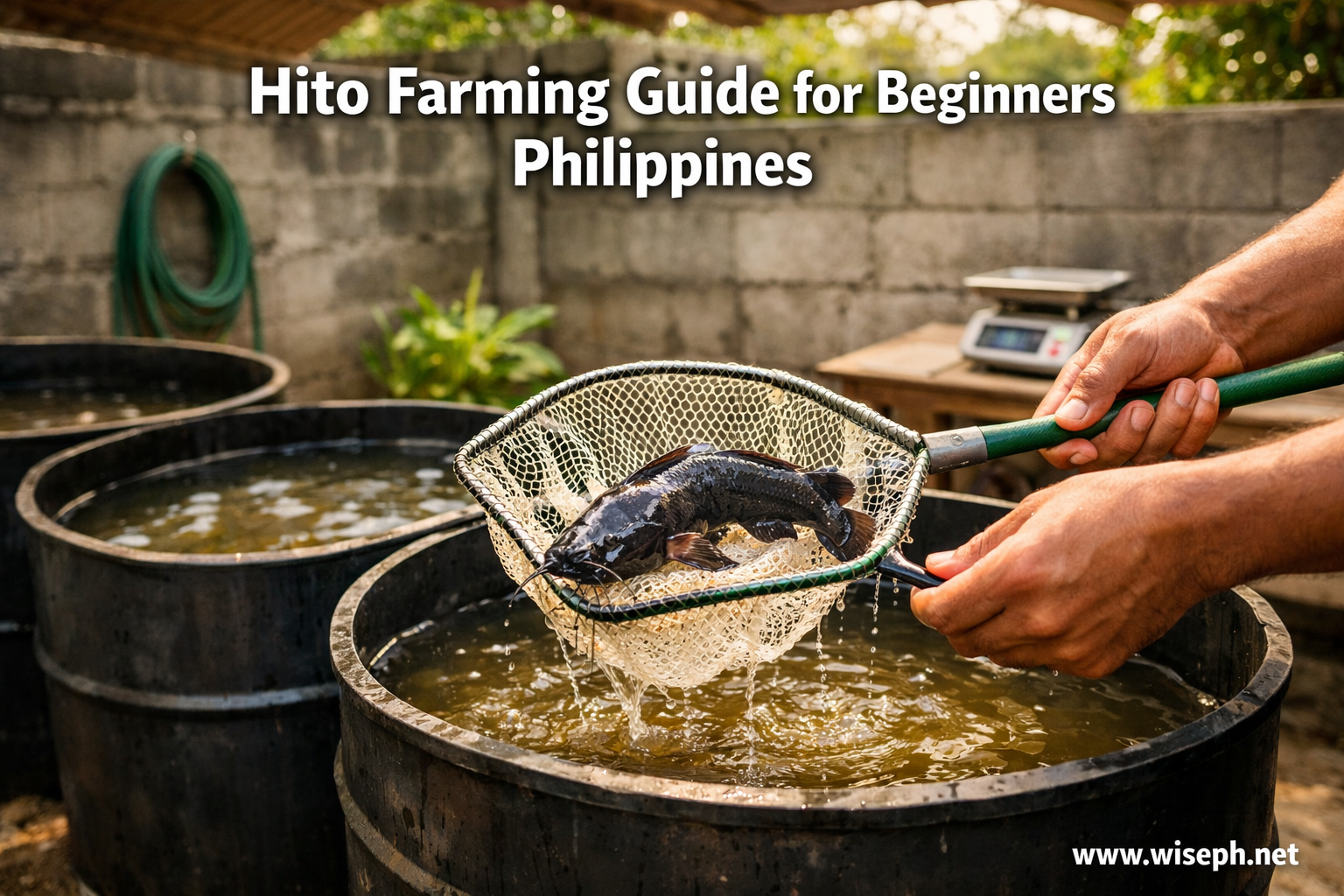
I’ve been raising hito in my Cavite backyard for over four years. My first cycle was a costly disaster. I lost more than half my fish to cannibalism because I skipped one sorting day. That mistake cost ₱18,000 and two months of work for nothing.
Now I harvest 400 to 600 kg per cycle from two concrete ponds and six nursery drums. Everything in this guide is what I wish someone had told me before that first batch.
If you want a low-capital agri-business you can run from your backyard, hito farming deserves serious attention.
Why hito farming suits Filipino backyards
Hito (Clarias gariepinus, African catfish) breathes air directly, tolerates low dissolved oxygen, and survives a wide range of water conditions. You don’t need a fishpond, a river lot, or expensive gear.
A 50 to 100 sqm concrete yard, six 200-liter drums, and roughly ₱20,000 is enough to run your first cycle. Demand is consistent year-round. Wet markets, carinderias, and household buyers pay ₱140 to ₱180 per kilo live weight (May 2026) for hito used in adobo and sinigang. A 100 kg harvest earns ₱14,000 to ₱18,000 gross. That’s real money for a part-time setup.
How much does it cost to start a hito farm?
For a 6-drum setup stocked with 200 to 240 advanced fingerlings, the all-in first-cycle budget runs ₱15,000 to ₱22,000. Drums are a one-time purchase. From cycle 2, your cost drops to ₱7,000 to ₱10,000 per cycle (fingerlings and feed only).
| Expense | Cost range | Notes |
|---|---|---|
| Drums and setup (6 half-cut 200L HDPE drums, standpipes, covers) | ₱4,500 to ₱6,500 | ₱700 to ₱850 per drum on Lazada/Shopee; DIY cutting saves labor cost |
| Fingerlings (200 to 240 pcs, 4 to 5 inch advanced) | ₱1,500 to ₱2,200 | ₱7 to ₱9 each from Bulacan or Pangasinan hatcheries |
| Commercial feed (3 to 4 sacks, 25 kg each) | ₱4,500 to ₱6,000 | Tateh, B-Meg, or Santeh; covers the full 4-month cycle |
| Water treatment consumables | ₱800 to ₱1,500 | Agricultural lime, rock salt, pH strips, potassium permanganate |
| Tools and miscellaneous | ₱1,200 to ₱2,000 | Digital scale, dip net, hose, buckets, fingerling transport |
| Total (first cycle) | ₱15,000 to ₱22,000 | Drums are reused every cycle after this |
Feed is 50 to 60% of your total cost per cycle. Saving ₱200 per sack by buying cheap or expired pellets raises your feed conversion ratio, slows growth by weeks, and worsens water quality. It costs more in the end.
What setup do you actually need as a beginner?
You don’t need a fishpond for your first cycle. Six half-cut food-grade HDPE drums (200 liters each, black-colored to limit algae) is the proven starter setup. Each drum holds 30 to 40 advanced fingerlings comfortably.
Prepare these before your fingerlings arrive:
- 6 drums cut horizontally, each fitted with a PVC standpipe for water level control
- Mosquito net or shade cloth covers (hito jump at night)
- Small dip net and plastic buckets for water changes and sorting
- Cheap digital kitchen scale for weighing fish samples on sorting day
- Rock salt, agricultural lime (apog), and pH test strips
No aeration pump is strictly required since hito breathe air. But a small submersible pump (around ₱800) simplifies water changes and is essential during summer when ammonia builds within days.
Place drums in a shaded area. Direct afternoon sun in Philippine summers pushes water above 34°C, which suppresses appetite and invites disease.
Where to buy hito fingerlings in the Philippines
Buy advanced fingerlings: 4 to 5 inches (10 to 12 cm), uniform size, same batch from one spawn. These cost ₱7 to ₱9 each but survive significantly better than cheap 1 to 2 inch fry.
| Region | Key areas | Notes |
|---|---|---|
| Bulacan | Bustos, Pulilan, Pandi, Calumpit | Very active; many direct-from-farm sellers, strong strains |
| Pangasinan | Urbiztondo and nearby towns | Strong reputation for volume and consistency |
| Laguna | Sta. Cruz, Los Banos, Bay | Good option for Southern Luzon and Cavite buyers |
| Cavite (local) | Various farms (e.g., Scifi Hito Hatchery Farm) | Convenient; confirm current stock availability first |
| BFAR regional offices | Nationwide | Subsidized or low-cost batches for beginners and groups |
Search “Hito Fingerlings Philippines” on Facebook. Sellers post daily with photos and delivery options. Quarantine all new arrivals for 5 to 7 days in a separate drum before main stocking.
Red flags to avoid: mixed-size batches, fish priced under ₱5 each, sellers who won’t let you inspect, and any fish showing white spots, fuzzy patches, or lethargy on arrival. I bought a “bargain” mixed batch once and lost 40% in the first month. Never again.
How to feed hito at every growth stage
Hito are carnivorous. They need high-protein pellets fed consistently, at fixed times, in measured amounts. Here’s the schedule I follow after four years of cycles:
| Stage | Days | Feed type | Frequency | Daily ration |
|---|---|---|---|---|
| Starter | 1 to 30 | 35 to 40% protein crumble, 1 to 2mm pellet | 3x daily: 7 AM, 1 PM, 5 PM | 5 to 7% of biomass |
| Grower | 31 to 90 | 30 to 32% protein, 3 to 5mm pellet | 2x daily: morning and late afternoon | 3 to 5% of biomass |
| Finisher | 91 to harvest | Same grower/finisher pellet | 2x or once (morning) | 2 to 3% of biomass |
Feed to near satiation each meal. Scatter small handfuls and watch. Stop when fish slow down or ignore new pellets. Remove uneaten feed after 15 minutes. In Philippine summer heat, leftover pellets rot fast and spike ammonia.
I supplement once or twice a week with chopped chicken entrails or trash fish during the grower phase. Cheaper protein, and fish love it. Commercial pellets stay as the primary feed for consistent growth rates.
The one rule that makes or breaks your first cycle
Sort fish by size every 21 days. No exceptions. No “maybe next week.”
Hito are natural cannibals. After three to four weeks, the fastest growers pull well ahead in size. Left together, the big ones swallow the smaller ones whole. By month two, you open your drums and find skulls, spines, and a few fat survivors.
I learned this on my first cycle. I bought 800 uniform 2-inch fingerlings, fed them well, and changed water on schedule. By day 25, some were already 4 to 5 inches while others were still 2 inches. I told myself “maybe next week.” By day 45, I had 350 fish left. The rest had been eaten. That cost me ₱18,000 and two months of work for zero harvest.
Every DA-BFAR extension worker I’ve spoken to, and every commercial grower from Luzon to Visayas, says the same thing. Sorting is the difference between 75 to 85% survival and a 30% disaster.
On sorting day: partially drain the drum, scoop fish into a bucket, and move the top 20 to 30% biggest fish to a separate drum. Feed to satiation consistently so no fish goes hungry enough to turn. Never mix new fingerlings with older stock.
How to manage water quality in drum setups
Hito tolerates poor water better than most species. But in 200-liter drums packed with 35 fish during Philippine summer, ammonia builds within days. One skipped water change during a hot spell and you wake up to floating fish.
The four parameters that actually matter for drum setups:
| Parameter | Target range | Low-tech way to check |
|---|---|---|
| Temperature | 26 to 30°C (max 32°C) | Digital aquarium thermometer: ₱150 to ₱300 |
| pH | 6.8 to 7.5 | pH test strips or liquid kit: ₱200 to ₱500 |
| Dissolved oxygen | Above 4 to 5 mg/L | Watch for surface gulping; act immediately if seen |
| Ammonia (NH3) | Near zero (below 0.05 mg/L) | API ammonia kit: ₱400 to ₱700; test weekly or when water smells bad |
My basic maintenance routine: 20 to 30% water change every 3 to 5 days per drum. Let tap water sit 24 hours first (or add a pinch of sodium thiosulfate to dechlorinate). Add a small amount of agricultural lime after each change to stabilize pH.
When things go wrong fast: immediate 40 to 50% water change, 1 to 2 kg rock salt per 200L drum, stop feeding for 24 hours, then observe. That combination fixes most ammonia spikes before they become fatal. In four years I’ve had only two real outbreaks. Both traced directly to skipped water changes during rainy season.
Common hito diseases and how to prevent them
Most outbreaks in drum setups are secondary to stress, poor water, or handling injuries. Fix the root cause and hito recover fast.
| Disease | Key symptoms | First response |
|---|---|---|
| Bacterial (Aeromonas) | Red ulcers, swollen belly, fin rot, sudden deaths | 50%+ water change; 0.5 to 1% salt bath for 3 to 5 days; stop feeding 24 to 48 hours |
| Fungal (Saprolegnia) | White cotton patches on skin or fins | Salt bath; improve water quality; remove severely affected fish |
| Parasites (Ich/White spot) | White dots on body; fish rubbing on drum walls | Raise temp to 30 to 32°C; 0.3 to 0.5% salt; quarantine all new arrivals |
| Fin rot/Columnaris | Grayish-white fin edges; fraying | Same protocol as bacterial above |
Never reach for antibiotics first. Start with salt and a large water change. Use potassium permanganate bath only if the problem spreads to multiple drums. The Bureau of Fisheries and Aquatic Resources (DA-BFAR) documents growing antibiotic resistance in backyard aquaculture setups across the country.
Between cycles: sun-dry empty drums for 3 to 5 days, lime the bottom, and disinfect all nets and buckets with salt or KMnO4 solution before restocking.
How much can you realistically earn from hito farming?
These are honest numbers for a 6-drum beginner setup. No highlight-reel math, no inflated survival rates.
| Metric | First cycle | Cycle 2 onward |
|---|---|---|
| Stocking | 200 to 240 fingerlings | 200 to 240 fingerlings |
| Expected survival | 65 to 75% (learning curve) | 75 to 85% (with sorting discipline) |
| Harvest weight | 80 to 100 kg | 90 to 120 kg |
| Total cost | ₱15,000 to ₱22,000 | ₱7,000 to ₱10,000 |
| Revenue at ₱150/kg average | ₱12,000 to ₱15,000 | ₱13,500 to ₱18,000 |
| Net profit | Break-even to ₱3,000 | ₱5,000 to ₱10,000 |
Two cycles a year is realistic with a 4 to 4.5 month grow-out and 2 to 3 weeks for sun-drying and restocking. That’s ₱10,000 to ₱20,000 net per year from six drums. Real supplemental income on a part-time schedule.
Sell direct to households and community buyers whenever possible. That gets you ₱160 to ₱180 per kilo versus ₱130 to ₱150 from a trader. Build your buyer list two weeks before harvest day. Watch fuel and transport cost updates — they affect input costs and what buyers will pay.
Once two successful cycles are done, put the profit to work. Many backyard farmers I know deposit their hito earnings into a Pag-IBIG MP2 account and use the MP2 savings calculator to track compounded returns between harvest seasons.
If your farm earns consistently, register with your LGU and check the 2026 BIR 1701A guide for sole proprietors before your first full year ends.
How to harvest and sell your hito
Stop feeding 24 hours before harvest day. This cleans their gut and improves flavor and shelf life for buyers.
- Drain drums partially at first light. Cooler morning temperatures reduce handling stress.
- Scoop fish with a soft dip net into clean, aerated buckets.
- Weigh in batches. Market size is 300 to 500 g per fish (2 to 3 pcs per kilo).
- Hold live fish in clean, aerated water for up to 1 to 3 days if needed. Choose your timing and buyer.
- Sell live whenever possible. Live hito commands ₱20 to ₱40 per kilo more than dressed fish.
Farmgate prices in Luzon (May 2026): ₱130 to ₱160 per kilo to traders; ₱160 to ₱180 per kilo direct to buyers; up to ₱220 to ₱250 per kilo dressed and delivered to restaurants. One person can harvest six drums in 2 to 3 hours. I always bring a family member — faster, and less stress on the fish.
Once your hito income is steady, consider expanding into other proven backyard agri-businesses. Both crayfish farming in the Philippines and agarwood farming pair well with a hito setup — different markets, same small land footprint.
What most hito farming guides get wrong
I’ve read dozens of online guides and watched many farming vlogs. Most get these five things wrong:
- Cannibalism gets one sentence. In a real drum setup, it’s the dominant threat in the first 60 to 90 days. Skip one sort and you lose 40 to 70% of your stock to each other, not to disease.
- Survival rates are inflated. “90 to 95% survival” happens on optimized research farms. A real backyard first cycle is 65 to 75%, and that is perfectly fine. Plan for it.
- Drum water is not pond water. 200 liters with 35 fish in 32°C heat spikes ammonia in days. “Hito are hardy” is true for short periods. It is not permission to skip water changes.
- Labor is understated. Sorting days are physical. Daily observation takes 30 to 60 minutes. Guides show 10-minute feeding and success thumbnails. They skip the frogs in the drums, the midnight jumpers, and the smell when ammonia spikes.
- Selling isn’t automatic. Your first harvest often moves slower and at lower prices while you build buyer relationships. Start finding buyers two weeks before harvest, not after.
Hito farming works very well in the Philippines. But only for people who go in with honest expectations and disciplined habits.
Frequently asked questions
How long does it take for hito to reach market size in the Philippines?
From 4 to 5 inch advanced fingerlings, market-size hito (300 to 500 g) takes 4 to 4.5 months under good feeding and management. Poor water quality, overfeeding, or skipped sorting days all extend this timeline and reduce average harvest weight.
How many hito fingerlings can I stock per 200-liter drum?
30 to 40 advanced fingerlings (4 to 5 inches) per drum is the safe stocking density for beginners. Going higher increases ammonia load and cannibalism risk, especially without aeration or frequent water changes.
What is the best feed for hito fingerlings in the Philippines?
Use commercial starter pellets with 35 to 40% protein (Tateh Starter, B-Meg, or Santeh) during the first 30 days. Switch to grower/finisher pellets (30 to 32% protein, 3 to 5 mm) from day 31 onward. Cheap or expired feed slows growth and worsens water quality.
How much can a beginner earn from a 6-drum hito farm in the Philippines?
Expect to break even or earn a small profit on your first cycle. From cycle 2 onward, with drums already paid for, net profit of ₱5,000 to ₱10,000 per 4.5-month cycle is realistic. Two cycles per year means ₱10,000 to ₱20,000 net annual income from a part-time backyard setup.
Do I need a permit or license to raise hito in my backyard in the Philippines?
For small-scale backyard production under 1 hectare sold locally, a formal fishery license from BFAR is generally not required. Register your micro-enterprise with your LGU and the BIR once income becomes consistent. Check with your municipal agriculture office for local requirements.
Ready to explore more backyard options? Browse agri-business ideas in the Philippines for other low-capital farming setups that work on small land and limited capital.