


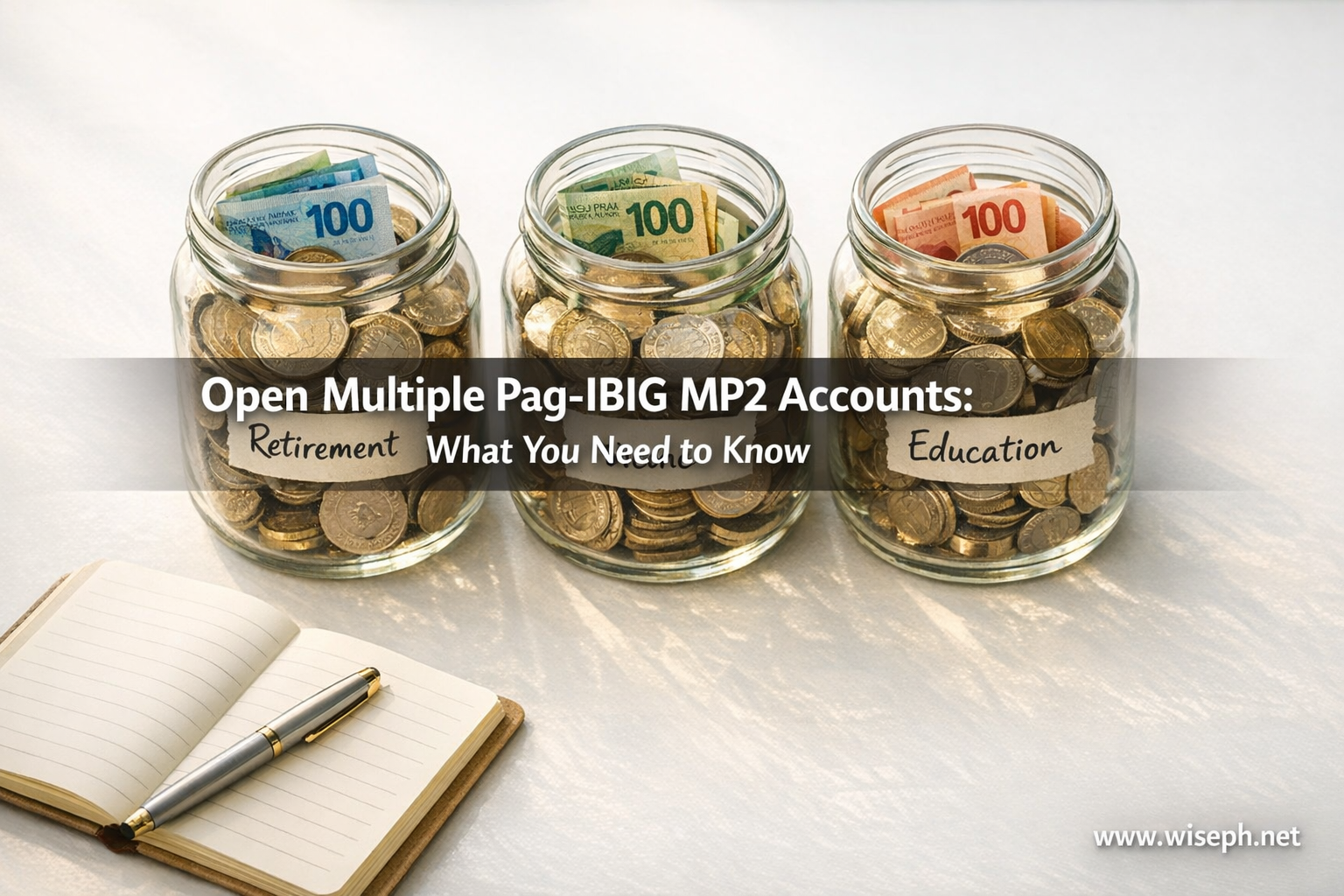
I have two MP2 accounts. Not because I found a dividend loophole or unlocked a better rate.
I opened the second one because I wanted one savings pot I’d never touch for five years and another I could adjust freely when freelance income slowed down. Different maturity dates meant I wouldn’t need to decide what to do with all my savings at the same time. That single structural choice made everything easier to manage.
Below is everything you need to know before opening a second MP2 account, including the traps most members fall into.
Can you open more than one Pag-IBIG MP2 account?
Yes. Pag-IBIG allows members to open multiple MP2 accounts under a single MID. There’s no publicly stated hard cap on how many you can have. Each account gets its own unique 12-digit account number and its own independent 5-year term.
| Rule | Details |
|---|---|
| Minimum contribution per deposit | ₱500 |
| Monthly contribution required | None |
| Maintaining balance required | None |
| Hard cap on number of accounts | None stated |
| Proof of income required | For deposits above ₱100,000 |
| Payment via check required | For single deposits above ₱500,000 |
If you haven’t started yet, the process for a second or third MP2 account is identical to the first. Pag-IBIG doesn’t add extra requirements since your profile is already verified. See the full walkthrough on how to open an MP2 account if you need a step-by-step guide.
How multiple MP2 accounts work under one MID
Each account you open gets a unique 12-digit number. All of them sit under the same Pag-IBIG MID, so you only need one Virtual Pag-IBIG login. Once you’re in, all your MP2 accounts appear together, each with its own balance, dividend records, and transaction history.
Importantly, here’s the part most people don’t expect: Pag-IBIG doesn’t let you name your accounts. They show up as raw number strings. No labels, no descriptions. If you have two accounts, you’ll see something like “0000-1234-5678” and “0000-9876-5432” and nothing else to tell them apart.
So the organization falls on you. I keep a simple note on my phone: account ending in 78 is the long-term fund, ending in 32 is the flexible one. Low-tech, but it prevents costly mistakes. You can also check your MP2 balance and contributions online inside Virtual Pag-IBIG to confirm each account’s details without going to a branch.
Additionally, each account runs its own 5-year maturity clock from the date of the first deposit. Open Account A in 2024 and Account B in 2026, and they mature in 2029 and 2031 respectively. That staggered timeline is often the real strategic reason for opening a second account, not any expectation of better returns.
What goals actually make sense for a separate MP2 account?
MP2 works best for goals you genuinely won’t touch for five years. The lock-in isn’t a limitation to work around; it’s the design. Your goal has to fit that timeline or the account will just create pressure instead of security.
Goals that fit MP2:
- Retirement fund — longest time horizon, maximum dividend compounding benefit
- Home down payment — predictable 5-year target, lump sum at maturity
- Child’s education fund — specifically if the need is still 5 or more years away
Goals that don’t fit MP2:
- Emergency fund — MP2 doesn’t allow penalty-free early withdrawal in normal circumstances; emergency money has to be accessible immediately
- Short-term business capital — if there’s any real chance you’ll need it within 5 years, it doesn’t belong here
Specifically, I wouldn’t put emergency savings in MP2 under any circumstances. If the reason you’re opening a second account is “just-in-case money I might need soon,” a regular savings account is the right tool. Similarly, if you need fast cash for a specific project, a Pag-IBIG Multi-Purpose Loan gives you access to funds without touching your MP2 at all.
For accounts where you’re deciding how to contribute, the breakdown on MP2 lump sum versus monthly contributions helps you choose the right funding approach for each goal.
Does opening more accounts earn higher dividends?
No. This is the most common misconception about multiple MP2 accounts, and it’s worth being direct about.
Pag-IBIG declares a single dividend rate for the entire MP2 program each year. It doesn’t matter whether you have one account or five, or whether you hold ₱1,000 or ₱1,000,000 in savings. Every peso earns the exact same rate. Opening more accounts does not unlock a higher tier, a better return, or any additional benefit from Pag-IBIG’s side.
What it does create is fee leakage. Every time you fund an MP2 account through GCash or Maya, you typically pay ₱5 to ₱10 in transaction fees per account per payment. Over a 5-year term, that adds up faster than most people expect.
| Active accounts | Monthly fee (at ₱10/account) | Total fees over 60 months |
|---|---|---|
| 1 account | ₱10 | ₱600 |
| 2 accounts | ₱20 | ₱1,200 |
| 3 accounts | ₱30 | ₱1,800 |
| 5 accounts | ₱50 | ₱3,000 |
Those fees come directly out of your Total Accumulated Value. In addition, you can verify exactly how fee leakage affects your projected returns by running the numbers in the MP2 Pag-IBIG calculator. More accounts means more fees for the exact same dividend rate. Unless there’s a real strategic reason to split, consolidating into one or two accounts is the more efficient choice.
How to avoid contributing to the wrong account
This is where multiple accounts can cause real, hard-to-fix problems.
Specifically, Pag-IBIG generates a brand-new 12-digit number for every MP2 account you open. If you accidentally fund the wrong account you own — say, you mean to top up your 2029 account but type the 2031 number instead — Pag-IBIG will credit it to whichever valid number you entered. They generally won’t reverse or transfer it internally. Your goal timelines shift, and there’s no quick fix.
Worse: if you mistype a single digit and land on a completely different member’s account, you’ll need to visit a physical Pag-IBIG branch, file a formal erroneous payment tracing request, provide official receipts, and wait weeks for a manual investigation. A painful outcome for one wrong digit.
Three ways to prevent mix-ups:
- Save each account as a named biller in your e-wallet. Never type the 12-digit number manually. When you pay your MP2 via GCash or Maya, save each account as a favorite biller and give it a specific label: “MP2 — Home Fund (2029)” or “MP2 — Retirement (2031).” That way, you select a goal, not a string of numbers.
- Keep a simple tracker. A one-page spreadsheet with each account number, its purpose, opening date, and maturity date is all you need. Update it once a year.
- Keep fewer accounts open. The more accounts you manage, the more opportunities for a slip. If you’re not actively using a laddering strategy, two accounts is a reasonable ceiling.
The laddered maturity strategy
Laddering is the one scenario where multiple MP2 accounts genuinely justify the extra management.
The idea is simple: open one new MP2 account each year. Since each account matures 5 years from its first deposit, you end up with one account maturing every year after the initial ramp-up period. As a result, you get annual access to a lump sum, which you can withdraw or reinvest without waiting for your entire savings to come due at once.
| Account | Year opened | Year it matures |
|---|---|---|
| MP2 Account A | 2024 | 2029 |
| MP2 Account B | 2025 | 2030 |
| MP2 Account C | 2026 | 2031 |
| MP2 Account D | 2027 | 2032 |
For freelancers and self-employed members, that kind of annual liquidity can be genuinely useful — especially in years with irregular income.
One critical warning: if an MP2 account reaches maturity and you don’t claim it, the account stops earning MP2 dividends immediately. The balance then earns only the lower regular Pag-IBIG savings rate for up to two years before being reclassified as accounts payable. Don’t let a matured account sit unclaimed. If you want to continue saving after maturity, you’ll need to open a new MP2 account. For the full process, the guide on how to claim your Pag-IBIG MP2 savings walks through each step. And if you’re weighing whether to claim early for a specific reason, check what’s allowed under early MP2 withdrawal before maturity first.
Should you open multiple MP2 accounts or stick to one?
One account is the right default for most members. Specifically, it keeps your fees low, your tracking simple, and your contribution focused.
However, two accounts makes sense if you have two genuinely separate goals with different timelines — for example, a retirement fund you’ll leave untouched for 10 or more years and a home down payment you’re targeting in 2030. The behavioral benefit of seeing separate balances grow toward specific goals is real, and it can keep you motivated.
Beyond two, however, the management burden starts to outweigh the benefits unless you’re running a deliberate laddering strategy. Don’t open a new account just because it’s a new year or you got a bonus. You can contribute as much as you want to a single active MP2 account without any cap. Fewer accounts means fewer numbers to track, lower total fees, and fewer chances to fund the wrong one.
If you’re also wondering about the impact of inconsistent contributions on your plan, the guide on what happens when you miss an MP2 contribution explains the real consequences. For everything about MP2 in one place, the Pag-IBIG guides on WisePH cover account setup, calculators, dividends, and claims.
Frequently asked questions about multiple MP2 accounts
Can I open multiple Pag-IBIG MP2 accounts?
Yes. Pag-IBIG allows members to open more than one MP2 account under the same MID. Each account gets its own unique 12-digit account number and its own independent 5-year term. There is no publicly stated limit on how many accounts you can hold simultaneously.
Do multiple MP2 accounts earn higher dividends?
They don’t. Pag-IBIG sets a single dividend rate for the entire MP2 program each year. Every peso in every account earns that same rate regardless of how many accounts you hold or how much you’ve saved in total. Opening additional accounts adds transaction fees, not returns.
Can I see all my MP2 accounts in one Virtual Pag-IBIG login?
Yes. All MP2 accounts under your MID appear inside the same Virtual Pag-IBIG portal. You can view each account’s balance, dividend records, and contribution history separately, all from one login. The only downside is that Pag-IBIG doesn’t let you name the accounts, so you’ll need to track which number belongs to which goal on your own.
What happens if my MP2 account matures and I don’t withdraw?
The account stops earning MP2 dividends at maturity. After that, the balance earns the lower regular Pag-IBIG savings rate for up to two years. If still unclaimed after that window, the account is reclassified as accounts payable. Claim your matured account on time to protect your full dividend earnings.
How many MP2 accounts should I open?
One or two is the practical answer for most members. One long-term account works well unless you have a genuinely separate goal with a different timeline. Beyond two, the management complexity and additional transaction fees typically outweigh any organizational benefit, unless you’re running a deliberate laddering strategy for annual liquidity.