


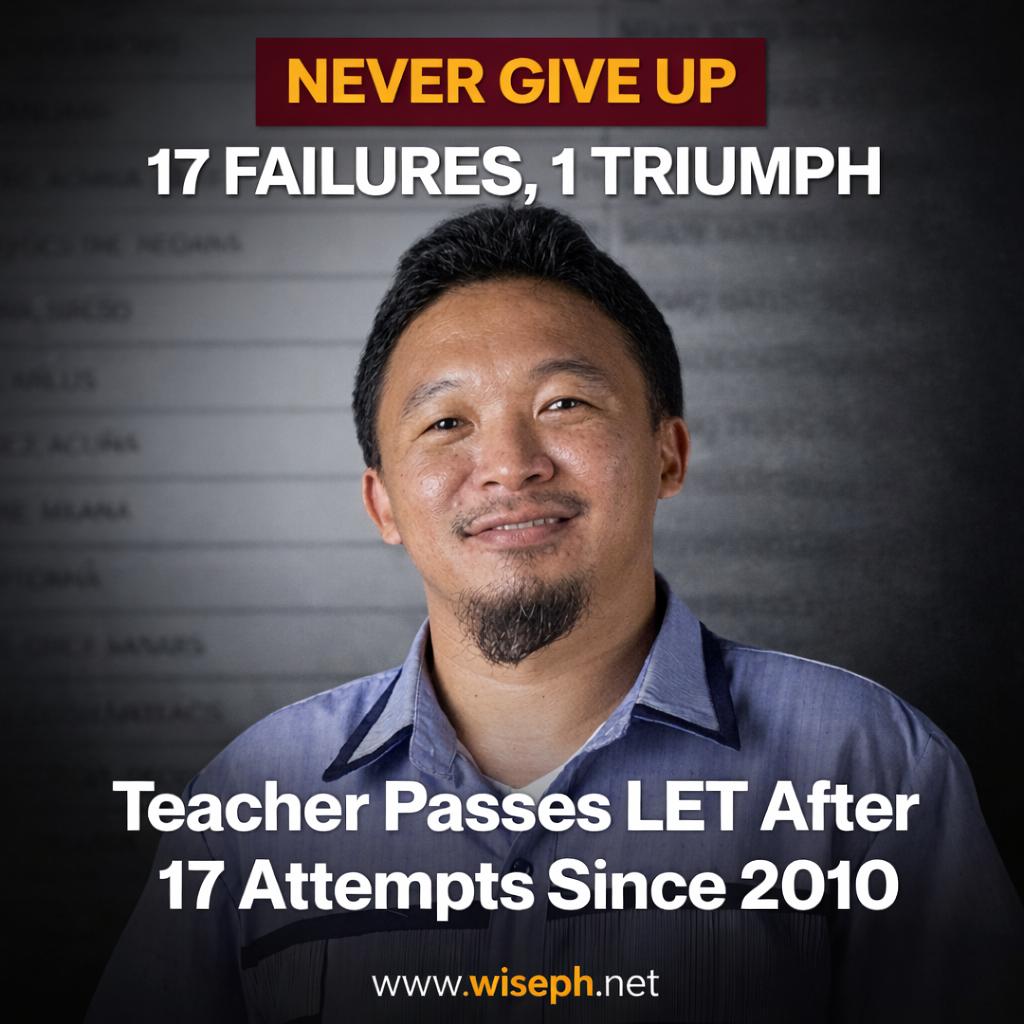

The March 2026 LET exam result dropped on May 12. Thousands of Filipinos refreshed their browsers, hearts pounding, waiting to see if their name was finally on the list. Some found it. Some didn’t.
Before you scroll to the full results, I want to tell you about a teacher from Cadiz City named Leonel. He took the LET 17 times over 12 years. His story is everywhere right now, and almost every repost gets it wrong.
The March 2026 LET exam result is out, and 63,377 teachers passed
The PRC officially released the March 2026 LET exam result on May 12, 2026, thirty-nine working days after the exam on March 15. A total of 63,377 out of 94,357 examinees passed across 41 testing centers nationwide.
| Level | Passers | Takers | Passing Rate |
|---|---|---|---|
| Elementary | 18,376 | 32,796 | 56.03% |
| Secondary | 45,001 | 61,561 | 73.10% |
| Total | 63,377 | 94,357 | 67.17% |
Both levels improved compared to March 2025. The 73.10% secondary rate is among the strongest for a March cycle in recent years. For the full list, visit our March 2026 LET exam result page. You can also browse all PRC board exam results on WisePH.
17 attempts, one classroom: what Leonel’s story is really about
Leonel Martos Mabaquiao graduated from Philippine Normal University-Visayas in 2010 with a Bachelor of Elementary Education degree. That same year, he took the LET for the first time.
He didn’t pass. So he tried again.
Over the next twelve years, he sat for the LET seventeen times total. He traveled to testing centers in Cebu, Iloilo, and Bacolod, far from his home in Cadiz City, Negros Occidental, because that is what provincial test-takers do when the nearest center is hours away. He started a family. Money for reviewers ran out sometimes and he borrowed from friends. He kept showing up.
Through all of it, he walked into a classroom every single day.
In March 2022, his name finally appeared on the PRC list. He was 37 years old. Twelve years had passed since that first exam. The entire time, he had been teaching in Cadiz City.
“Never give up,” he said afterward, “because God’s timing is always perfect.”
During one of his review trips to Bacolod, he found a quiet moment at Lupit Church. In the provinces, that kind of prayer isn’t a detour from the work. It’s what keeps you standing when more than a decade of failed results gets loud at 2 a.m.
What every viral repost of this story gets wrong
Every Facebook share frames it the same way: “17 tries! Never give up!” A few fireworks emojis. A “God is good” comment. A hundred shares by 8 a.m.
That framing misses the whole point.
Leonel was not sitting at home, buried in reviewers, pausing his life until the day the PRC decided he was ready. He was already in the classroom. Every day. Teaching real children, buying supplies from his own salary, staying late for struggling pupils, going home tired with no official license to his name.
The 17 attempts were not 17 failures. They were 17 times Leonel had to quietly convince himself (and his family, and probably some skeptical colleagues) that he belonged in front of those kids, even without papers to prove it.
What the viral posts skip: the exam fees paid over twelve years, the nights when doubt hit hardest around attempt 10 or 13 or 15 while most people would have quietly walked away, the gatherings he probably missed while buried in a reviewer, the “bakit wala pa rin?” from relatives who never quite understood why he kept coming back.
The real inspiration in this story is not the 17th try. It is the 1st through the 16th, when he walked into that classroom anyway.
My cousins Ate Ana and Kuya Marco went through the same fire
I didn’t take the LET myself. I went the IT-business route, built a small company in CALABARZON, and eventually started writing here on WisePH. But the LET has always felt personal, because of two cousins who lived this exact story.
Ate Ana’s three attempts
My cousin Ate Ana from Laguna sat for the LET for the first time in 2018. She had already printed “Future Teacher” calling cards. When her name wasn’t on the list, she didn’t leave her room for two days.
She failed again in 2019. By then, some relatives were whispering: “Baka hindi talaga para sa kanya.” She was already working as a volunteer tutor, buying her own materials, teaching other people’s children while waiting for the system to say yes. Before her third attempt in 2021, she lit a candle and prayed.
Her name appeared. I still remember the group chat exploding with “Finally!” and happy tears. She now teaches in a public elementary school in Laguna. Every time a parent thanks her, she tells me it was worth every failure.
Kuya Marco’s five attempts
My cousin Kuya Marco from Batangas failed four times between 2019 and 2023. He was already 28, supporting his own children, and the pressure was crushing. After each failed result, he would walk quietly to the back of their house, sit under the mango tree, and just stare.
He told me once: “Dudu, kapag sumuko ako, parang sinukuan ko na rin yung mga bata na darating sa classroom ko.”
On his fifth attempt, his name was on the list. The family celebrated with pancit and ice cream. Simple. Real. He now teaches high school in Batangas and says the long road made him a better teacher than if he had passed on the first try.
The provincial struggle no Manila article talks about
Leonel traveled to Cebu, Iloilo, and Bacolod for his LET attempts. Not by choice. When you live in Cadiz City, that is the reality of a national exam.
Far from the testing centers, still showing up
My cousins rode habal-habals to reach review centers. They borrowed reviewers from friends because buying a full set was not always possible. They sat for exams in unfamiliar cities, found their way to testing halls they had never visited, and took long bus rides home to wait for results they sometimes checked on someone else’s phone.
Whether you are from Negros Occidental, Laguna, Batangas, Cebu, Davao, or any small town between those places, the experience is the same. Family pressure, self-doubt, the “bakit wala pa rin?” from relatives who don’t understand why you keep trying: none of it changes based on your province.
The faith that keeps you standing
In our culture, prayer is not a guarantee of easy victory. It is the strength to keep standing when the results keep saying “not yet.” Ate Ana lit her candle before her third try. Kuya Marco sat under the mango tree and prayed quietly before his fifth. Leonel found a moment of stillness at Lupit Church during a review trip in Bacolod.
That faith is part of every serious LET taker’s story, in every province in this country.
If your name is on the March 2026 LET list: what to do next
Congratulations. Here is what to take care of in the coming weeks.
- Apply for your PRC professional ID through the PRC online portal. Schedule your oath-taking and registration early.
- Secure your Certificate of Registration and Professional ID Card; both are required for employment at DepEd or private schools.
- Read our guide on what your PRC license covers and what rights it gives you as a licensed professional.
- Monitor the DepEd hiring portal for Teacher I applications. Windows open at specific times each year.
- If you know someone still trying, tell them. Your name on the list is proof that it happens.
If your name is not on the list yet: this part is for you
I know what this moment feels like, not from my own exam, but from watching Ate Ana not leave her room for two days. From watching Kuya Marco walk quietly to the back of the house and sit under the mango tree.
If you failed again today, whether it is your second time or your seventh, you are allowed to feel it fully. Take the day. Let it hurt. Do not let anyone rush you to “just try again.”
But when you are ready, hold on to this: the license does not make you a teacher. It is the last gate in a long process. The care, the patience, the belief that your future students need you. All of that was already there before today’s result came out. Leonel taught in Cadiz City for twelve years without a license. Kuya Marco walked into classrooms the same way. The PRC list did not create their calling. It just finally caught up to it.
If money is tight and you need support for your next review or exam fees, check our guide on loans for teachers in the Philippines.
The system eventually catches up
In 2025, Leonel was promoted to Teacher III. He now serves as a proctor for LET, CSC, and NAPOLCOM examinations. The system eventually caught up to him. But those who watched him through those years know the truth: he had earned every bit of that title long before the papers said so.
Leonel didn’t become a teacher after 17 tries. He had been a teacher for more than a decade already. The license just made it official.
If you just checked the March 2026 LET exam result, whether your name is there or not, drop a comment below. Tell us your story in one or two sentences.
You are not alone in this. Someone here is reading your words right now and finding strength from them.
Frequently asked questions about the LET exam result
When was the March 2026 LET exam result released?
The PRC released the March 2026 LET exam result on May 12, 2026, thirty-nine working days after the exam on March 15, 2026, across 41 testing centers in the Philippines.
What is the passing rate for the March 2026 LET?
The overall passing rate is 67.17%. Elementary: 56.03% (18,376 out of 32,796). Secondary: 73.10% (45,001 out of 61,561). In total, 63,377 out of 94,357 examinees passed.
How many times can you retake the LET in the Philippines?
There is no limit. You may take the exam as many times as needed, as long as you meet the eligibility requirements. Leonel Martos Mabaquiao passed on his 17th attempt after twelve years of trying.
What should I do after passing the March 2026 LET?
Apply for your PRC professional ID online and schedule your oath-taking. Secure your Certificate of Registration, then check the DepEd hiring portal for Teacher I applications during the official application windows.
Can I still become a licensed teacher after multiple LET failures?
Yes. Each attempt is a fresh start. Identify your weak subjects, use updated reviewers, and consider a structured review program. Many teachers pass on their third, fifth, or even seventeenth try.