
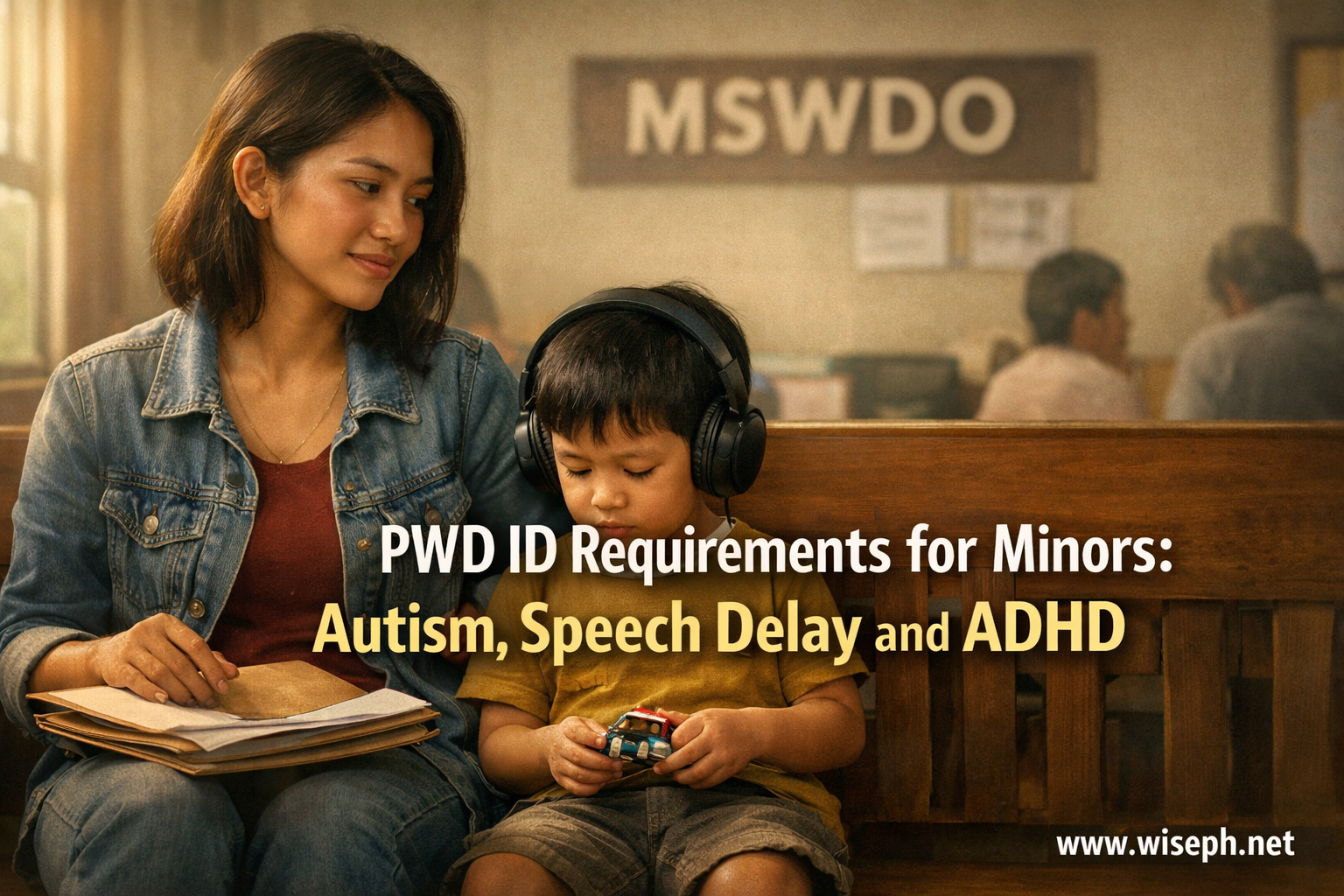
My 4-year-old nephew has speech delay with autism spectrum features. He does not speak meaningful words yet, has limited eye contact, repeats certain movements, and gets overwhelmed in noisy places. Helping my sister get him a PWD ID for minor Philippines applicants like him was one of the most exhausting things we have done together, not because the MSWDO process is complicated, but because no guide told us the one thing that actually matters.
We spent three months, visited three developmental pediatricians, and paid ₱14,100 in consultation fees before we got a certificate the MSWDO would accept. This guide is what I wish someone had handed us on day one.
This guide covers the PWD ID for minor Philippines cases specifically: non-apparent conditions, minors without standard IDs, and the medical certificate problem that trips most families up. For adults applying on their own behalf, read our complete guide to applying for a PWD ID in the Philippines.
Can a child with autism or speech delay get a PWD ID?
Yes. Under Republic Act 7277 (the Magna Carta for Persons with Disabilities), autism, speech delay, ADHD, and Global Developmental Delay are all recognized disabilities. There is no minimum age requirement. Infants and toddlers can be registered as PWDs as long as their condition is properly documented.
However, these conditions are classified as non-apparent disabilities. Because the MSWDO cannot assess them visually, every PWD ID for minor Philippines application involving a non-apparent condition depends heavily on what the doctor writes on the certificate.
| Condition | Classification | Qualifies? |
|---|---|---|
| Autism Spectrum Disorder | Psychosocial disability | Yes |
| Speech and language delay | Communication disorder | Yes |
| ADHD (moderate to severe) | Psychosocial disability | Yes, if functional impairment is documented |
| Global Developmental Delay | Intellectual disability | Yes |
| Mild learning disability | Varies | Depends on how the certificate is written |
The medical certificate is the make-or-break document
The certificate from your developmental pediatrician is the single most important document in the entire process. Without the right wording, the MSWDO sends you home the same day, even if your child’s condition is obvious to everyone in the room.
We learned this the hard way. Our first two certificates were rejected on the spot. However, the third one was accepted immediately.
| Certificate wording | Result at MSWDO |
|---|---|
| “Speech delay” (one line only) | Rejected |
| “Developmental delay, needs follow-up” | Rejected |
| “Global Developmental Delay with features of Autism Spectrum Disorder” plus specific behaviors listed | Accepted immediately |
What the certificate must include
According to NCDA Administrative Order 001-2021, a certificate for non-apparent disabilities must include:
- The doctor’s full name, PRC license number, specialization, and contact number
- A specific diagnosis (not “possible” or “suspected”)
- Functional descriptions of how the condition affects daily life (for example, “limited verbal communication, repetitive movements, poor eye contact, sensory sensitivity”)
- A recommendation for therapy or early intervention
What finally worked for us
The third doctor, at Southern Tagalog Regional Hospital in Batangas, wrote: “Global Developmental Delay with features of Autism Spectrum Disorder.” She listed specific observed behaviors and recommended early intervention therapies. The MSWDO accepted it immediately. The first two certificates said “speech delay” and “developmental delay.” Both were sent back.
How to find a “PWD-ID friendly” developmental pediatrician
Parents in autism support groups use the phrase “PWD-ID friendly” for doctors who know how to write detailed, MSWDO-acceptable certificates for non-apparent disabilities. Finding one before your first appointment is the single action that would have saved our family the most time and money.
We found the right doctor through a Facebook group for parents of children with autism in Cavite. Another parent shared the doctor’s name and schedule at Southern Tagalog Regional Hospital. That one tip saved us from a fourth wasted consultation and another month of waiting.
Where to look
Post this question in any Facebook autism or speech delay parent group in your province:
“May I ask for a developmental pediatrician who writes detailed certificates that MSWDOs accept for PWD ID applications for young children with autism or speech delay?”
Parents who have already gone through it share names, clinics, and schedules. No government website gives you that. Most are also happy to answer follow-up questions.
Government hospital vs. private clinic
| Option | Average cost | Appointment wait | Certificate quality |
|---|---|---|---|
| Private clinic | ₱4,500–₱6,800 | 1–2 weeks | Varies widely |
| Government hospital | ₱2,800 | 3–5 weeks | Often more detailed |
Government hospital doctors often process more PWD ID-related evaluations and are generally more familiar with MSWDO requirements. The appointment wait is longer, but the consultation costs significantly less. In our case, the certificate was also far more detailed than either private clinic we visited.
Exact documents you need for a minor’s PWD ID application
We went to the MSWDO in Cavite with this exact set of documents:
| Document | Required? | Notes from our experience |
|---|---|---|
| PSA Birth Certificate (original + 2 photocopies) | Yes | They keep one photocopy. Old NSO copies are not accepted at most offices. |
| Parent’s valid government ID | Yes | SSS card, driver’s license, Philippine passport, or Postal ID |
| Medical certificate from a developmental pediatrician | Yes | Must state the specific diagnosis, observed behaviors, and the doctor’s PRC license number |
| 2 pcs 1×1 or 2×2 ID photos | Yes | White background. Write the child’s name at the back. |
| Barangay Certificate of Residency | Sometimes | Call your MSWDO first to confirm whether they require this |
| PWD ID application form | Yes | Available at the MSWDO window on the day of application |
What if someone other than the parent is applying?
The biological parent must be physically present and sign as the representative. If a grandparent, aunt, or other relative is handling the application instead, they must bring a notarized Special Power of Attorney or court-issued guardianship papers. Arriving without these documents means the application cannot proceed that day.
How to apply at the MSWDO, step by step
Once you have the right documents, the MSWDO process itself takes 20 to 30 minutes. The preparation before that visit is what actually takes time. Here is the exact order that worked for us:
- Get the medical certificate first. This step takes the longest. Find a developmental pediatrician who is familiar with PWD applications before booking any appointment. See the section above for exactly how to find one.
- Gather all documents before going. Call your MSWDO in advance to confirm any local requirements. Some municipalities ask for documents not listed in the national guidelines.
- Go to the MSWDO in your child’s city or municipality. Apply where your child is officially a resident, based on the PSA birth certificate or Barangay Certificate. Going to the wrong office means immediate rejection, regardless of how complete your documents are.
- Submit the documents at the MSWDO window. The parent or legal guardian signs as the representative. Bring originals and photocopies of everything on the checklist above.
- Wait for the PWD ID card. Most MSWDOs print and release the card within 2 to 4 weeks. Follow up if you have not received it after 30 days.
Seven mistakes parents make (and how to avoid them)
These are the most repeated mistakes in the Facebook autism and speech delay support groups in Cavite, Laguna, and Batangas. They come up constantly in threads about the PWD ID for minor Philippines applications. Many are easy to avoid with one phone call to the MSWDO before going.
- Getting a vague medical certificate. A certificate that only says “speech delay” or “developmental delay” will be rejected. The diagnosis must be specific, with observed behaviors listed and no vague qualifiers.
- Applying at the wrong office. You must apply where your child officially lives, based on the PSA birth certificate. Going to the nearest MSWDO when you live in a different municipality is a wasted trip.
- Bringing only photocopies of the PSA birth certificate. They will ask for the original plus two photocopies. An old NSO version is also not accepted at most offices.
- Wrong photo size or background. Bring 1×1 or 2×2 photos with a plain white background, with the child’s name written at the back. Small detail, but it sends you home the same day.
- Forgetting proof of residency. Some MSWDOs require a Barangay Certificate of Residency. Call first so this does not catch you off guard.
- Showing up without the biological parent. The parent must be physically present to sign. A grandparent or relative without a notarized Special Power of Attorney will be turned away.
- Expecting same-day card release. The PWD ID takes 2 to 4 weeks to print. Follow up after 30 days if you have not heard anything.
Which other childhood conditions qualify for PWD ID?
Beyond autism and speech delay, many other childhood conditions qualify. Here is what parents in support groups have successfully gotten approved, and where the MSWDO typically pushes back:
| Condition | Typical outcome | Notes |
|---|---|---|
| Global Developmental Delay | Approved | Most common approval after autism and speech delay |
| Down Syndrome | Almost always approved | Genetic confirmation is helpful |
| Intellectual Disability | Approved | Needs a detailed certificate |
| Cerebral Palsy | Approved | Even non-physical forms with cognitive impact qualify |
| ADHD (moderate to severe) | Usually approved | Doctor must document functional impairment clearly |
| Hearing Impairment | Approved | Audiometry results required |
| Visual Impairment | Approved | Ophthalmologist report required |
| Rare genetic conditions (Fragile X, Rett syndrome) | Usually approved | Confirmed genetic diagnosis needed |
| Mild ADHD or mild learning disability | Often rejected | MSWDO may say “not disabling enough” without strong documentation |
| Behavioral issues without a confirmed diagnosis | Rejected | Must have a confirmed medical diagnosis, not just reported behaviors |
The common thread across all of these: the medical certificate decides everything. Non-apparent disabilities get the most scrutiny because the MSWDO cannot see what is wrong. So they rely entirely on what the doctor writes.
Benefits your child can use right away
The day you get the PWD ID, the 20% discount starts. That is not a future benefit or something you have to apply for separately. It kicks in at the therapy center window the next time you pay. Under Republic Act 10754, the discount plus VAT exemption covers therapies and medicines at all private and government facilities. If a clinic refuses, you can report them to the NCDA.
My nephew goes to speech therapy twice a week and occupational therapy twice a week. This is what the savings actually look like:
| Expense | Before PWD ID | After 20% discount | Monthly savings |
|---|---|---|---|
| Therapies (speech + OT, 4 sessions/week) | ~₱8,000 | ~₱6,400 | ₱1,600 |
| Medicines and supplements | ~₱2,500 | ~₱2,000 | ₱400–₱600 |
| Total | ~₱10,500 | ~₱8,400 | ₱2,000–₱2,300 |
The card also gets your child priority lanes in government offices and hospitals. Public transport fares are discounted for the child and one companion. Private SPED tuition discounts apply too, though availability varies by school.
Government programs most parents never hear about
The PWD ID opens doors beyond the 20% therapy discount. These programs exist, but most parents only find out about them through support groups, not through any official announcement.
DepEd SPED programs
The Department of Education operates 648 SPED centers nationwide, including elementary-level programs for children with autism, speech delay, and intellectual disabilities. Enrollment is free. You can also request an Individualized Education Program through the school’s SPED coordinator once your child is enrolled. Contact your local DepEd division office for a complete list of centers in your area.
MSWDO Special Assistance Program
Many cities and municipalities offer cash assistance for therapy materials, school supplies, or monthly food and medicine support for PWD children. These programs are almost never advertised. Simply show your child’s PWD ID and medical certificate at the MSWDO window and ask specifically what local assistance is available for children with developmental delays. In Cavite, some municipalities also offer free or subsidized therapy sessions at LGU-run centers.
PhilHealth benefits for your child
You can add your child as a PhilHealth dependent and access hospitalization and diagnostic coverage. If your child has co-morbid conditions such as epilepsy or severe developmental delay, some assessments and treatments may be partially covered. Check your PhilHealth eligibility for specific benefits before booking any procedure. For children with co-occurring mental health diagnoses, the PhilHealth Yakap program covers some consultations, and the Yakap dental benefit also applies to dependents. When filing any claim, prepare the required PhilHealth claim documents in advance to avoid delays at the hospital.
Priority lanes and transport discounts
PWD cardholders and one companion get priority in all government queues and some private establishments. Similarly, provincial buses and the LRT/MRT system extend a discounted fare to the child and one accompanying adult.
What if it still feels too overwhelming?
I hear you. When my sister first heard “speech delay with autism spectrum features,” the paperwork was not the hard part. It was sitting in the car afterward, not knowing what to say. There were days she cried on the way home from a clinic because the whole thing felt like too much at once. The diagnosis, the waiting, the doctor who looked at her son and still would not write a clear certificate.
Here is what I would tell you if you were sitting across from me right now.
You do not have to figure this out alone. The parents in those Facebook groups have already done it. One post asking for a “PWD-ID friendly” developmental pediatrician will save you months. They will name the doctor, give you the clinic, and sometimes even tell you what wording to ask for.
The hardest part is already behind you. Getting the diagnosis, sitting with it, deciding to fight for your child anyway. None of that is paperwork. That is love. The MSWDO process, by comparison, is just logistics. Once you have the right medical certificate, the rest moves fast.
And the savings start the day the card arrives. That 20% discount on every therapy session is not symbolic. For our family, it covers one extra session per month for my nephew. That extra session matters more than I can explain.
Start small. Find your province’s autism or speech delay Facebook group. Post one question. That is all. Everything else follows.
Frequently asked questions
Is there a minimum age for a child to get a PWD ID in the Philippines?
There is no minimum age. Even infants can be registered as PWDs if the condition is properly documented. For very young children with non-apparent conditions like autism, the challenge is that some developmental pediatricians prefer to wait before writing a firm diagnosis. Finding a doctor who is familiar with PWD ID applications makes this significantly easier.
What happens if the MSWDO rejects our application?
Ask for the specific reason in writing. In most cases, the issue is the medical certificate: either the wording is too vague or the doctor’s PRC credentials are not included. Get a new certificate from a different developmental pediatrician who is familiar with PWD ID requirements, then resubmit.
Can a grandparent or relative apply on behalf of the child?
Yes, but they must bring a notarized Special Power of Attorney or court-issued guardianship papers. The biological parent’s information must be in the document. Arriving without these papers means the application cannot proceed that day.
Is the 20% discount on speech therapy and occupational therapy mandatory?
Yes. Under Republic Act 10754, the 20% discount plus VAT exemption applies to all medically necessary therapies at both private and government therapy centers. If a clinic refuses to honor it, you can report them to the NCDA.
How long is the PWD ID valid for a minor?
The PWD ID is valid for three years, though some LGUs still follow an older five-year schedule. You can renew it at the same MSWDO where it was originally issued. Some offices ask for an updated medical certificate upon renewal, especially for conditions that may change over time.