

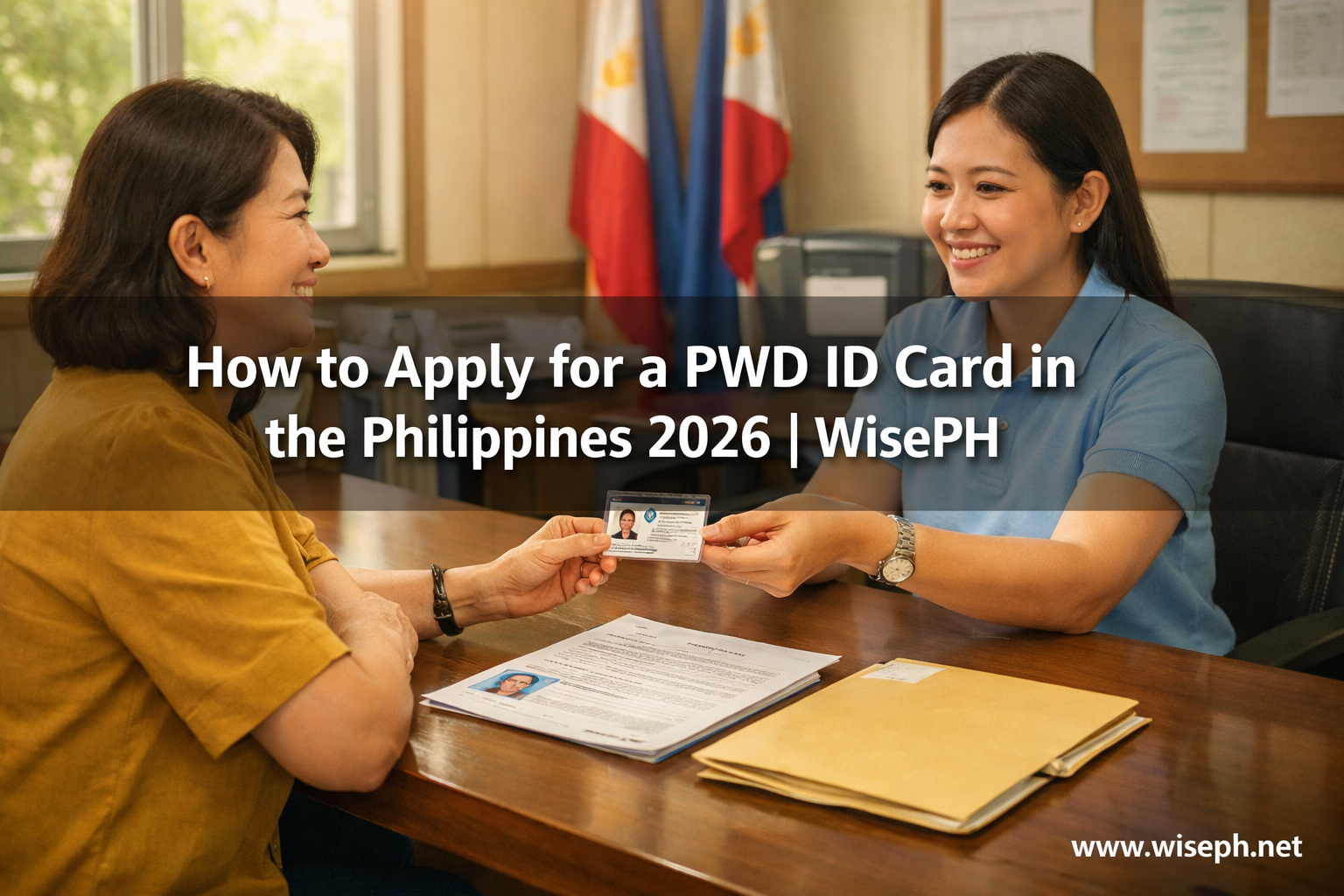
I helped my uncle get his PWD ID card at our local MSWDO in CALABARZON last year. I accompanied him the whole day, so I saw exactly how the process works. He walked out with the card the same afternoon, printed, laminated, and ready to use at the pharmacy.
Below is the honest breakdown of what we brought, what almost tripped us up, and what to expect from the moment you queue to the moment you hold the card.
Who can apply for a PWD ID card?
Any Filipino citizen with a long-term physical, sensory, mental, intellectual, or chronic illness disability can apply for a PWD ID card. You must apply at the City or Municipal Social Welfare and Development Office (C/MSWDO) or the Persons with Disability Affairs Office (PDAO) of the city or municipality where you currently live.
| Disability category | Examples |
|---|---|
| Physical / Orthopedic | Old injury, spinal condition, limb difference, paralysis |
| Visual | Low vision, blindness |
| Hearing | Deaf, hard of hearing |
| Speech / Language | Aphasia, severe stuttering disorder |
| Psychosocial / Mental | Schizophrenia, bipolar disorder, severe depression |
| Intellectual / Learning | Down syndrome, autism spectrum disorder |
| Chronic Illness | Cancer, rare disease, diabetes with complications |
However, one rule many families miss: you can only apply at the office covering your current barangay address. Applying at a relative’s municipality, even temporarily, usually doesn’t work, since the office checks the Barangay Certificate against your declared address. Senior citizens who also qualify as PWDs may hold both a senior citizen card and a PWD ID card; for the PhilHealth side of senior citizen coverage, see our guide on PhilHealth rules for senior citizen members.
What documents do you need to apply for a PWD ID card?
To apply for a PWD ID card, bring five things: the registration form, ID photos, two valid government IDs, a Barangay Certificate, and a Certificate of Disability. The MSWDO provides the registration form free on the day itself. No need to download or print in advance.
| Document | Notes |
|---|---|
| PWD Registration Form (Form 1) | Provided free at the MSWDO; fill out on-site |
| ID photos | 2 copies, colored, white background, taken within the last 3 months. Most MSWDOs ask for 2×2, but some LGUs (like New Imus PDAO) require 1×1 instead. Call your office the day before to confirm the size. |
| 2 valid government IDs | At least 1 primary ID (passport, driver’s license, PhilSys card); 1 secondary if needed |
| Barangay Certificate of Residency | Recent, from the barangay in the municipality where you’re applying |
| Certificate of Disability | From a licensed government physician or DOH-accredited doctor |
Also, bring originals and one photocopy of each. Bring a folder and a pen, since some offices run out of pens by mid-morning. If you don’t yet have a primary government ID, see our guides on how to apply for a Postal ID or Philippine passport requirements to get one first.
The medical certificate: exactly what it must say
Most same-day rejections happen here. The disability itself is rarely the problem. Instead, the certificate is simply too vague.
A week before our MSWDO trip, I took my uncle to a Level 1 provincial government hospital. An orthopedic resident examined him, reviewed his old X-ray plates from the work injury 12 years ago, and issued a one-page certificate on hospital letterhead. Here is exactly what it contained:
- Full name, age, and barangay address
- Exact diagnosis: “Chronic Low Back Pain secondary to Old Compression Fracture L3-L4 with limited spinal mobility”
- Disability category: Physical (Musculoskeletal/Orthopedic)
- Degree of disability: Moderate (approximately 40% functional limitation in bending, lifting, and prolonged standing)
- Statement that the condition is permanent and has been present for more than 10 years
- Issued specifically for PWD ID card application purposes
- Doctor’s PRC license number, signature, and hospital dry seal
The MSWDO social worker checked it in under two minutes and moved on. In fact, she told us that certificates written as “patient has disability” without those specifics get sent back immediately. The key phrase they look for is category and degree. Both must be written out plainly.
In total, the certificate cost ₱350 at the hospital cashier. No extra fees, no surprises.
Apparent vs. non-apparent disability: why it changes what you need
Most guides skip this distinction entirely, but it directly affects what you bring to the office.
For apparent disabilities (where the condition is visible and the assessor can observe it directly), the MSWDO may evaluate the applicant on-site and may not require a formal Certificate of Disability. The MSWDO assessor requests a medical certificate only if there is doubt about the nature or degree of the condition.
For non-apparent disabilities (including psychosocial, intellectual, learning, non-apparent hearing, and non-apparent visual or speech conditions), a specialist-backed Certificate of Disability is always required. A general practitioner’s note usually doesn’t pass. The certificate must come from the appropriate physician or health office with the competence to evaluate that specific condition. If you are a parent going through this for a child with autism, speech delay, or ADHD, the requirements are specific enough that we wrote a separate guide: see our full breakdown of applying for a PWD ID for a child with autism, speech delay, or ADHD, including the exact certificate wording most MSWDOs will accept.
For cancer and rare diseases, the certificate must come from an oncologist, surgeon, or a physician with relevant expertise. A general medicine doctor’s note is typically not accepted for these categories. Per NCDA Administrative Order No. 001, Series of 2021, these distinctions are written into the issuance guidelines.
How to apply for a PWD ID card, step by step
Go to your C/MSWDO or PDAO on a regular weekday with your complete documents. Most offices complete the process the same day.
- Arrive early. Target 7:30–8:00 a.m. Our MSWDO opens at 8:00 a.m. By that time, 25 people were already ahead of us.
- Initial document check. Staff review your documents before you sit with the social worker. If anything is missing, they send you to fix it before you move forward, so completeness on arrival matters.
- Social worker interview. The social worker goes through your form, asks basic questions about your disability and daily life, and helps fill out the application. My uncle’s session took about 45 minutes. The staff helped him write because his handwriting isn’t steady anymore.
- Photo and thumbprint. A staff member takes your photo and records your thumbprint for the PRPWD registry. Budget about 30 minutes depending on the queue ahead of you.
- ID printing and release. Staff print and laminate the PWD ID card on-site after approval. My uncle’s card came out in under 10 minutes. You walk out with the actual card the same day.
How long does the whole thing actually take?
The NCDA Citizen’s Charter says processing can be completed within one day. In practice, the actual timeline depends on your LGU’s queue size and system. Same-day release is standard at most offices, but it is not a guaranteed national rule; some cities run faster through online pre-registration or a larger PDAO setup.
At our MSWDO, the full breakdown was: 1 hour 40 minutes in queue for document review, 45 minutes for the social worker interview, 30 minutes for photo and thumbprint, and under 10 minutes for printing. Total: 4 hours 15 minutes, with around 25 people ahead of us.
Specifically, arriving by 7:30 a.m. on a slow weekday could cut the total time to under 2 hours. This experience was noticeably smoother than renewing a government document with long queues. For comparison, see what the LTO driver’s license renewal process looks like.
What if the PWD cannot go to the office personally?
The NCDA issuance guidelines allow the application to be filed by the PWD applicant, a legal guardian, or an authorized representative. For a bedridden patient or someone with severe mobility issues, a guardian or authorized representative can handle the full application.
If a guardian is filing: bring proof of guardianship along with the standard documents.
Authorized representatives must instead bring a notarized authorization letter plus the complete set of requirements for the PWD.
In addition, both must bring proof of the PWD’s current residence: a voter’s ID, Barangay Certificate, or utility bill with the exact name and address. Home visits are not a national requirement under NCDA guidelines. The PWD ID card should be processed and released once all requirements are complete. If an LGU offers home visits, that is a local accommodation, not the standard process.
What discounts and benefits does the PWD ID card give you?
Once you have the PWD ID card, RA 10754 entitles you to a 20% discount and VAT exemption on a wide range of goods and services. The discount applies strictly to the PWD’s personal consumption, not the whole household’s.
| Category | Discount |
|---|---|
| Medicines and medical supplies | 20% + VAT exempt |
| Medical, dental, and diagnostic services | 20% + VAT exempt |
| Restaurants and food establishments | 20% on own meal |
| Hotels and lodging | 20% |
| Domestic air and sea travel | 20% |
| Land transport (bus, jeepney, taxi, LRT, MRT, tricycle) | 20% |
| Recreational and entertainment venues | 20% |
| Funeral and burial services | 20% |
In practice, my uncle uses his PWD ID card most at the pharmacy. The 20% discount plus VAT exemption on maintenance medicine saves him ₱250–450 per purchase every month. For tricycle rides, he shows the card before the trip and most drivers charge the reduced fare without any back-and-forth.
One thing many people don’t realize: you have to ask for the discount every single time. It is not applied automatically. Some smaller establishments still push back, though. If they refuse, you can calmly cite RA 10754, since the discount is mandated by law and most businesses back down quickly. My uncle had one carinderia owner say “Wala po kaming ganyan” before backing down after a polite explanation. For the complete breakdown of where the card works, how much you can realistically save per year, and how to handle pushback, see our dedicated guide on PWD ID benefits and discounts in the Philippines.
The income tax angle: what most people get wrong
The PWD ID card does not make anyone’s salary tax-exempt. That is the most common misconception, and it leads families to expect a tax break that no longer exists.
Before 2018, a family member who supported a PWD dependent could claim an extra ₱25,000 personal exemption on their ITR. The TRAIN Law (RA 10963), which took effect in January 2018 and remains in place as of 2026, removed all additional personal exemptions, including that one. So there is no extra deduction on your ITR just because a household member has a PWD ID.
Instead, the real tax-related benefit is the 20% discount and VAT exemption at the point of sale, under RA 10754. That is what saves money in practice. For employers, there is also a separate incentive: companies that hire PWDs as regular employees can claim an additional 25% deduction from gross income on top of the salaries paid, under RA 10524. That one is still active. For context on how annual income tax filings work, see our guide on BIR business registration and compliance.
How to renew or replace a lost or damaged PWD ID card
The PWD ID card is valid for 5 years. Renewal can be done one month before expiration or after it has already lapsed.
For a standard renewal (if already in PRPWD), the documents needed are lighter than the original application:
- Accomplished PWD Registration Form with the renewal box checked
- Expired PWD ID card
If the old card is no longer available, bring 2 recent 1×1 ID photos instead.
If you lost your PWD ID card: submit an Affidavit of Loss together with the renewal documents. Similarly, a damaged card can be replaced, usually with a minimal fee. Ask your MSWDO for the current amount.
However, if the applicant was never entered into the PRPWD system, the office treats it as a new application with the full document set required.
One thing to watch out for: some local offices still follow the older 3-year validity schedule. If your MSWDO says “3 years,” they may be using an outdated internal memo. The current NCDA Administrative Order sets the validity at 5 years.
Why applications get sent back the same day
Most same-day rejections have nothing to do with the severity of the disability. Instead, they come down to missing or mismatched paperwork. Here are the most common reasons, in order of frequency:
- Wrong medical certificate. Bringing a hospital abstract, old prescription, or lab result instead of a proper Certificate of Disability. The office looks specifically for the stated category and degree.
- Address mismatch. The valid ID shows an old address and there is no Barangay Certificate to confirm current residency in the municipality.
- Declared category does not match documents. Some applicants choose “physical” because it seems simpler, but their supporting records point to psychosocial or chronic illness. Category and supporting documents must match.
- Incomplete or unsigned form. Handwritten information that does not match the IDs; blank or unsigned sections on the form.
- Wrong photo size. Most MSWDOs ask for 2×2, but some offices require 1×1. New Imus City Hall PDAO, for example, requires 1×1. Always call your specific office the day before to confirm.
- Assuming old age alone qualifies. Senior citizens still need medical documentation for a recognized disability category; age is not a disability category by itself.
Fortunately, the fix is straightforward: prepare photocopies of everything, double-check the latest requirements on your MSWDO or local DSWD Facebook page the night before, and secure the correct Certificate of Disability before you go.
One thing to do before going to the MSWDO
Secure the Certificate of Disability first. In most cases, everything else can be gathered in a day or two, but this document requires a separate trip to a government hospital or accredited physician and may take a week to schedule if the doctor is busy.
Before that hospital visit, call your MSWDO and ask two questions: is the disability apparent or non-apparent by their assessment, and which type of physician or specialist do they accept for the certificate? Different LGUs interpret the NCDA guidelines slightly differently, so knowing upfront saves you a second trip.
Once the certificate is in hand and clearly states the category and degree of disability, the rest of the application moves quickly. For more government guides on IDs, benefits, and applications, browse our full current events section.
Frequently asked questions
Is the PWD ID card free to get?
Yes. The application and issuance of a PWD ID card is free. The only out-of-pocket cost is the medical certificate from the hospital, which runs around ₱350 at most government facilities. An Affidavit of Loss is also required if you are replacing a lost card.
Can I use my PWD ID card at any store or pharmacy in the Philippines?
You can use it at any establishment covered by RA 10754, including pharmacies, restaurants, hotels, transport providers, and medical services. Small establishments sometimes push back. If a covered business refuses, the discount is mandated by law and you can report non-compliance.
Can I apply for a PWD ID online in the Philippines?
As of 2026, most LGUs still require an in-person appearance at the MSWDO or PDAO for the final ID issuance. Some cities with the unified PRPWD system have started accepting online pre-registration, but physical document submission is still required to complete the process.
Can a child apply for a PWD ID card?
Yes. A minor with a recognized disability can apply for a PWD ID card. A parent or legal guardian files on their behalf with proof of guardianship and all required documents, including the appropriate Certificate of Disability. For children with non-apparent conditions like autism or speech delay, the process has some specific differences. Read our dedicated guide on PWD ID requirements for minors with autism and speech delay.
Does the PWD ID card work for PhilHealth or SSS benefits?
The PWD ID card is not a PhilHealth or SSS card and does not automatically unlock those benefits. However, showing PWD status may be relevant for certain benefit claims. Check your PhilHealth eligibility separately through the member portal.