

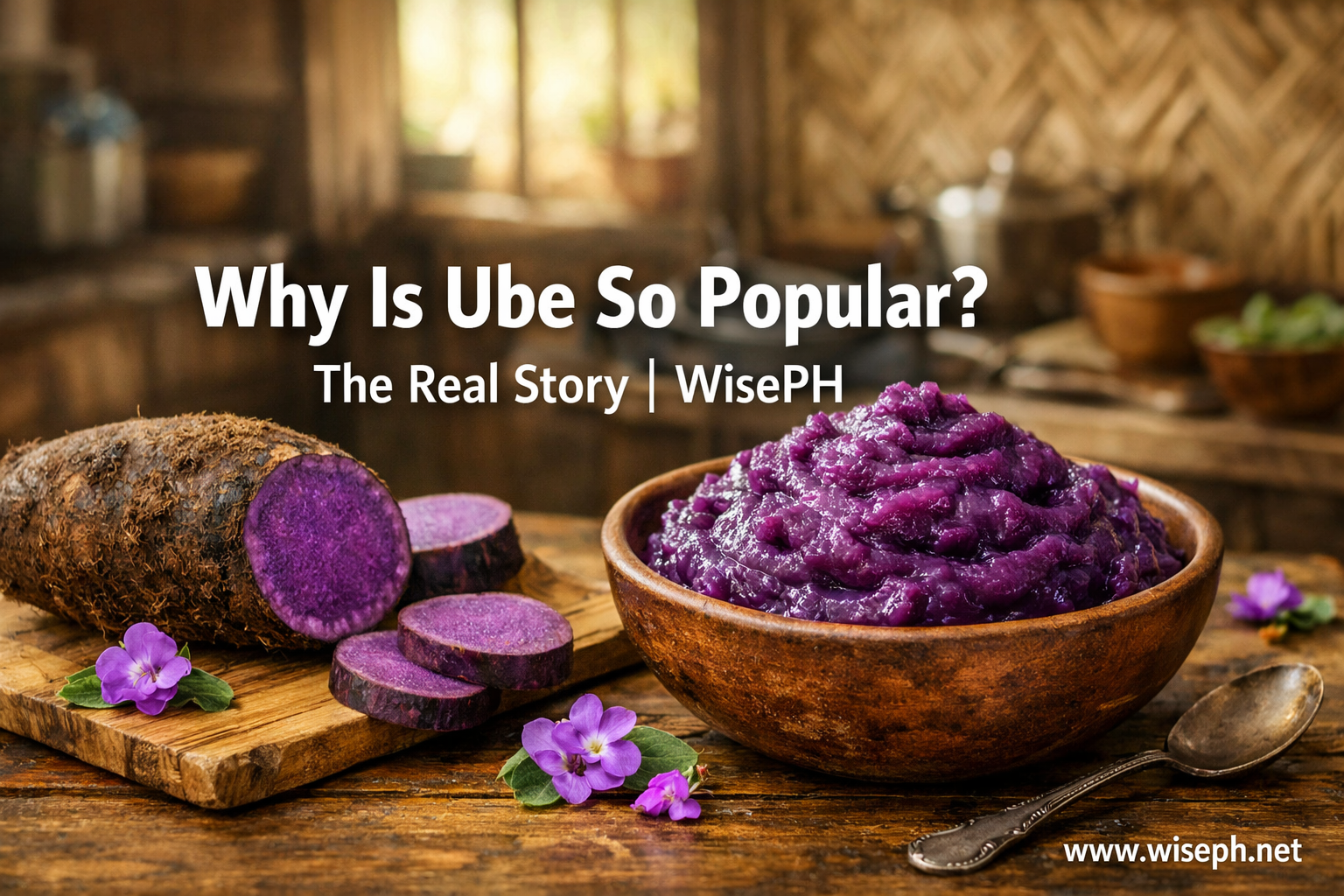
Standing in a muddy ube plot in Tarlac in early 2020, a farmer showed me his phone. His entire harvest was already spoken for by an exporter shipping to California. “Kuya Malik, they’re buying our powder like crazy,” he said.
That was the moment I knew ube had left the barrio for good.
I’ve been writing about Philippine agriculture and Filipino food for years. I’ve pulled ube tubers from the red clay in Batangas, steamed them the same afternoon, and watched lolas turn them into halaya while the whole kitchen filled with that vanilla-lavender scent. For most of that time, ube was just Tuesday dinner. A fiesta staple. A backyard root nobody thought to explain.
So why is ube suddenly so popular? Here’s the honest answer from someone who’s spent time in both the muddy fields and the kitchens.
What exactly is ube?
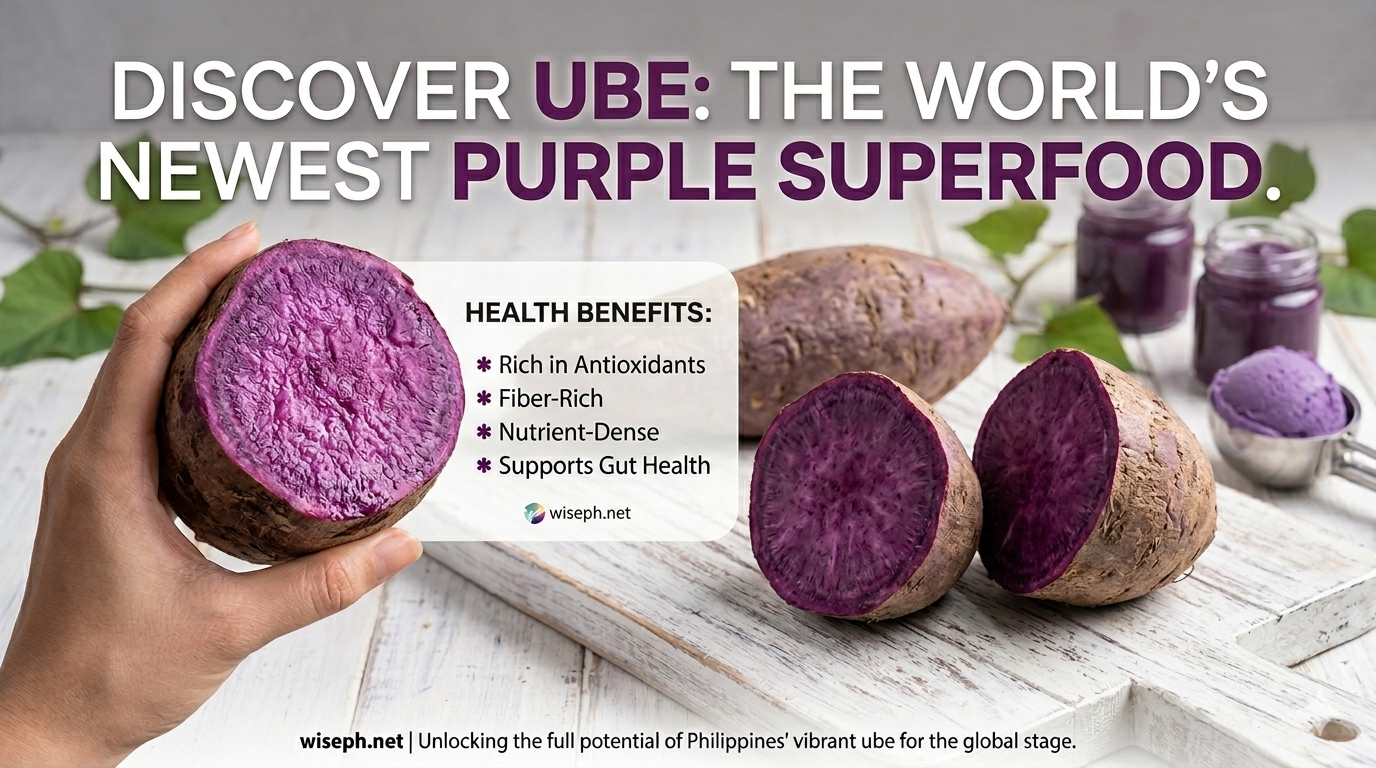
Ube (pronounced oo-beh) is a true yam (Dioscorea alata) native to the Philippines. The flesh is deep purple, the flavor subtly sweet with a quiet vanilla-floral note, and the halaya it makes is unlike anything else in the root world. It grows on climbing vines, hides deep in red clay soil, and takes 8 to 11 months to mature properly.
Filipinos have eaten it for centuries. Fiesta tables, birthday spreads, everyday merienda: ube halaya, ube ice cream, purple rice cakes. It was always there, always ours. What changed, however, is that the rest of the world finally showed up.
Ube vs taro vs purple sweet potato: why Filipinos cringe at the mix-up
These three are not the same plant. Calling taro “ube” in a bubble tea shop is the culinary equivalent of mixing up Tagalog and Thai (both Asian), and that’s where the similarity ends.
| Ube | Purple sweet potato | Taro | |
|---|---|---|---|
| Scientific family | Dioscoreaceae (true yam) | Morning glory family | Araceae (corm) |
| Flavor | Earthy-sweet, vanilla-floral | Candy-sweet, starchy | Nutty, neutral |
| Color when cooked | Deep, vibrant purple | Reddish-purple | Pale lavender-gray |
| Texture mashed | Silky, smooth | Can get fibrous | Sticky, gluey |
| Filipino use | Dessert staple | Not traditional | Laing, sinigang (savory) |
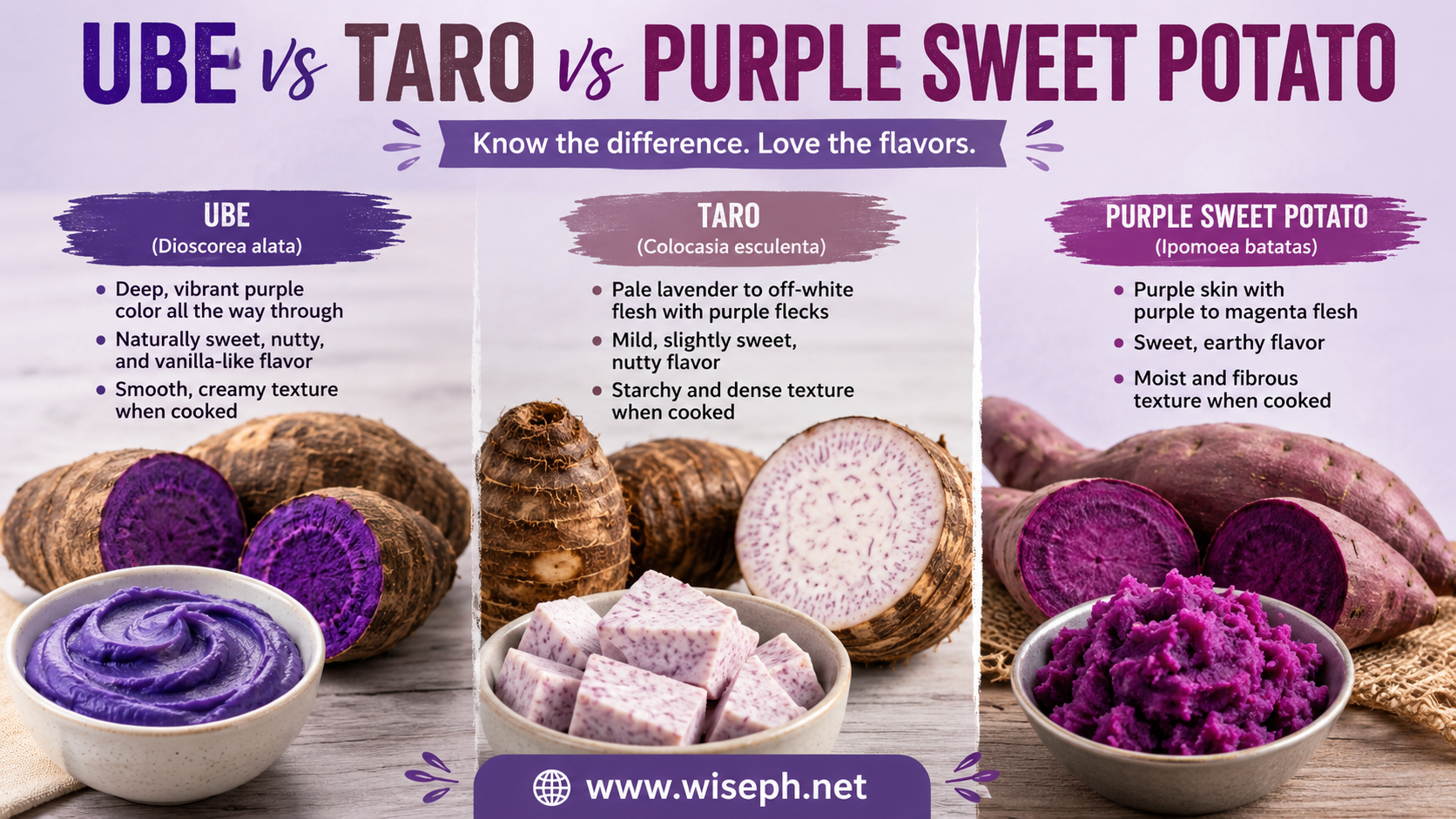
On the farm, you can’t confuse them if you actually grow them. Ube vines climb trellises in Batangas fields; the tubers are long and twisted, hiding deep in clay. Purple sweet potato crawls low like regular kamote. Taro grows in wet, almost swampy patches; it’s a corm, not a tuber, and the huge elephant-ear leaves look nothing like ube’s heart-shaped ones with the purple tint on the underside.
What Filipinos notice that foreigners miss
In the kitchen, the difference hits before you even taste. Steam real ube and the whole house fills with a soft, sweet, almost perfumed smell, like vanilla bean mixed with fresh earth. Purple sweet potato smells like a stronger, simpler sweet potato. In contrast, taro smells starchy and mild. Filipinos, in fact, catch it the second the pot lid lifts.
“Malapit pero hindi siya,” diaspora aunties in California say when they try the substitute. Close, but that’s not it.
The mix-up frustrates us because once you’ve had the real thing, the fake is a genuine letdown. A food blogger labeling a taro latte “ube” robs first-timers of the actual experience. Once they’ve been disappointed by the fake, it’s genuinely hard to win them back.
Ube vs Purple Sweet Potato vs Taro
How ube went from backyard staple to Starbucks menu
It was never one viral TikTok. Instead, it was a slow build that started in diaspora kitchens and snowballed because of that ridiculous purple color.
Filipino chefs and home bakers in LA, New York, and Sydney were quietly posting ube cheesecakes and ube pandesal through the early 2010s. Manila Social Club in Miami put a $100 gold-dusted ube donut on the menu around 2016. It got some buzz, but still mostly inside the community.
The first real signal to the wider market came in 2019. Trader Joe’s dropped their ube ice cream. Non-Filipinos started posting purple scoops with captions like “what is this magic?” The flavor, not just the color, did the rest.
The pandemic years (2020 to 2022) also poured gasoline on it. People stuck at home ordered ube powder online. Diaspora cooks posted ube brownies, ube cheese pandesal, even ube cocktails. The color also photographed better than anything else, far more striking than matcha. I remember seeing a woman in Texas declare ube ice cream better than vanilla because “it looked like unicorn food.” That was when the bridge crossed.
When the big chains noticed
By 2025 into 2026, big chains noticed. Starbucks rolled out ube coconut macchiatos across the US, with Costa Coffee following in the UK. Export orders doubled. It moved from specialty Filipino stores and indie cafes to high-street menus and Costco freezers.
The Filipino diaspora kept the real flavor alive for years. Social media made the color travel. Big brands packaged it for people who’d never heard the name. All three had to happen in that order.
Filipino food culture had been building global curiosity for years through dishes like lechon baboy and Pampanga sisig. Ube became the ingredient that broke through first because the color travels better on a screen than any other Filipino flavor. That combination is also why ube is so popular in markets that had barely heard of it five years ago.
The numbers behind the purple boom
The global ube market hit $455.3 million in 2024 and is forecast to reach $943.6 million by 2035 at a 6.9% compound annual growth rate, according to Transparency Market Research. That’s not fad math. That’s infrastructure building.
| Year | Philippine Exports | Volume |
|---|---|---|
| 2024 | ~$2.5M (estimated) | ~1.4M kg |
| 2025 | $3.06–3.2M | 1.7M kg |
| Year-on-year change | +20% | n/a |
The US takes roughly half, about $1.6 million in 2025. Canada, Australia, and the UK follow as well. Restaurant menu mentions in the US also grew over 230% in four years. So when Starbucks and major chains add ube items, it isn’t a coincidence. The ingredient converts curious first-timers into repeat buyers, and the data shows it. Numbers like these explain why ube is so popular with global buyers and not just a one-season trend.
Global Ube Market Growth
USD millions, 6.9% CAGR
2024
2035 (forecast)
Source: Transparency Market Research, 2024
The fake ube problem nobody talks about
A lot of what gets sold as “ube,” however, is not real ube. Since 2023, when the hype peaked, a flood of products entered the market using purple sweet potato (camote) mislabeled as ube, or real ube so diluted with artificial extract, sugar, maltodextrin, and food dye that the original plant barely shows up.
I’ve seen small exporters admit in group chats that they’ve blended 70% camote with 30% real ube powder just to hit price points for US distributors. The economics make sense. Purple sweet potato grows faster, ships cheaper, and gives that screaming Instagram purple without the complexity. Mix in some lab-made aromatics and sugar, and you’ve got something that looks “ube” to anyone who’s never tasted the real thing.
Serious complaints started reaching me in late 2022 from farmers in Batangas and Quezon. One kuya who ships to California lost a contract because “the color wasn’t purple enough and the flavor was too mild.” His cheaper competitor was using camote powder. Diaspora bakers were messaging me photos of ingredient lists by 2024: “natural flavors,” “ube extract,” zero actual yam listed.
The damage is real. A non-Filipino tries a chain version made with synthetic flavor and posts “this is overhyped and too sweet.” Someone who grew up with real fiesta ube reads that and thinks the trend is ruining our food. Meanwhile, farmers with actual Dioscorea alata are left explaining why their price can’t drop to match the imposters.
How to spot the fake: look for “Dioscorea alata” on the label, not just “ube extract” or “ube flavor.” Filipino-owned brands that trace back to Philippine farms are, in my experience, the safest source.
The farmers growing the real thing, and what they actually earn
Filipino farmers I know are proud ube finally has a global stage. Most of them, though, also carry a quiet resentment.
Last month I was outside Lipa, Batangas with a farmer who’s been growing ube on the same red-clay hillside since the early 2000s. Export brokers call every harvest now. His farmgate price per kilo, however, hasn’t moved in five years. Some harvests actually pay less than before.
“Kami pa rin ang gutom sa presyo,” he told me, wiping sweat. We’re still the ones starving on the price.
In fact, national production dropped from over 15,000 metric tons in 2021 to around 12,483 in 2025. Typhoons disrupt harvests. Planting material is also harder to source. Meanwhile, some exporters are quietly importing ube from Vietnam and China to fill orders, even as domestic farmers struggle to get fair prices.
A halaya family in Quezon that has made pure ube jam for three generations now watches their jars appear in overseas specialty stores at five times what they were paid. “Tapos sila ang may pera,” one auntie told me. And they’re the ones with the money.
Ube isn’t the only crop where this happens. The same pattern runs through calamansi farming, hito farming, and agarwood cultivation; Filipino producers grow and process, but someone else captures the markup. Some cooperatives doing direct-to-exporter deals are doing better. However, it’s still the exception.
Is ube actually good for you?
The short answer: yes, in a real and honest way. Not in the way influencers market it, though.
Real ube contains about 38 milligrams of anthocyanins per 100 grams, the same class of antioxidants found in blueberries and purple cabbage. The specific types in Dioscorea alata (cyanidin and peonidin, often acylated) are more stable than most and survive cooking better than the anthocyanins in other purple foods. Research published on PubMed Central shows antioxidant and anti-inflammatory activity from Dioscorea alata anthocyanins in animal studies.
Beyond the pigment, ube also provides 4.1 grams of fiber per 100 grams, decent potassium and vitamin C, and a lower glycemic index than white yam or regular sweet potato. The resistant starch slows glucose absorption. Our lolas always said purple foods “clean the blood.” Modern lab work backs the antioxidant part well.
The honest caveat: most large-scale human clinical trials on eating whole ube daily are still limited. Processing and baking degrades a good chunk of those compounds. Many commercial ube products contain so little actual yam that the health angle is basically decorative. A purple donut won’t cure anything. But the real ingredient is genuinely nutritious (fiber, antioxidants, lower glycemic index), and that’s worth protecting as the hype grows.
The best ube in the Philippines: Bohol’s Kinampay
Ask any serious halaya maker or premium exporter which ube they want and you get the same answer: Kinampay from Bohol.
Kinampay is a native Dioscorea alata variety grown around Panglao, Guindulman, and southwestern Bohol. The tubers are rounder, the flesh deeper purple, and the aroma noticeably stronger when steamed, with that vanilla-lavender whisper that makes good halaya smell like a memory. Boholanos call it sacred. It fed communities through wars and droughts long before ube was trending anywhere.
I’ve steamed Kinampay side by side with ordinary ube from other provinces. The difference, however, hits before the fork even touches it.
Strong runners-up worth knowing
Batangas and Quezon produce long, hefty tubers with balanced sweetness and great color from the red volcanic clay, so these are my regular stops when visiting farms. Pangasinan is also emerging fast, especially around Dagupan and Urdaneta, with younger farmers scaling up solid results. Mindoro and Zambales are known for vivid purple and specific shapes. Pampanga’s Aeta mountain farms give smaller yields but unique character from elevation and shade.
It’s a terroir story, similar to wine. Volcanic or red-clay soil with proper drainage also gives higher anthocyanin content and better natural oils that carry the aroma. So when you can source by variety or origin, chase Kinampay first. Your halaya will show the difference.
Other traditional Filipino specialties tell the same story about place and ingredients. For example, sinanglaw from Ilocos, Ilocano pakbet, Vigan longganisa, and dinakdakan are each tied to a specific soil, climate, and way of cooking that can’t be replicated anywhere else. Ube is no different.
Best Ube by Philippine Region
How to cook real ube for the first time
The single biggest mistake beginners make is treating ube like purple sweet potato, either swapping it outright or drowning it in sugar and artificial flavoring before the tuber has a chance to speak. That, in turn, kills the quiet vanilla-earthy soul of real Dioscorea alata before it even starts.
Start with the right ube
Look for fresh tubers at an Asian grocery, good-quality frozen grated ube, or pure Philippine powder labeled “100% Dioscorea alata.” If the label says only “ube extract” or “ube flavor,” that’s lab-made aromatics, not the real root. Bohol Kinampay, Batangas, or Quezon origin on the packaging is a good sign.
Steam, never boil
First, cut into even chunks and steam for 30 to 45 minutes until a fork slides in easily. Boiling waterlogs the starch and washes away the signature aroma, so steam is the only right method here. Steam keeps the starch intact and the color deep.
Grate while warm, taste it plain first
While still warm, peel and grate the ube finely (like a cheese grater) or mash it gently. The warmth releases the natural oils and that soft vanilla-lavender note. Then taste a spoonful plain, maybe with just a pinch of sugar. This is real ube before anything else gets in the way. It should surprise you.
Build the halaya slowly
Finally, cook the grated ube in a wide pan with condensed milk and a little coconut milk, stirring constantly on medium-low until it thickens and pulls from the sides. Old recipes use very little added sugar because the tuber already carries natural sweetness. Rushing it gives you candy. Patience gives you halaya.
How to Make Real Ube Halaya
Steam
30-45 min, never boil
Grate warm
Releases natural oils
Taste plain first
Before adding sugar
Slow-cook halaya
Patience over candy
Do this once and you’ll understand why we’ve loved this root for generations. No amount of food coloring or extract can fake the smell that fills the kitchen when real ube steams properly. The purple catches your eye. The flavor is why you keep coming back.
Conclusion
You now know why ube is so popular. The world found it through Instagram and Starbucks menus. But none of that would have stuck without the actual flavor behind the color.
The real story starts in muddy fields in Batangas and Bohol, where farmers pull tubers from red clay and lolas make halaya the same afternoon, the whole kitchen smelling like vanilla and warm earth. That’s where ube comes from. Every latte and donut claiming its name is reaching back to those fields.
If you’re here because of a TikTok scroll or a purple latte, welcome. Now go find the real thing. Buy from honest suppliers. Then make a small batch of halaya from scratch at least once. That’s when you’ll understand what we’ve known all along.
Maraming salamat for reading this far. The farmers in Tarlac, Batangas, and Bohol are quietly hoping you take that next step.
Frequently asked questions about ube
What does ube taste like?
Ube has a subtly sweet, earthy flavor with a quiet vanilla-lavender note. It’s not aggressively sweet like purple sweet potato. Steamed and plain, it sits somewhere between vanilla, a hint of pistachio, and clean earth.
Is ube the same as taro?
No. Ube (Dioscorea alata) is a true yam from a completely different plant family than taro (Colocasia esculenta). Taro is a corm with a neutral-nutty flavor that gets gluey when mashed. Raw taro also contains calcium oxalate crystals that cause throat irritation if undercooked. Ube has neither of those issues.
Why is ube purple?
The deep purple color comes from anthocyanins, specifically acylated cyanidin and peonidin. These are the same class of antioxidants in blueberries, but the version in Dioscorea alata is more stable, meaning the color holds better through cooking and baking than most other purple foods.
Where can I buy real ube outside the Philippines?
Asian grocery stores carry frozen grated ube and sometimes fresh tubers. For powder, look for Philippine-origin products labeled “100% Dioscorea alata” with no fillers. Filipino-owned brands and online specialty stores are more reliable than generic supermarket house brands. If the ingredient list shows “ube extract” before actual yam, keep looking.
Is ube healthier than regular sweet potato?
In some ways, yes. Ube has a lower glycemic index, more anthocyanins (about 38mg per 100g), and fiber that slows glucose absorption. The caveat: most commercial ube products contain very little actual ube, so the health benefit gets buried under sugar and processing. Eat the real thing to get the real benefit.