

I get a lot of reader questions about TESDA in general: is it better than college, what does an NC actually mean, will an employer take it seriously. I covered all of that in our main TESDA guide. But one question keeps coming up on its own: what exactly is the TESDA Online Program, and is it really as free as people say?
I have not personally taken a TOP course. I want to be upfront about that. What I do have is a stack of real questions from readers, many of them fresh high school graduates weighing TESDA against college. So I went straight to TESDA’s own rules to answer them honestly, instead of repeating whatever a random Facebook post claims.
What is the TESDA Online Program?
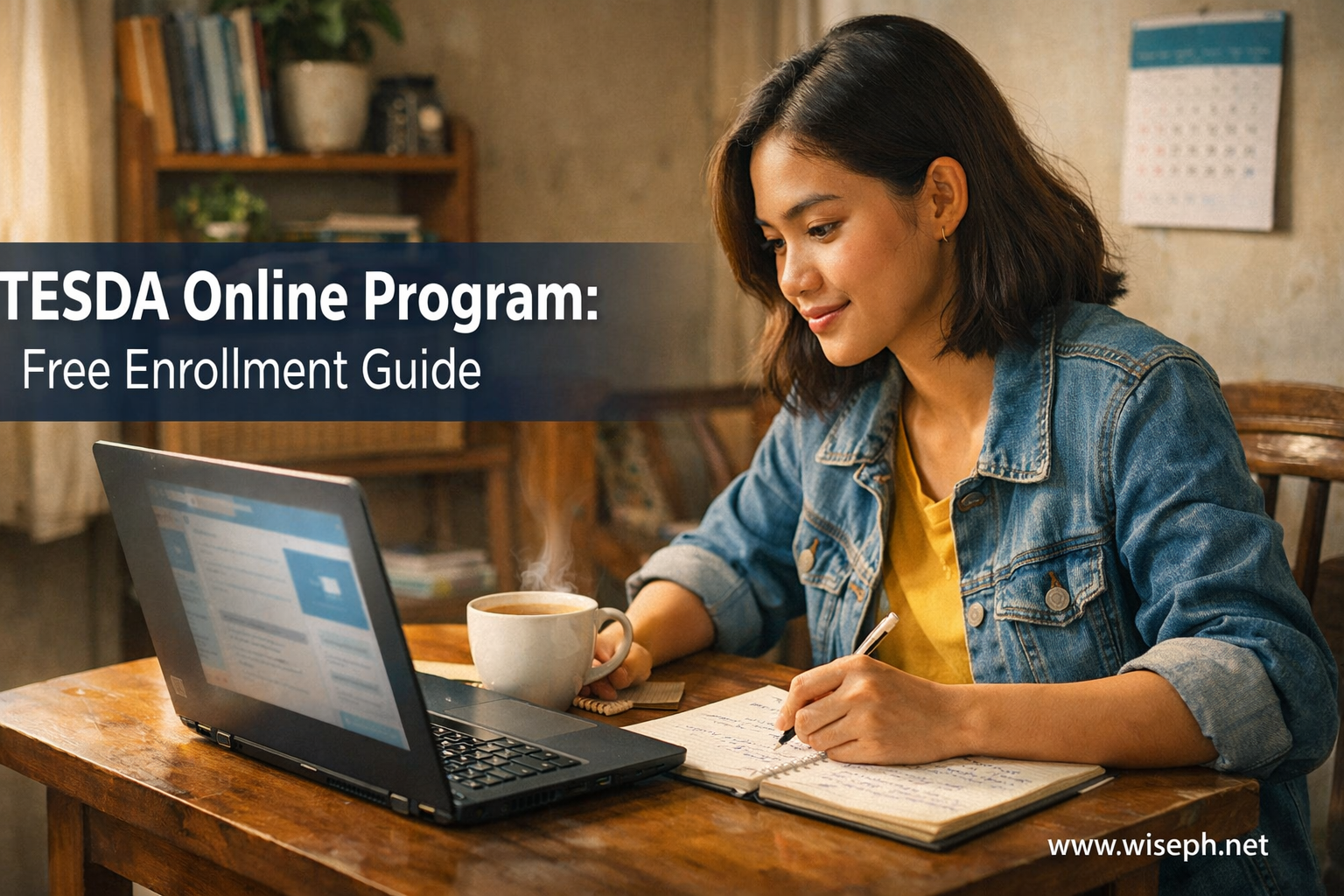
The TESDA Online Program (TOP) is a free e-learning platform run by TESDA at e-tesda.gov.ph. It offers over 150 self-paced courses covering ICT, agriculture, tourism, healthcare, construction, and entrepreneurship. Anyone with an email and internet connection can sign up.
TOP was built for people who cannot attend a physical training center every day, whether because of distance, work schedule, or family responsibilities. You watch video lessons, answer quizzes, and finish everything on your own time. There is no instructor watching over your shoulder and no classroom to show up to.
That flexibility is the whole appeal. It is also, as you will see below, exactly why it has limits.
Is TOP really 100% free, even the assessment?
The TOP course itself costs nothing. Registration, video lessons, and quizzes are all free. What is not free, in most cases, is the face-to-face competency assessment you need afterward to earn an actual National Certificate.
| Step | Free? | What you get |
|---|---|---|
| TOP registration and course modules | Yes | Access to lessons and quizzes |
| Pre-test, post-test, satisfaction survey | Yes | Required to unlock your certificate |
| Certificate of Completion | Yes | Digital e-certificate, proves you finished TOP |
| Face-to-face competency assessment | Usually no | Access to earn an NC II or NC III |
| National Certificate (NC) | No, unless subsidized | Official TESDA credential employers ask for |
Assessment fees depend on the qualification. Expect roughly ₱400 to ₱1,000 for courses like Bread and Pastry Production or basic caregiving-related assessments. Trades like Electrical Installation or Cookery usually run ₱1,000 to ₱2,000. Technical fields like Shielded Metal Arc Welding (SMAW) can reach ₱2,000 to ₱3,000 or more.
There are occasional free assessment slots for Senior High School TVL graduates or specific scholarship batches, but these are not automatic. If your only goal is learning a skill for your own use or padding your resume, TOP genuinely costs you nothing. If your goal is the actual NC, budget for the assessment separately.
How do you enroll in TOP, step by step?
Enrollment takes about 15 to 20 minutes of setup, then it is entirely on your own schedule. Here is the process:
- First, go to the official TESDA Online Program portal and click sign up.
- Then, fill out your learner profile with a working, active email address you check often. This matters more than it sounds; more on that below.
- After that, wait 10 to 15 minutes for a confirmation email, then click the activation link.
- Once you are logged in, browse the course catalog and pick one course to start. Juggling too many at once tends to backfire.
- Next, complete the pre-test, which gauges your starting knowledge for that course.
- From there, work through the video lessons and unit quizzes at your own pace.
- When you are done, finish the post-test and the short satisfaction survey.
- Finally, return to your dashboard, open the completed course, and download your Certificate of Completion.
You will also want a valid ID on hand for later. You will need one if you eventually book a paid assessment. If you do not have one yet, our guide on how to apply for a postal ID walks through the cheapest option most students use.
Certificate of Completion vs. National Certificate: what’s actually different?
A TOP Certificate of Completion proves you finished the online modules. A National Certificate (NC II or NC III) proves you passed a hands-on competency assessment. Employers, especially abroad, almost always ask for the NC, not the completion certificate.
| Certificate of Completion | National Certificate (NC) | |
|---|---|---|
| How you earn it | Finish TOP lessons and quizzes | Pass a face-to-face skills assessment |
| Cost | Free | Assessment fee applies (₱400 to ₱3,000+) |
| What it proves | You studied the theory | You can perform the actual skill |
| Accepted by most employers abroad | Rarely on its own | Yes |
This is the mix-up I have to correct the most. People finish the online course and assume that’s the NC sorted. It isn’t. Think of TOP as the theory half of the equation and the assessment as the half that actually counts on paper. If you already hold or are pursuing a professional license, our explainer on what a PRC license actually covers shows how that credential path differs from a TESDA NC.
Can you use a TOP certificate to apply for jobs abroad?
Not on its own. Most recruitment agencies and employers abroad require a TESDA National Certificate, not just a TOP Certificate of Completion. Treat TOP as preparation, and schedule the paid assessment afterward if working abroad is the actual goal.
If you are already abroad or cannot attend physical classes, TOP is still useful for learning the basics. You can fly home for an assessment later, or look into local training options once you land a job. Readers headed that direction should also check our guides on SSS coverage for OFWs and Philippine passport requirements. Both come up right after the TESDA question in most reader messages I get.
Which TOP courses are worth your time, and which feel like filler?
That depends entirely on what you plan to do after finishing. Courses tied to a full National Certificate qualification tend to hold real value. Broad, generic modules without a clear NC path tend to be filler.
Worth prioritizing
Based on local and overseas demand:
- Caregiving NC II, still one of the strongest for overseas work
- Electrical Installation and Maintenance NC II
- Shielded Metal Arc Welding (SMAW) NC II
- Automotive Servicing NC II
- Refrigeration and Air-Conditioning Servicing NC II
- Computer Systems Servicing NC II, especially when paired with basic troubleshooting practice
Lower priority
Meanwhile, unless you have a specific plan for them:
- Very generic digital literacy or entry-level entrepreneurship modules
- Courses with no full NC qualification attached
- Oversaturated fields like basic housekeeping or cookery, unless you are specifically aiming at hotel or cruise ship work
Before picking a course, ask yourself the same question I ask readers: what is your plan after this, a local job, working abroad, or just an extra skill? The answer should decide which course you pick, not the other way around.
How long does a course take, and can you enroll in more than one at once?
Most TOP courses take one to four weeks if you study consistently. There is no strict limit on how many courses you can enroll in, though starting with one or two keeps you from losing momentum on all of them.
| Course type | Estimated content hours | Realistic time to finish |
|---|---|---|
| Short or basic courses | 8 to 20 hours | 3 to 10 days |
| Average or medium courses | 20 to 40 hours | 2 to 4 weeks |
| Longer, comprehensive courses | 40+ hours | 4 to 8 weeks |
There is also no minimum age or education requirement. You can sign up whether you are still in high school, never finished high school, or are a senior citizen looking to pick up a new skill. All you need is an email, a device, and an internet connection.
Common TOP technical problems and how to avoid losing your certificate
TOP is still fairly glitchy in 2026, even after moving to better cloud hosting. The single biggest mistake readers make is registering with a throwaway or rarely used email. Lose access to that inbox, and you lose your certificate for good.
| Issue | How common | What it means for you |
|---|---|---|
| Slow loading, especially on the mobile app | Very common | Use a laptop or desktop browser instead when you can |
| Timeouts and “attempt still in process” errors | Very common | Refresh and retry rather than resubmitting repeatedly |
| Website and app showing different progress | Common | Stick to one platform for a given course |
| Activation email delayed or missing | Common | Check spam, wait it out before creating a duplicate account |
| Progress not saving properly | Occasional | Save often, do not rely on auto-save near a deadline |
The email mistake deserves its own warning. Readers finish a course, then go to download the certificate and cannot log back in. The password reset link goes to an email they abandoned months ago. Account recovery on TOP is nowhere near as smooth as Google or Facebook. Use the email address you actually check, not a random one you created just to sign up.
TOP vs. Coursera or Udemy vs. a physical training center: which fits you?
TOP wins on cost because it is completely free, but it loses on production quality and platform reliability compared to Coursera or Udemy. For hands-on trades, none of the three beat an actual physical TESDA training center.
| TOP | Coursera / Udemy | Physical training center | |
|---|---|---|---|
| Cost | Free | ₱400 to paid tiers | Varies, sometimes free via scholarship |
| Video and course quality | Basic, sometimes dated | Higher production value | Hands-on, not video-based |
| Best for | Zero-budget theory learning | Digital skills like design or bookkeeping | Trades needing real practice |
| Leads to an NC on its own | No | No | Usually paired with assessment |
Skip TOP entirely and go straight to a physical training center if your target skill is highly hands-on, such as welding, electrical work, automotive servicing, or caregiving. Videos cannot substitute for handling real tools and equipment, and most employers abroad prefer candidates who trained in an actual workshop. Physical training also tends to prepare you better for the face-to-face assessment you will need regardless.
For purely theoretical or digital skills, like basic bookkeeping or introductory graphic design, TOP or a good Udemy course both work. The practical move for most readers: use TOP for the theory side, then pursue physical training or assessment for the skill that actually needs certifying.
Once you land that first job, whether local or abroad, a few other things become relevant fast. Our guide on getting an SSS number online covers one of the first steps. Our piece on the First-Time Jobseekers Assistance Act covers another. And once you start earning, opening something like an MP2 savings account or picking your first beginner credit card are the next logical steps.
Frequently asked questions
Is the TESDA Online Program really free, even the assessment?
The online course itself is completely free. But the face-to-face competency assessment that gets you an actual National Certificate usually costs between ₱400 and ₱3,000 or more, depending on the qualification.
Kung online lang, valid ba talaga ang certificate? Tinatanggap ba ng employer?
A TOP Certificate of Completion is valid proof you finished the training, but most employers, especially agencies hiring for overseas work, ask for a National Certificate instead. You need the paid assessment to get that.
Pag natapos ko ang course sa TOP, kailangan ko pa bang pumunta sa training center para mag-assessment?
Yes, if your goal is an actual NC. Finishing TOP only earns you a Certificate of Completion, so the NC still requires a separate face-to-face assessment at a TESDA-accredited center.
May limit ba sa dami ng courses na pwedeng kunin sa TESDA Online?
No strict limit exists. You can enroll in as many courses as you want, though starting with one or two at a time helps you actually finish them.
Can I use a TOP certificate to apply for jobs abroad?
Not by itself in most cases. Recruitment agencies and employers abroad typically require a National Certificate. Use TOP to prepare, then schedule the paid assessment if working abroad is your goal.
If you want the fuller picture, including what an NC I through NC IV actually means, which scholarships can cover training costs, and whether TESDA is worth it compared to college, our complete guide on what TESDA is and how it works covers all of that in depth.