

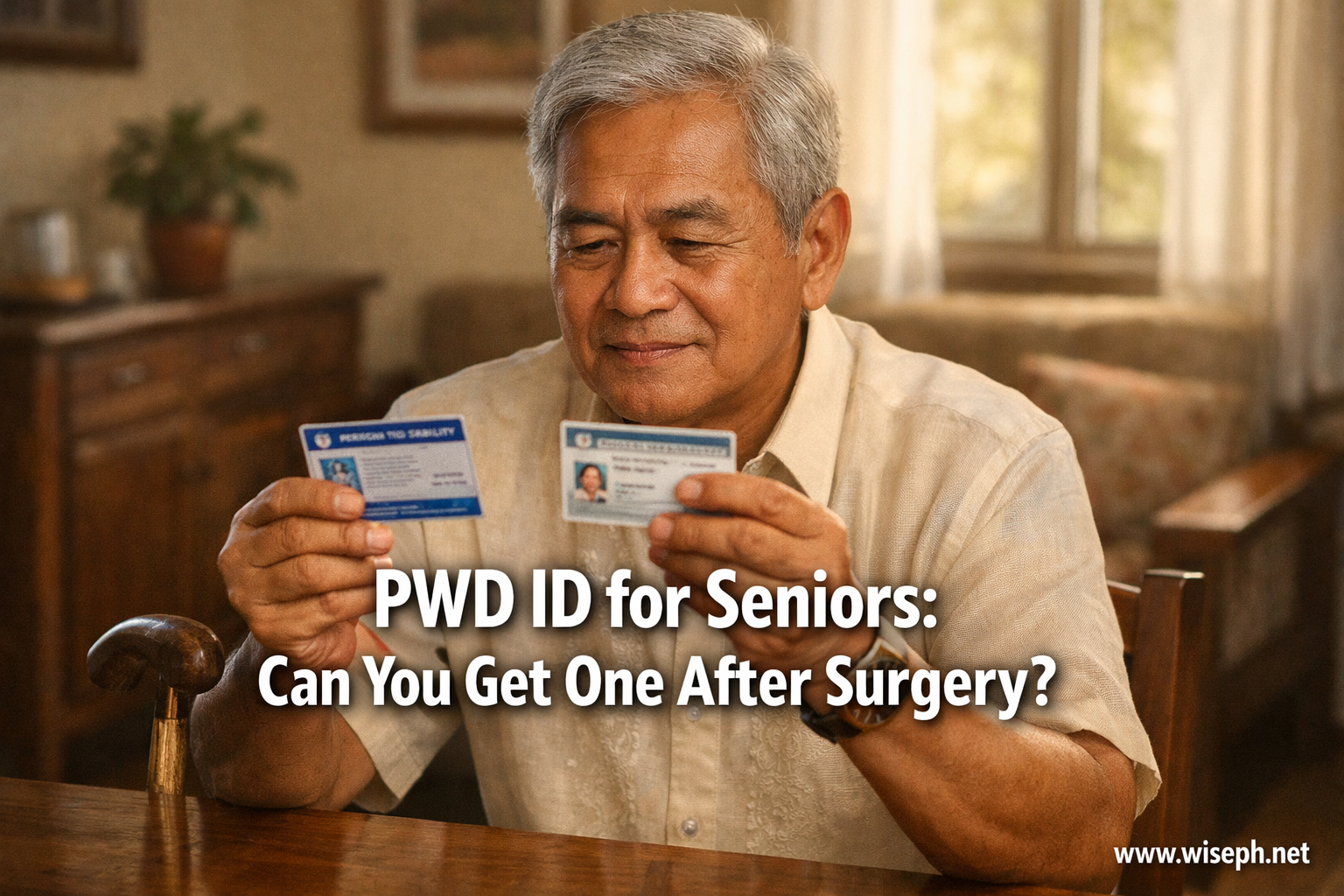
A family friend called after his spinal surgery. He was in his late 60s, still using a walker, and couldn’t bathe or dress without help. Someone told him that people with lasting mobility problems after surgery might qualify for a PWD ID. He had two questions: does he qualify, and can he stack the two discounts for a bigger savings?
Getting a PWD ID for seniors is possible, but the rules around both questions are clearer than most posts online make them. The operation alone does not qualify you. The discount stacking is not allowed. And the one thing that determines whether you go home approved or rejected has nothing to do with how serious your surgery was.
What actually happened when he applied is worth knowing before you go.
Can a senior citizen get a PWD ID in the Philippines?
Yes. A senior citizen can hold both a Senior Citizen ID and a PWD ID. There is no rule that prevents it.
However, age and surgery alone do not qualify you. What matters is whether the condition causes lasting limitations in daily activities: walking, standing, bathing, or getting around without help. That limitation has to be documented by the right specialist in the right kind of certificate.
Two laws set the framework: RA 7277 (Magna Carta for Disabled Persons, as amended by RA 9442) and NCDA Administrative Order No. 001 (Series of 2008, updated 2021). Together, they explicitly cover “persons suffering from disabling diseases resulting in limitations to do day to day activities as normally as possible.” This includes dialysis patients, heart patients, severe cancer cases, and others with conditions causing temporary or permanent disability.
| Senior Citizen ID | PWD ID | |
|---|---|---|
| Can you hold both? | Yes | Yes |
| Age requirement | 60 and above | None |
| Based on | Age | Disability |
| 20% discount | Yes | Yes (plus VAT exemption) |
| Can be stacked? | No (one discount per transaction) | |
Which operations and conditions actually qualify?
In practice, the operation itself is not what the MSWDO evaluates. The question is whether the resulting condition causes significant, lasting limitations in daily activities, and whether your doctor can clearly describe those limitations on paper.
| Condition / Operation | Category | Likely to qualify? | Key factor |
|---|---|---|---|
| Amputation (leg, foot, arm) | Orthopedic | Very high | Loss of limb = clear limitation |
| Stroke with residual effects | Physical | High | One-sided weakness, mobility loss |
| Cancer (active or survivor) | Chronic Illness | High | Protected under RA 11215 |
| Kidney dialysis / CKD Stage 5 | Chronic Illness | High | Severe daily limitation |
| Spinal surgery with implants | Orthopedic | Medium-High | Depends on functional impact |
| Hip or knee replacement | Orthopedic | Medium | Only if mobility is still significantly affected |
| Heart bypass / valve surgery | Chronic Illness | Medium | Needs proof of ongoing severe limitation |
| Routine surgery with full recovery | N/A | Unlikely | No lasting functional limitation |
Also, cancer patients get extra legal protection. RA 11215 (National Integrated Cancer Control Act) explicitly declares cancer patients, survivors, and persons living with cancer as PWDs under RA 7277. So for all other conditions, the quality of the medical certificate is what drives the outcome.
A real case: spinal surgery, two bone implants, and a walker
The family friend I mentioned is a gentleman from our area (late 60s, retired, living in CALABARZON with his wife). He went through major spinal surgery for osteomyelitis, a serious bone infection that spread to his vertebrae. Treatment required spinal fusion with two bone implants. Two to three months after the operation, he was still using a walker. He couldn’t sit or stand for long periods, and his wife had to help him bathe and dress.
His monthly medicine bill ran ₱4,500 to ₱6,000 during those first few months: Tramadol, Celecoxib, muscle relaxants, antibiotics, plus wound care supplies. Regular Grab rides to the hospital for follow-ups also added to the cost. As a result, he raised the PWD ID question because someone told him the 20% discount might help ease the burden.
What happened when he applied
When he went to the MSWDO, the staff asked: “Sir, may Senior Citizen ID na po kayo, kailangan pa ba talaga ng PWD ID?”
Not hostile, just a routine check. They seemed to assume the Senior Citizen ID was already enough. He explained the situation and showed his medical certificate from his orthopedic surgeon. The certificate described the implants, the infection history, and how the condition limited his ability to walk and care for himself. The staff processed his application without further questions.
As a result, he was approved the same day.
So over the next six months, the 20% discount on medicines and wound care saved him roughly ₱8,000 to ₱10,000. It didn’t erase his medical debt. But it reduced the monthly pressure during the hardest part of his recovery, and that mattered.
The PWD ID was one layer of financial help. For hospital bills, he also used his PhilHealth hospital coverage. If you are still contributing voluntarily, check whether you can also claim an SSS sickness benefit during recovery; both can layer on top of what the PWD ID covers.
Can you combine the senior discount and the PWD discount?
No. You cannot stack both discounts on the same purchase to reach 40%.
RA 10754 gives PWDs a 20% discount and VAT exemption. RA 9994 (Expanded Senior Citizens Act) gives seniors the same 20%. Neither law allows double discounting on a single transaction. The maximum per purchase is 20%, no matter how many qualifying IDs you carry.
When he tried to use both IDs at a pharmacy, the manager explained it clearly:
“Sorry po sir, pero ayon po sa batas, kapag may Senior Citizen ID at PWD ID, isa lang po ang pwedeng gamitin sa isang transaction. Hindi po pwedeng pagsabayin para maging 40%.”
At a grocery store, the cashier was friendly about it and suggested he rotate which ID he used depending on the purchase. That is actually good advice. Having both IDs gives you flexibility, since some establishments apply the rules slightly differently depending on which ID you show.
| What you can do | What you cannot do |
|---|---|
| Hold both a Senior Citizen ID and a PWD ID | Use both IDs on the same transaction |
| Choose which ID to use per purchase | Combine discounts for 40% off |
| Use your Senior ID one day, PWD ID the next | Split one purchase across two receipts to apply both |
So for a full breakdown of where and how the PWD discount is applied across pharmacies, hospitals, transport, and other establishments, see the PWD ID benefits and discounts guide.
The one document that determines approval or rejection
A medical certificate from your doctor is required. But most seniors arrive at the MSWDO with the wrong kind, and get sent home.
The certificate must describe your functional limitations, not just your surgical history. Many MSWDO offices will not approve a PWD ID based on a document that only records what procedure you had. They need to see how the condition affects daily life.
What “status post surgery” gets you rejected
A certificate that says “Patient underwent spinal surgery with implants for osteomyelitis” tells the MSWDO what happened in the operating room. It says nothing about how the patient gets through the day. That is often not enough for approval.
Common versions that get sent back:
- “Patient has hypertension and heart disease.”
- “Post-chemotherapy for breast cancer.”
- “Patient is recovering from hip replacement surgery.”
Starting points, not disability certificates. Without functional limitations described, the MSWDO sends you back to get better documentation, sometimes the same day you showed up.
What the certificate should actually say
In contrast, a proper Certificate of Disability from your specialist needs these five elements:
- Your specific diagnosis, the procedure, and any implants or devices used
- The disability category (such as Orthopedic Disability or Chronic Illness Disability)
- Functional limitations in clear, daily-life terms: “Patient has difficulty walking more than 10 meters without assistance due to spinal instability and chronic pain post-surgery”
- Expected duration of the limitations (temporary or long-term)
- Doctor’s full name, PRC license number, and specialization
That phrase about “10 meters without assistance” is the kind of specific language MSWDO staff look for. It is the difference between approval and being sent back. Ask your surgeon specifically for a Certificate of Disability, not a medical abstract or prescription, and ask them to describe how your condition limits daily activities.
For a full checklist of every document the MSWDO reviews, the complete PWD ID application guide covers each requirement in detail.
How to apply for a PWD ID as a senior
Generally, the process is the same as any PWD ID application. However, for seniors with post-surgical conditions, the medical certificate is the part that needs the most preparation; everything else is straightforward once that document is ready.
Step 1: Get the right certificate first
Before going to the MSWDO, schedule an appointment with your specialist: orthopedic surgeon, neurologist, or oncologist (depending on your condition). Ask specifically for a Certificate of Disability focused on functional limitations. In fact, this is the step most seniors skip, and it is the reason most come home without the ID.
Step 2: Gather your documents
- Certificate of Disability from your specialist (not a prescription or surgical abstract)
- 2 pcs colored ID photos (1×1 or 2×2; confirm the required size with your MSWDO first)
- At least 2 valid government IDs (your Senior Citizen ID counts as one)
- Barangay Certificate of Residency (some LGUs require this; call ahead to check)
- PWD Registration Form (provided free at the MSWDO on the day of your visit)
Also, if your Senior Citizen ID is your only government-issued ID, the Postal ID is one of the fastest to obtain and is accepted at most MSWDO offices.
Step 3: Go to your local MSWDO or PDAO
Also, bring a family member if walking is difficult. Processing is usually done the same day when all documents are complete. Arrive early; some offices have a priority lane for seniors and PWDs.
If a staff member asks why you need both IDs, let the medical certificate explain it. A clear, detailed document from a specialist usually settles it fast.
While sorting out your MSWDO documents, also review the PhilHealth claim documents you may need for hospital reimbursements. The two processes often run at the same time. Also check the PhilHealth rules for senior citizens to confirm your coverage is active during recovery.
Where the PWD ID actually saves you money during recovery
The discount does not work equally everywhere. So here is the honest breakdown from real experience.
Most reliable
Mercury Drug and Watsons were the most consistent. The 20% discount plus VAT exemption on pain medications, antibiotics, muscle relaxants, and wound care supplies went through at most branches without hassle. Monthly savings ran ₱900 to ₱1,200. Over five to six months of active recovery, that adds up to ₱5,000 to ₱7,200.
Grab rides to hospital follow-ups also helped. Round trips that normally cost ₱450 to ₱550 dropped to ₱360 to ₱440 when the driver honored the discount. Not all drivers do; messaging before confirming the booking made it more likely to work.
Similarly, smaller private clinics and diagnostic labs usually gave the 20% discount on professional fees and some lab tests, which helped with bi-weekly check-ups and X-rays.
Less reliable
However, hospital pharmacies inside major chains were the biggest surprise (not in a good way). Some branches honored the discount; others needed manager approval or gave the runaround. One hospital chain was smooth at one branch and refused at another. Be ready to ask politely but firmly.
Similarly, SM Supermarket and Robinsons branches were hit or miss. Some gave the full discount without issues; others required manager approval or limited it to certain items. Not reliable enough to plan around.
As for online shopping, Lazada and Shopee almost never applied the PWD discount in practice. Do not count on it.
For a full list of where the discount is honored, the PWD ID benefits and discounts guide breaks it down by establishment type. Also check whether you have any unclaimed SSS sickness benefits you can layer alongside the PWD ID savings during recovery.
My honest take on the system
The law is good. The execution is not built for someone recovering at 65.
After a major operation, most seniors are already dealing with pain, limited mobility, and mounting bills. The system still expects them to figure out exactly what kind of certificate to ask for. They also have to go back to their doctor and guide them on how to write it properly, navigate different requirements across municipalities, and sometimes argue with staff just to get something they are legally entitled to.
I find that genuinely frustrating. But many seniors give up, not because they don’t qualify, but because they are in too much pain to keep pushing. These are people who worked for decades, paid into the system, and now have to fight for something that should be straightforward.
Some establishments also treat seniors like they are trying to game the system, when they are simply trying to afford their medicines and get to their next check-up.
Until the process gets easier, walking in prepared is what gets you through. If you are helping an elderly parent or relative apply, handle the Certificate of Disability step for them. That one action smooths everything else out.
If income stops during an extended recovery, an SSS retirement pension calculator can help you estimate your monthly support and plan around it.
Frequently asked questions about PWD ID for seniors
Can a senior citizen apply for a PWD ID in the Philippines?
Yes. A senior citizen can hold both a Senior Citizen ID and a PWD ID. The PWD ID is based on disability, not age. If a senior’s operation or illness results in lasting limitations in daily activities, they may qualify. Common categories are orthopedic, physical, and chronic illness disability.
Can I use both my Senior Citizen ID and PWD ID for a combined 40% discount?
No. Philippine law does not allow double discounting on a single transaction. You can hold both IDs and choose which to use per purchase, but the maximum discount on any one transaction is 20%.
What type of doctor should sign the Certificate of Disability?
It should be signed by the specialist who handles your condition. An orthopedic surgeon is the right choice for spinal surgery or hip replacement. A neurologist handles stroke cases, and an oncologist covers cancer. The doctor’s PRC license number must appear on the certificate.
Does the PWD ID expire?
The standard PWD ID is valid for three years. Some LGUs issue IDs with different validity periods depending on whether the disability is classified as permanent or temporary. Renewal usually requires lighter documentation than the initial application.
What happens if the MSWDO rejects my PWD ID application?
Ask for the specific reason. The most common cause is an incomplete or vague medical certificate. Go back to your specialist, request a more detailed Certificate of Disability that describes your functional limitations, and reapply. Most cases are resolved by improving the certificate alone.