

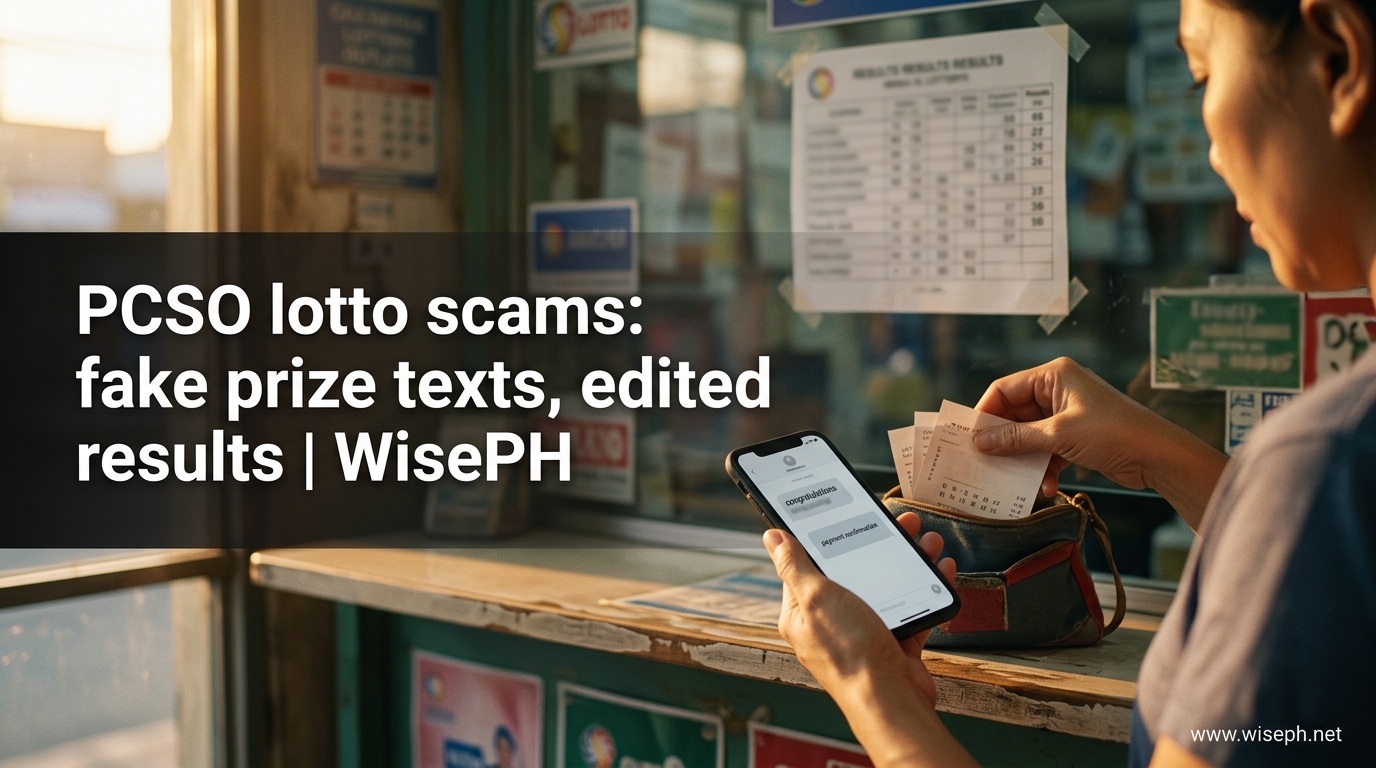
In 2025, a message landed on my cousin’s load page in CALABARZON. It first showed up as a comment under an ordinary promo post. Then came a direct message from an account using PCSO’s name and a logo that looked right at thumbnail size.
The message was short: “Congratulations, napili ang number ninyo sa Swertres. Premyo ₱25,000. I-claim sa link. Processing fee ₱500 para ma-release.” It gave no draw date that matched any ticket he had sold, and no ticket number. He did not reply. Instead, he screenshotted it and posted it in our sari-sari chat with one word: “huwag.”
One regular almost paid anyway. She had played the 5 PM draw that week, saw ₱25,000, and asked if the fee was “yung tax.” She already had GCash open. This page covers the two PCSO lotto scams we actually see, and the one check that stopped her.
Does PCSO message lotto winners?
You find out you won from your own ticket, not from a message. A real win shows up when you check the ticket you bought against the official draw result. PCSO has warned the public about fake social media pages that use its name and logo. It has also told people to get winning numbers from its official website, pcso.gov.ph.
- PCSO posts official results on its website, pcso.gov.ph.
- Since December 31, 2024, PCSO’s draws have aired on IBC-13, D8TV and DWAN 1206 AM. The official PCSO, IBC-13 and DWAN websites, Facebook pages and YouTube channels stream them live.
- Your outlet usually posts the latest results too. At ours, the teller tapes the printout on the glass.
So a surprise notice from a page or account adds nothing a real winner needs. In our experience, it has never been the prize. It has always been the ask.
How the “you won, pay the fee” PCSO lotto scam works
The pattern is always the same: amount first, fee second, logo on top. The fee changes names, though. Sometimes they call it tax. Other times it is a “processing fee,” and once we saw “ATM activation.” Only after you pay do they ask for more details.
The amount is chosen with care, too. ₱25,000 is small enough that ₱500 feels like a reasonable step, yet large enough to hurt if it were real. That is exactly why our regular paused with her finger over the GCash button.
My cousin’s answer to her was simple. PCSO does not collect a fee in advance. Also, you claim a ₱25,000 Swertres prize with the paper ticket at a PCSO branch, not through a link. Then she checked her slips. Nothing in her bag said ₱25,000, so she closed GCash. As far as I know, she never sent the ₱500.
How real PCSO prizes are claimed
Every real claim starts with the original paper ticket. For prizes of ₱10,000 or less, you can claim at any authorized lotto outlet. For larger prizes, you go to a PCSO branch with the ticket and a valid ID. Jackpot winners go to the PCSO main office in Mandaluyong City with two valid IDs. You have one year from the draw to claim.
- ₱10,000 or less: any authorized outlet, paid in full, with no tax.
- Above ₱10,000: PCSO branch, with the ticket and an ID. The 20% final tax comes off the prize at payout.
- Jackpots: PCSO main office in Mandaluyong City, with the ticket and two valid IDs.
Notice what is missing from that list: a link, a fee you send first, and a stranger who “releases” your prize. Because PCSO takes the tax out of the prize itself, you never need to pay anything up front. For the full process at each prize level, see our step-by-step guide to claiming PCSO prizes.
Fake and edited lotto results
The second scam we see costs time, not money, at least at first. In 2025, an edited 5 PM Swertres result went around our load chat. It showed 4-4-7, with the header cropped tight and the time stamp cut off. One regular had played that exact pair as a rambol, which pays ₱1,500 per ₱10 on a pares. For about ten minutes, he thought he had won.
Then he walked to the outlet. The teller’s copy on the glass said 4-7-2. When he held the two images side by side, he saw it: someone had typed a second 4 over the 7. Nobody had won with 4-4-7. Even so, the page that posted it had a PCSO-looking name and no outlet behind it. By evening, people were still sharing the graphic. Two other people asked if their tickets had hit before anyone looked at the glass.
How to check a result before you celebrate
Around our outlet, people trust the teller’s printout most, because the paper sits right beside their ticket. After that comes Facebook, then a YouTube live if the draw is still running. The Facebook page is the source that has been wrong, yet people still open it first. It has a familiar name, it posts fast, and sometimes it shows the numbers someone hoped to see.
So check three things before you celebrate. First, confirm the draw date and time match your ticket, since people often read a 2 PM result against a 5 PM ticket. Next, compare the numbers with the outlet’s copy or an official source. Finally, distrust any screenshot with a cropped header or a missing time stamp. Our PCSO lotto results hub posts every draw with its date and time, so you can line your ticket up against the full result.
Never post a photo of your ticket
After the 4-4-7 screenshot, two people asked our regular to send a photo of his slip “para ma-check.” He posted it in the chat before he had even compared it with the glass. That ticket lost, so no harm came of it. However, he should not have sent it. The original paper is your claim. A picture of it in a group thread is how that claim leaves your hands before you reach an outlet or branch.
Got one of these messages? What to do
Do not pay, do not click the link, and do not send a photo of any ticket. Check whether you hold a ticket that matches the official result. If you do not, close the message. Already sent money through an e-wallet? Keep the reference number. Then report it to your e-wallet and to the CICC hotline, 1326, which runs 24/7.
Also report the page or account to the platform where it appeared. After that, warn your group chat, the way my cousin did with his one-word post. If the message offered to place bets for you through GCash, that is a different scam with its own red flags. We cover it in our guide to betting PCSO lotto online and fake lotto agents.
Frequently asked questions
Does PCSO text or message lotto winners?
You find out you won by checking your own ticket against the official draw result. PCSO has warned the public about fake social media pages using its name and logo, and it tells people to get winning numbers from its official website, pcso.gov.ph.
Do I need to pay a fee to claim a PCSO prize?
No. Any authorized outlet pays prizes of ₱10,000 or less in full. For larger prizes, PCSO takes the 20% final tax out of the prize at payout. So there is nothing to pay in advance. Any message asking for a processing fee, tax or activation fee first is a scam.
Where can I check official PCSO lotto results?
PCSO posts official results on pcso.gov.ph, and its draws air on IBC-13, D8TV and DWAN 1206 AM with livestreams on official channels. You can also compare your ticket with the outlet’s posted copy. The WisePH lotto hub at lotto.wiseph.net also lists every draw with its date and time.
How do I spot an edited lotto result screenshot?
Look for a cropped header, a missing date or time stamp, and a page with no real outlet behind it. Then compare the numbers with an official source or the outlet’s copy before you assume you won.
Where do I report a PCSO lotto scam?
If you lost money through an e-wallet, keep the reference number and report it to your e-wallet and to the CICC hotline 1326, which runs 24/7. Also report the page or account to the platform where it appeared.
If the message is how you found out you won, you did not win
A real result lives on the ticket you bought, checked against the outlet’s copy or the official draw. It never arrives as a comment, a link and a fee from an account you have never dealt with. The ₱25,000 message had a logo and an amount, yet it still failed that test. Meanwhile, the 4-4-7 screenshot failed it the other way, because it matched a hope instead of the glass. So before you pay because of any PCSO lotto scam message, check your slips. Then check the full draw on our live lotto results hub.