

Results are out for the April 2026 PLE. The passers list, top 10 placers, and school performance PDFs are all linked below. If you passed, three mandatory steps come before you can legally practice as a registered pharmacist. If you didn’t, the retake plan is further down this page.
This is your permanent reference for the Pharmacists Licensure Examination. No new page each cycle. The latest results stay at the top, and the archive below grows every batch.
For all PRC board exam results and schedules, WisePH tracks every licensure cycle throughout the year.
April 2026 pharmacists board exam results
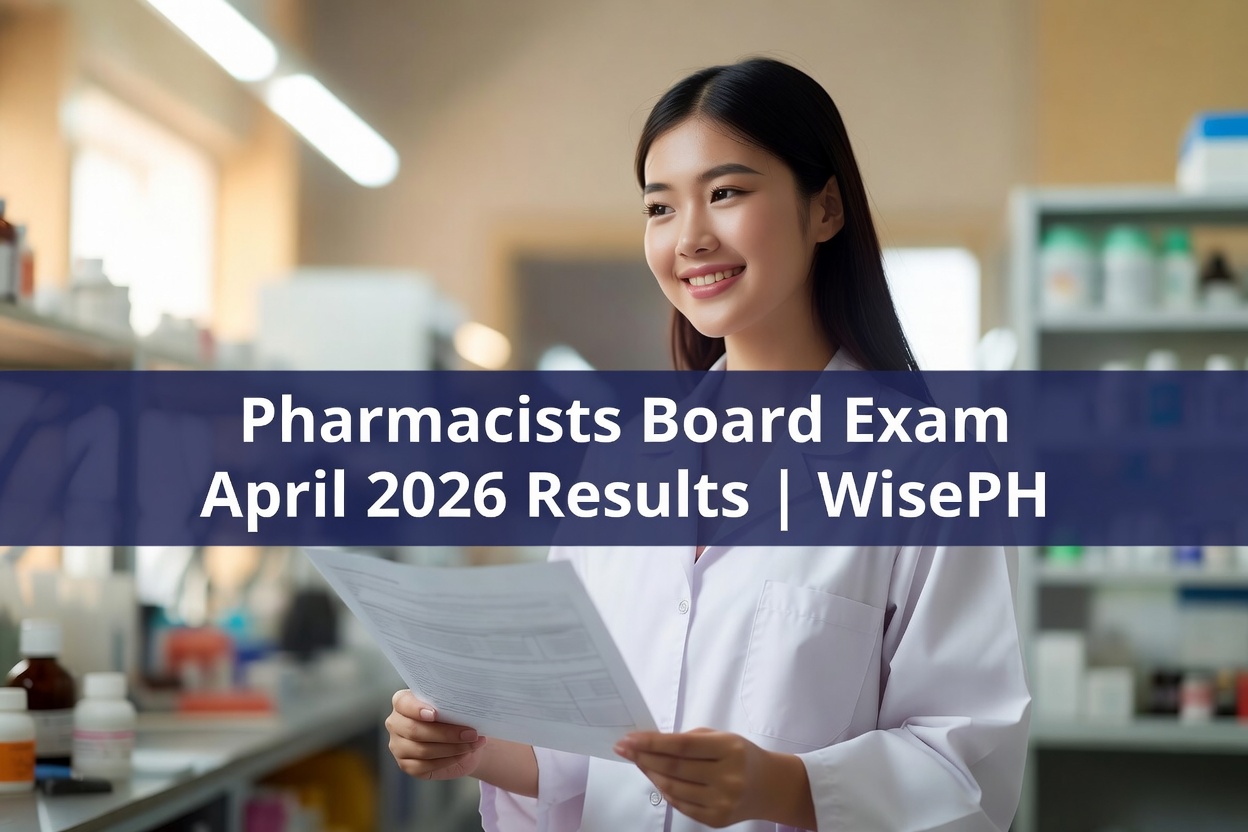
PRC released the April 2026 PLE results on April 22, 2026, three working days after the two-day exam held on April 18 to 19, 2026. The Board of Pharmacy was led by Acting Chairperson Hon. Alicia P. Catabay, with members Hon. Mildred B. Oliveros and Hon. Anthony Aldrin C. Santiago.
✅ Official results: released April 22, 2026
Pharmacists: 1,085 out of 1,895 passed (57.26%) across 13 testing centers.
| Detail | April 2026 |
|---|---|
| Exam dates | April 18 to 19, 2026 |
| Result release | April 22, 2026 |
| Total examinees | 1,895 |
| Total passers | 1,085 |
| Pass rate | 57.26% |
| Testing centers | 13 nationwide |
| Board chair | Hon. Alicia P. Catabay (Acting) |
April 2026 PLE topnotchers and top performing schools
PRC published the top 10 highest placers and performance of schools on the same day as the passers list. Also, both PDFs are in the button group above. Specifically, the topnotchers list shows each placer’s name, school, and subject-by-subject ratings. The 13 testing centers were: NCR, Baguio, Cagayan de Oro, Cebu, Davao, Iloilo, Lucena, Pagadian, Pampanga, Rosales, Tacloban, Tuguegarao, and Zamboanga.
What the pharmacists licensure exam covers
The PLE runs over two days and covers six subjects. To pass, you need a general weighted average of at least 75%, with no single subject falling below 50%. The 75% GWA threshold is stricter than most other licensure exams, so every subject matters more than it might on a 70% standard.
| Subject | Day | Time | Weight |
|---|---|---|---|
| Pharmaceutical Chemistry | Day 1 | 8:00 to 10:00 AM | 20% |
| Pharmacognosy/Biochemistry | Day 1 | 11:00 AM to 12:30 PM | 15% |
| Practice of Pharmacy | Day 1 | 1:30 to 3:30 PM | 17.5% |
| Pharmacology-Pharmacokinetics | Day 2 | 8:00 to 9:30 AM | 15% |
| Pharmaceutics | Day 2 | 10:30 AM to 12:30 PM | 17.5% |
| Quality Control/Quality Assurance | Day 2 | 1:30 to 3:30 PM | 15% |
The subject most examinees underestimate
Pharmaceutical Chemistry carries the highest single weight at 20%. It covers inorganic, organic, and analytical chemistry as applied to drug substances and formulation. Most examinees pour review hours into clinical and pharmacology subjects and treat Chemistry as a last-minute sweep. That is the wrong order.
Practice of Pharmacy and Pharmaceutics each carry 17.5%. Together, those three subjects account for 55% of your total grade. So if review time is limited, those three deserve most of it. Pharmacology-Pharmacokinetics, Pharmacognosy/Biochemistry, and QC/QA each carry 15%, meaning no single one of them can compensate for a weak score in the heavier trio.
October/November 2026 PLE: next exam schedule
The next Pharmacists Licensure Examination is expected in October or November 2026. PRC has not released the official date. Check leris.prc.gov.ph for the updated filing schedule and application window. There is no mandatory waiting period for retakers.
| Item | Details |
|---|---|
| Next PLE cycle | October/November 2026 (tentative; confirm on LERIS) |
| How to apply | Online via LERIS (leris.prc.gov.ph) |
| Requirements (retaker) | NBI Clearance and Good Moral Certificate; verify full list on LERIS |
| Application fee | Check LERIS for current amount |
How to check your PLE results safely
PRC posts official results at prc.gov.ph. That is the only source to trust. Results appear as a downloadable PDF, not a searchable online database. Search your name inside the PDF after downloading it.
Fake-results pages flood social media within minutes of every major board exam announcement. They mimic PRC’s design and ask for your reference number or personal details. In fact, PRC never requests payment or a log-in to view the passers list. The official PDF is free and public. If any site asks for money to “check your name,” it is a scam.
You passed: 3 steps you must not skip
Passing the PLE does not make you a licensed pharmacist yet. Under RA 10918 (Philippine Pharmacy Act), oath-taking, initial PRC registration, and PPhA membership all have to happen before you can legally practice or use the RPh designation.
| Step | What it involves | Cost of skipping |
|---|---|---|
| 1. Oath-taking | Register via LERIS, attend PRC mass oath-taking ceremony | No COR or PRC ID |
| 2. Initial registration | Personal appearance at PRC, P1,050 fee | Not officially a registered pharmacist |
| 3. PPhA membership | Join the Philippine Pharmacists Association at your local chapter | Cannot use RPh title; blocks hospital credentialing and most pharmacy employment requirements |
Starting May 25, 2026, registration for your Professional Identification Card and Certificate of Registration is online at prc.gov.ph. You still need to appear in person for oath-taking. In addition, bring the following: downloaded Oath Form (Panunumpa ng Propesyonal), Notice of Admission, two passport-sized photos (colored, white background, complete name tag), two sets of documentary stamps, and one short brown envelope.
Why PPhA membership is required, not optional
The Philippine Pharmacists Association (PPhA) is the primary PRC-accredited professional organization for registered pharmacists. Under PRC rules, membership is required for both initial license registration and every three-year renewal. Also, you cannot use the RPh designation on any professional document without it.
PPhA chapter fees vary by region, but initiation typically covers your first year of dues and a membership ID. Go within the first month after oath-taking. Delaying it means delaying your CPD compliance record, which matters at your first renewal in three years.
The year-one setup moves most new pharmacists miss
The first year after your PRC ID sets your practice track, your CPD record, and your standing when the first renewal comes due. As a result, most new pharmacists who skip the administrative side deal with it under a deadline when hospital credentialing or PDEA registration comes up later.
Months 1-3: PPhA and PDEA registration
After oath-taking and initial registration, join PPhA right away. Most hospital pharmacy departments and chain drugstore HR teams require PPhA membership before processing your employment documents. If you plan to work in a community pharmacy or drugstore, PDEA registration comes next.
Pharmacists who dispense or handle controlled dangerous substances (CDS) need a Certificate of Registration from the Philippine Drug Enforcement Agency under RA 9165. PDEA registration requires your PRC ID, PPhA membership, and the pharmacy’s own PDEA license. Without it, you cannot legally dispense Schedule 1 through 5 drugs, which covers most of what community pharmacies carry daily.
Months 4-9: hospital credentialing or industry track
Hospital pharmacy positions require credentialing with the institution’s medical staff office. Requirements typically include your PRC ID, PPhA membership, a drug test clearance, and an NBI clearance. For those entering pharmaceutical manufacturing or the FDA track, RA 9711 requires licensed pharmacist supervision for drug manufacturing, distribution, and QC operations. So the FDA route needs your PRC license active and your PPhA membership current from the start.
Meanwhile, build your CPD record from month one. You need 45 CPD units per three-year renewal cycle under PRC Memorandum Order 2020-02. PPhA seminars, hospital CME programs, and industry training events all count.
Months 6-12: financial setup alongside your practice
Open a Pag-IBIG MP2 savings account with your first paycheck. Pharmacist starting salaries in hospitals and community chains are stable but modest, particularly in provincial settings. A compounding savings account builds a buffer alongside your starting salary.
Register with BIR if you plan any independent consultancy or compounding work. File BIR Form 1901, get official receipts, and register your professional activity. Community pharmacy owners also need to comply with FDA License to Operate (LTO) requirements for the pharmacy establishment itself, which is a separate process from your individual PRC license.
What to do if you failed the PLE
Download your PRC rating slip as soon as results drop. Specifically, it shows your exact score per subject. So use that number, not gut feeling, to plan your October retake.
If Pharmaceutical Chemistry failed, the gap is almost always applied analytical and organic chemistry problems, not missed content. Generic reviewers that focus on memorization will not close that gap. Add applied problem sets to your schedule: titrimetric analysis, dosage form calculations, and drug structure-property relationships. If Practice of Pharmacy or Pharmaceutics fell below 50%, work through RA 10918 (Philippine Pharmacy Act) provisions, compounding standards under the Philippine National Drug Formulary, and Good Pharmacy Practice guidelines. Similarly, if Pharmacology-Pharmacokinetics failed, add drug-drug interaction case studies and PK calculation drills alongside your standard reviewer.
Then log in at prc.gov.ph and go to your LERIS dashboard to download your rating slip.
Pharmacists board exam results archive
This table grows each cycle. Also, the newest batch always appears first.
| Batch | Released | Passers | Pass rate |
|---|---|---|---|
| April 2026 | April 22, 2026 | 1,085 | 57.26% |
PDF downloads by batch
April 2026
Frequently asked questions about the pharmacists board exam
When are the April 2026 pharmacists board exam results released?
PRC released the April 2026 PLE results on April 22, 2026, three working days after the April 18 to 19, 2026 exam. 1,085 out of 1,895 passed, a 57.26% passing rate. Check prc.gov.ph or the official PRC Facebook page for the announcement and downloadable PDF.
What is the passing rate for the Pharmacists Licensure Examination?
The April 2026 PLE passing rate was 57.26%. 1,085 out of 1,895 examinees passed across 13 testing centers. The passing requirement is a 75% general weighted average, with no subject falling below 50%. However, that 75% threshold is stricter than the 70% standard used in most other PRC exams.
What subjects are covered in the Pharmacists Licensure Examination?
The PLE covers six subjects over two days. Day 1 includes Pharmaceutical Chemistry (20%), Pharmacognosy/Biochemistry (15%), and Practice of Pharmacy (17.5%). Day 2 covers Pharmacology-Pharmacokinetics (15%), Pharmaceutics (17.5%), and Quality Control/QA (15%). Specifically, Pharmaceutical Chemistry carries the highest single weight at 20%.
What are the next steps after passing the pharmacists board exam?
Complete three steps under RA 10918: register for the PRC oath-taking ceremony via LERIS, complete initial registration at PRC in person (P1,050 fee, personal appearance required), and join a PRC-accredited professional organization such as PPhA. In addition, register with PDEA if your role involves handling controlled dangerous substances. All three PRC steps are required before you can legally practice or use the RPh title.
When is the next pharmacists board exam?
The next PLE is expected in October or November 2026. PRC has not released the official date yet. Check leris.prc.gov.ph for updates. There is no mandatory waiting period, and retakers typically only need an NBI Clearance and Good Moral Certificate to refile.
For other board exam results this cycle, the Physicians licensure exam results and Midwives board exam results are also updated on this site. For all PRC board exam results and schedules, WisePH covers every licensure cycle.