

Still new to TESDA in general? Our main TESDA guide covers the basics first. If you already have a TESDA NC that is expiring or has expired, start with our guide on TESDA NC renewal, since this article is really the deep dive on one option mentioned there: renewing through work experience instead of retraining. Trying to get your very first NC without ever taking a formal course? This article still applies to you, just with more caution.
I want to be upfront about where this comes from. I have not personally gone through RPL, and I have not collected reader stories detailed enough to know exactly how someone’s application played out. What follows is built from TESDA’s own circulars and published guidance on Recognition of Prior Learning and portfolio assessment, not forum anecdotes.
What is Recognition of Prior Learning (RPL) at TESDA?
RPL, sometimes called Recognition of Current Competency, lets TESDA assess someone’s real work experience against a qualification’s competency standards. That means skipping the requirement for formal classroom training first. TESDA runs this through what it calls Portfolio Assessment.
This is not a shortcut in the sense of being easier. It still requires a full assessment; it just skips the training requirement if you can prove you already have the skill.
RPL for renewal vs. RPL for a first-time NC: know the difference
These are two very different situations with very different odds. Renewing an existing NC through work experience needs about 12 months of relevant experience. Getting a first NC through RPL usually needs several years of strong, documented experience.
| Situation | Experience typically needed | Realistic chance |
|---|---|---|
| Renewing an NC you already hold | At least 12 months during its validity | Moderately realistic, TESDA’s most common use of this path |
| Getting a first-time NC with no prior certificate | Often 5+ years of strong, documented experience | Difficult, and TESDA guidance targets this route mainly at experienced professionals |
Readers confuse these two constantly, and the confusion sets false expectations either way. If you already hold an NC, our renewal guide covers this exact 12-month scenario in more detail, including what documents count as proof. If you have never held an NC at all, treat the rest of this article as a realistic gut-check before you invest time gathering evidence.
Who does RPL realistically work for?
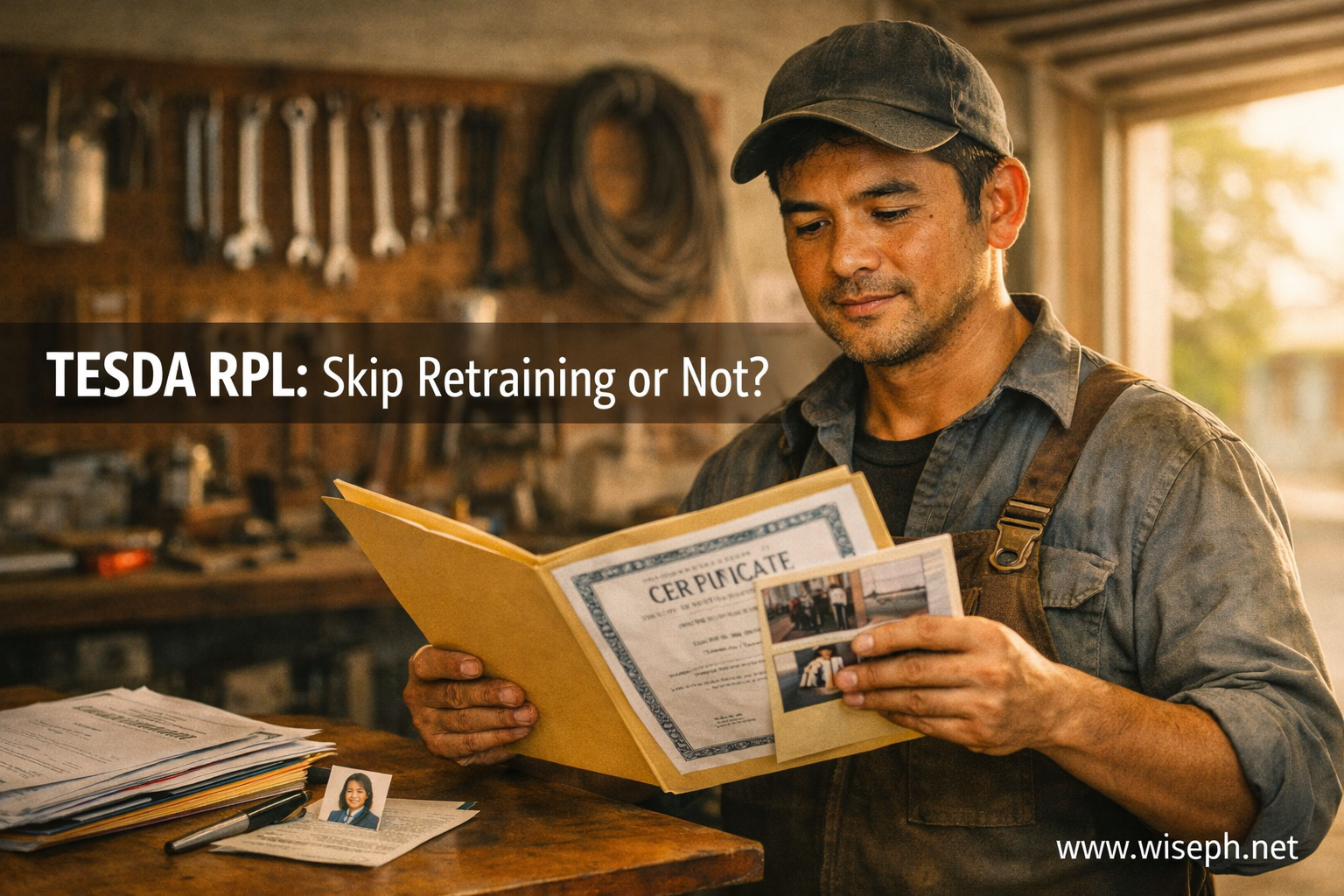
RPL works best for people with formal, verifiable documentation. Think official Certificates of Employment, signed contracts, performance evaluations, or an employer willing to confirm your work directly. Informal proof like handwritten notes, photos, or social media testimonials carries much less weight.
| Type of evidence | Chance of passing RPL |
|---|---|
| Formal COE, contracts, performance evaluations | Moderate to good |
| Mix of formal and informal evidence | Fair, but risky |
| Only handwritten letters, photos, informal testimonials | Low |
| Very minimal proof of any kind | Very low, usually redirected to regular training |
I want to set expectations conservatively here, since overhyping RPL wastes people’s time. If your only proof is informal, you will most likely be advised to enroll in regular training instead. That is not a failure on your part. It just reflects how strict assessors are required to be about verifying real competency, not just years worked.
Returning OFWs are usually in a stronger position than local self-taught workers. They typically hold an official Certificate of Employment, an employment contract, and sometimes a work permit from their host country. If that describes you, our guides on SSS coverage for OFWs and getting an SSS number online cover related paperwork worth sorting out at the same time. Local workers who learned on job sites or in small shops often only have informal proof, which is the harder starting point.
How do you actually apply for RPL?
You cannot walk into just any TESDA center for this. Start at the TESDA Provincial or District Office that would normally handle your qualification. Ask specifically whether Portfolio Assessment is currently available for it.
- Go to your TESDA Provincial or District Office and ask if Portfolio Assessment is offered for your specific qualification. Not every center is authorized to run it.
- Download and complete the Self-Assessment Guide (SAG) for that qualification from TESDA’s website. This document walks you through every competency you would need to prove.
- Gather your evidence: employment certificates, contracts, performance evaluations, photos of completed work, or third-party statements from employers. You will also need a valid government ID on hand. Our guide on applying for a postal ID covers the cheapest option if you do not have one yet.
- Submit your portfolio for review. A panel of assessors evaluates whether your documentation is strong enough to proceed.
- If accepted, go through the actual assessment. This usually still includes a practical demonstration, oral questioning, or a written test to confirm the skills your documents claim.
Sometimes your qualification does not have active RPL implementation in your area, or the office tells you your evidence is too thin. In that case, the realistic fallback is regular training. Our guide on enrolling in the TESDA Online Program covers the free theory portion, and our TESDA scholarship guide covers how to get that training paid for.
What happens on assessment day?
Assessment day is not just a document check. Depending on your qualification, you may still face a practical demonstration, oral questioning, a written test, or a review of submitted work samples. All of this comes on top of your portfolio.
TESDA’s own assessment framework allows several evidence-gathering methods: demonstration with oral questioning, written tests, interviews, third-party reports, portfolios, and submitted work projects. RPL leans heavily on the portfolio. But assessors can and do ask for additional proof through these other methods if your documents alone do not cover every required competency.
Prepare as if you might still need to demonstrate the actual skill, not just present paperwork. Treat the portfolio as your entry ticket, not your entire exam.
How much does RPL cost?
Portfolio Assessment costs around ₱1,500, which is at or above the regular competency assessment fee, not cheaper. Regular assessments typically run ₱500 to ₱2,000 depending on the qualification, with most falling between ₱600 and ₱1,500.
| Assessment type | Typical fee |
|---|---|
| Regular competency assessment | ₱500 to ₱2,000, most commonly ₱600 to ₱1,500 |
| Portfolio Assessment (RPL) | Around ₱1,500 |
The ₱1,500 fee is split among a panel of three assessors who review your case. That is why RPL is not the budget option people sometimes assume it is. Weigh this against your actual odds of passing before committing to the RPL route over regular training.
Watch out for fixers promising a guaranteed RPL pass
RPL depends so heavily on documents that it attracts a specific kind of scam. Some people offer to fabricate or “beef up” your work experience certificates for a fee, or promise a guaranteed pass regardless of your actual evidence. This is riskier here than in most other TESDA processes, since falsified documents can get you permanently disqualified, not just rejected.
Never pay anyone to manufacture proof of experience you do not actually have. Legitimate portfolio review only happens through your TESDA Provincial or District Office. No one can guarantee an outcome that depends on an assessor’s independent judgment.
What happens after you pass?
Once you have your NC, whether through RPL or regular assessment, the same next steps apply as with any TESDA certificate. If you are heading abroad, you will likely need a CAV and DFA apostille for that NC. It is also worth checking which trades actually have strong demand for OFWs before you commit further.
Your NC will also need renewal again in another 5 years, and the same work-experience logic from this article will apply then too. Our renewal guide is worth bookmarking for that future date.
Frequently asked questions
What is Recognition of Prior Learning (RPL) at TESDA?
It is a process that lets TESDA assess your real work experience against a qualification’s standards instead of requiring formal training first. It is carried out through Portfolio Assessment and still ends in a full competency assessment.
Can I get my first TESDA NC through RPL without any formal training?
It is possible but difficult. TESDA guidance generally targets this route at professionals with 5 or more years of strong, documented experience. Weaker or informal evidence usually gets redirected to regular training.
Is RPL the same as renewing an expired NC through work experience?
They overlap but are not identical. Renewal only requires proof of about 12 months of relevant work during your NC’s validity period, a much lower bar than the 5-plus years typically expected for a first-time NC through RPL.
How much does RPL cost compared to a regular assessment?
Portfolio Assessment runs around ₱1,500, which is often more expensive than a regular competency assessment, typically ₱500 to ₱2,000, most commonly ₱600 to ₱1,500.
What happens if my documents aren’t strong enough for RPL?
You will likely be advised to enroll in regular training and take the standard assessment afterward. This is common and not a personal failure; it simply reflects TESDA’s evidence standards.
If you already hold an NC, your best next step is straightforward. Contact the TESDA office that issued it and ask directly whether you qualify for renewal through work experience or need full reassessment. Bring your Certificate of Employment or other proof of at least 12 months of relevant work when you go. That one conversation will tell you more than any amount of searching online.