

Our main TESDA guide already covers what TWSP, STEP, and PESFA are in broad strokes. This article goes deeper: the actual documents, the application steps, and the reasons applications get rejected that nobody explains clearly.
I want to be upfront about where this comes from. I have not personally gone through a TESDA scholarship application, and most reader questions I get stay general, things like “which scholarship is easiest” or “can I still apply if I’m already working.” Because eligibility rules and priority courses shift from year to year, I built this on TESDA’s own published guidelines rather than older forum posts or anecdotes that might no longer be accurate.
Which TESDA scholarship should you apply for?
Choose based on what you want to do after training, not which one seems easiest. TWSP suits people who want a job. STEP is the better fit if you are building your own small livelihood, while PESFA works best for students already set on a private training school.
| Your goal after training | Best scholarship | Why |
|---|---|---|
| Get hired locally or abroad | TWSP | Job-focused, largest number of slots, tied to in-demand skills |
| Start a small business or livelihood | STEP | Community-based, includes a starter toolkit at the end |
| Study at a private TESDA-accredited school | PESFA | Covers tuition at private TVIs, includes a monthly stipend |
Do not pick a scholarship purely because it seems more available. Pick the one that matches your actual plan; each program is structured around a different outcome.
What documents do you need for a TESDA scholarship?
Most core documents are the same across TWSP, STEP, and PESFA. Each program then adds its own proof of income or indigency on top.
| Document | Required for |
|---|---|
| Accomplished scholarship application form | All three |
| PSA birth certificate (photocopy) | All three |
| High school diploma, Form 138, ALS certificate, or TOR | All three |
| Valid government ID with photo and signature | All three |
| 2×2 or 1×1 ID photos, white background | All three |
| Barangay clearance or certificate of residency | All three |
| Proof of employment status, if employed or underemployed | TWSP |
| Certificate of family income, ITR, or certificate of tax exemption (income under ₱300,000/year) | PESFA |
| Certificate of Indigency from your barangay or MSWDO | STEP |
Gather the common documents first, especially your PSA birth certificate and school records, since those take the longest to request. If you do not yet have a valid government ID, our guide on applying for a postal ID covers the cheapest option most applicants use. PESFA and STEP also both reserve a share of slots for PWD applicants. If that applies to you, our guide on applying for a PWD ID is worth reading alongside this one. Then confirm with your chosen training center which specific scholarship applies to your course. The same course can sometimes fall under different programs depending on the center.
Common misconception: “If I’m already working, I can’t apply”
This is not true. Having a job does not automatically disqualify you from a TESDA scholarship; what matters more is your total household income and whether you fall under a priority group.
You can still apply with part-time work, freelance income, or a small side business. If you have a stable, higher-paying job, your application may simply get lower priority. These scholarships are meant for people who need the support most. Underemployed applicants specifically can strengthen their case with a certificate of employment and a payslip showing low income. Do not assume you are ineligible before you actually apply and let TESDA evaluate your situation.
How and where do you apply?
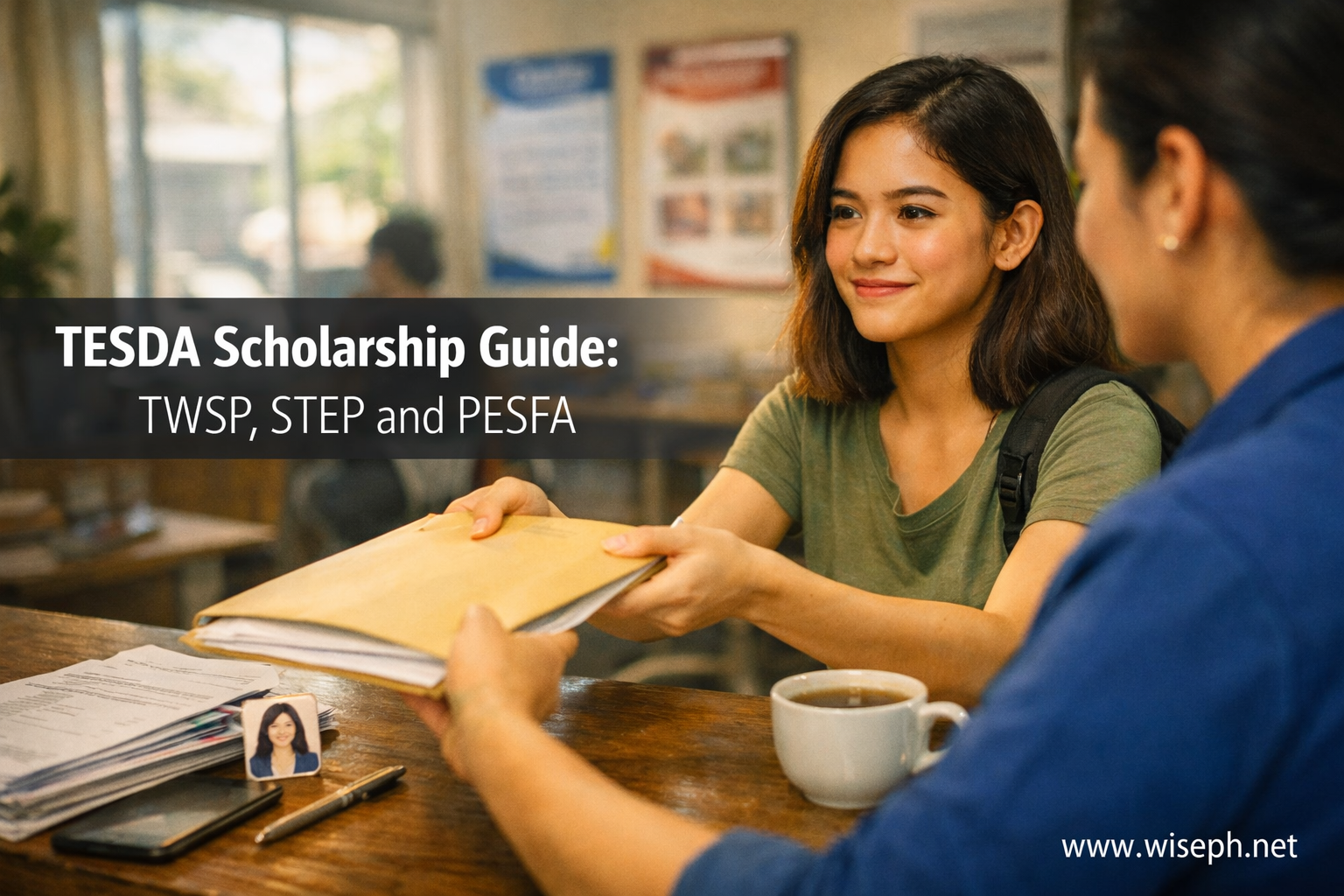
You can apply directly at a TESDA Provincial or District Office, through your chosen TESDA-accredited training center, or online through the TESDA portal. Most applicants go through their training center. Staff there can confirm available slots on the spot.
- Choose your course and confirm which training center offers a scholarship for it.
- Visit the center and ask which scholarship (TWSP, STEP, or PESFA) applies to that course.
- Submit your documents there. The center typically forwards your application to TESDA for you.
- Follow up after about a week if you have not heard back.
There is no single nationwide deadline. Applications run on a rolling basis, with January to March and June to August usually being the busiest intake periods. Slots are limited per course and per region, so apply as early as possible once you have picked a course.
How long does approval take?
Budget roughly 2 to 4 weeks from application to the start of training, assuming slots are available. Initial screening usually takes 3 to 10 working days, with full approval and voucher issuance taking 5 to 15 working days total.
| Stage | Typical time |
|---|---|
| Initial document screening | 3 to 10 working days |
| Full approval and voucher issuance | 5 to 15 working days total |
| Start of training after voucher | Usually within 2 weeks |
Waiting on your application does not have to mean sitting idle. Our guide on enrolling in the TESDA Online Program covers free theory courses you can start right away.
Why do applications get rejected or delayed?
Incomplete or incorrect documents are by far the most common reason applications get delayed or rejected. The second most common is applying for a course that has no remaining scholarship slots at that training center.
| Reason | How common |
|---|---|
| Incomplete or incorrect documents | Very common |
| No available slots for the course or center | Very common |
| Family income exceeds the PESFA cap | Common |
| Applying at a non-participating training center | Common |
| Already receiving another government scholarship | Occasional |
| Not meeting basic age or education requirements | Occasional |
A lot of applicants find out only after submitting that something is wrong. Maybe their Certificate of Indigency was not signed by the right official, or their income proof was already outdated. That back-and-forth alone can cost you your slot for that batch. Double-check every document against your training center’s checklist before you submit, and never submit falsified income or indigency documents, since that can lead to permanent disqualification.
What happens after you’re approved?
Once approved, you start training and eventually earn your NC. If you plan to work abroad afterward, you will likely need a CAV and DFA apostille for that NC. You will also need to renew it every 5 years to keep it valid. It helps to know these steps exist before you finish training, rather than being surprised by them later.
If your goal is a local job right after training, our explainer on what a PRC license actually covers is worth reading too. It clarifies how a vocational NC differs from a licensed profession. And if this is your first real job hunt, the First-Time Jobseekers Assistance Act can waive some of the fees you would otherwise pay when applying.
If your goal after training is overseas work specifically, our guide on choosing a TESDA course for OFWs covers which trades have the strongest demand and pay.
A light warning on scholarship “fixers”
Be cautious of anyone offering to “guarantee” you a scholarship slot for a fee. Also watch for a training center falsely claiming TESDA accreditation for a course it does not actually offer. Legitimate TESDA scholarships are free, and no one can pay their way into a slot.
If a training center pressures you to pay an unusual “reservation fee” tied to a scholarship slot, treat that as a red flag. The same goes for accreditation claims you cannot verify. Confirm directly with your regional TESDA office.
Frequently asked questions
Which TESDA scholarship should I choose: TWSP, STEP, or PESFA?
Choose based on your goal after training. TWSP fits people aiming for employment, STEP fits people building a small livelihood, and PESFA fits students enrolling in a private TESDA-accredited school.
Does having a job disqualify me from a TESDA scholarship?
No. Employment status alone does not disqualify you. What matters most is your household income and whether you fall under a priority group, though underemployed applicants may need to show proof of low income.
What is the income limit for PESFA?
Based on TESDA’s published guidelines, family income should not exceed ₱300,000 a year. Confirm the current figure with your training center or TESDA office, since guidelines can be updated.
Where do I apply for a TESDA scholarship?
At a TESDA Provincial or District Office, through your chosen TESDA-accredited training center, or online through the TESDA portal. Most applicants go through their training center directly.
How long does it take to get approved?
Usually 2 to 4 weeks from application to the start of training, if slots are available, though incomplete documents or a full course can delay this significantly.
Don’t just read this and stop. Pick your course, find the nearest training center that offers it, and go there this week. Ask them directly what scholarship slots are still open for that course, and bring your basic documents with you. That one visit will answer more than weeks of searching online.