


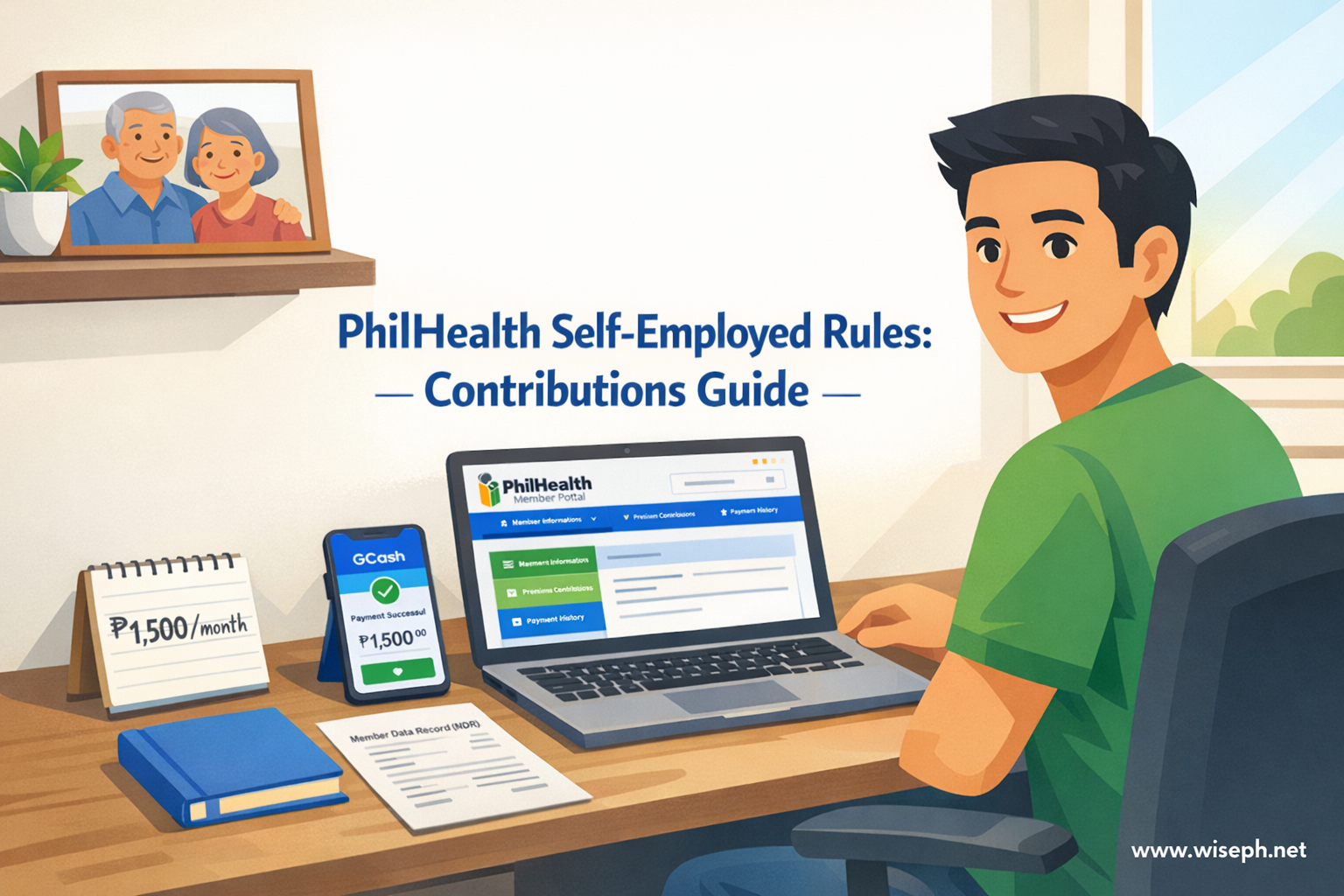
Managing your own PhilHealth as a self-employed or voluntary member is a different experience from having an employer handle it. Nobody reminds you when a payment is due. There is no one to fix a contribution posting error. Nobody fills out your MDR when you change your address or add a dependent.
I’m self-employed, and I’ve managed my own PhilHealth contributions for years. When I was hospitalized for dengue in 2024, I handled everything alone: the forms, the receipts, the follow-up. No HR. No payroll department. This guide covers what the official PhilHealth materials don’t clearly explain, including the rules for self-employed members, voluntary members, and senior citizens.
Who counts as PhilHealth self-employed, voluntary, or senior citizen?
The short answer: a PhilHealth self-employed member is anyone earning income without a formal employer. A voluntary member is a former employed member continuing coverage independently. A senior citizen member is a Filipino aged 60 or above not covered under another membership category.
| Membership type | Who qualifies |
|---|---|
| Self-employed | Freelancers, business owners, sole proprietors, independent professionals |
| Voluntary | Former employed members continuing PhilHealth coverage on their own |
| Senior citizen | Filipino citizens 60 years and above not covered under another category |
| Lifetime Member | Members aged 60+ who have paid at least 120 monthly contributions (10 years) |
In practice, the PhilHealth self-employed and voluntary categories follow the same contribution rules. The key difference is history: voluntary members previously had employer coverage and are continuing on their own. By contrast, self-employed members pay out of pocket from the start, with no employer share ever.
How much does a PhilHealth self-employed member pay?
PhilHealth self-employed members pay 5% of their declared monthly income. The minimum is ₱500 per month for income at or below ₱10,000, and the maximum is ₱5,000 per month for income at ₱100,000 or above. Unlike employed members whose employers cover half, a PhilHealth self-employed or voluntary member pays the full 5%.
| Declared monthly income | Monthly PhilHealth premium (5%) |
|---|---|
| ₱10,000 and below | ₱500 |
| ₱20,000 | ₱1,000 |
| ₱30,000 | ₱1,500 |
| ₱50,000 | ₱2,500 |
| ₱70,000 | ₱3,500 |
| ₱100,000 and above | ₱5,000 |
Source: GreatDay HR PhilHealth Contribution Table 2025
I declare my income based on my average monthly earnings for the year. As a result, my quarterly payment lands around ₱1,200–₱2,400 depending on my bracket for that period. Compared to what one hospital stay costs, that’s not a large amount, so I treat it as protection rather than an expense.
When and how to pay as a PhilHealth self-employed or voluntary member
PhilHealth self-employed and voluntary members can pay monthly, quarterly, semi-annually, or annually. Quarterly payments are due on the last working day of March, June, September, and December. You pay through the PhilHealth Member Portal, GCash, Maya, or any accredited bank.
| Payment schedule | Deadline |
|---|---|
| Monthly | Last working day of the month |
| Quarterly | March 31, June 30, September 30, December 31 |
| Semi-annual | June 30 and December 31 |
| Annual | December 31 |
Source: OmniHR PhilHealth Contribution 2026
I pay quarterly through GCash or online banking. The reference number posts quickly and I can verify it within a few days. What I avoid now: third-party remittance centers. I paid through one once and the contribution took almost three weeks to appear in my PhilHealth record. That gap made me nervous about eligibility right when I might have needed to use my coverage. Stick to digital channels and confirm posting a few days after every payment.
For a full breakdown of your payment options, check where to pay PhilHealth contributions online and how to generate your PhilHealth SPA for payment.
What happens if you miss a PhilHealth contribution payment?
Missing a payment as a PhilHealth self-employed or voluntary member does not cancel your membership. But it can make you ineligible for inpatient benefits if you no longer meet the required number of recent contributions when you actually need to file a claim.
To qualify for inpatient PhilHealth benefits, you need at least 3 monthly contributions within the 6 months before your hospitalization. A gap puts that count at risk, and unlike an employed member with automatic payroll deductions, a PhilHealth self-employed member has no safety net catching missed payments.
I experienced this worry firsthand after skipping a few months as a voluntary member. Specifically, the concern wasn’t the missed amount itself. Instead, it was the question: “Do I still have enough contributions if I get admitted this week?” I caught up on payments right away and then checked my PhilHealth contributions online to confirm the running count. You can’t backdate contributions, so pay consistently before a gap becomes a problem.
Why declaring the right income matters more than you think
As a PhilHealth self-employed member, you set your own income bracket. Naturally, it’s tempting to declare the minimum to keep your premium low. The problem, however, is that your declared income ties directly to your contribution record, and that record is what PhilHealth reviews during claims processing.
I’ve seen people declare the lowest bracket (₱10,000) to pay just ₱500 a month, then discover during hospitalization that their coverage was lower than they expected. The PhilHealth case rate doesn’t change based on your income, but underdeclaring creates a gap between your BIR-recorded earnings and your PhilHealth contributions. If those two records diverge significantly, it can create complications during a claim.
More practically: a few hundred extra pesos a month in contributions is nothing compared to what an unplanned hospital stay costs. I declare my income based on a realistic average of my monthly earnings for the year. Think of PhilHealth as protection that you size honestly, not an expense you minimize.
How PhilHealth senior citizen coverage works
Senior Filipinos aged 60 and above are covered by PhilHealth under Republic Act 10645 and the Universal Health Care Act. Those with at least 120 paid contributions (10 years total) qualify as Lifetime Members with no further premiums. Everyone else in this age group is covered automatically, with the government paying their premiums from sin tax revenues.
Automatic coverage vs. Lifetime Member: what’s the difference?
| Automatic senior citizen coverage | Lifetime Member | |
|---|---|---|
| Who qualifies | Filipinos 60+ without current PhilHealth coverage | Filipinos 60+ with 120+ paid monthly contributions |
| Premium required? | No (government pays via sin tax) | No |
| Enrollment needed? | Yes, at OSCA or PhilHealth office | Yes, verify contribution history at PhilHealth office |
| Coverage | Same PhilHealth benefit packages | Same PhilHealth benefit packages |
Sources: PhilHealth Senior Citizens Page, PhilHealth Lifetime Members Page
My father is 68 and became a Lifetime Member after retiring from government service. I assumed the status would be automatic once he turned 60 with enough contributions. It wasn’t. We still had to visit a PhilHealth office to verify that all his past contributions were correctly posted. Several from years ago were missing. We brought old documents and waited for manual checking, which delayed the activation by weeks.
When he suffered a stroke in January 2025, we filed the claim at the hospital ourselves. Specifically, we brought his PhilHealth ID, a printed MDR, and his medical abstract. Three weeks later, the claim was processed and we recovered close to 80% of the hospital bill. That result was only possible because we had verified his Lifetime Member status years before the emergency, not during it.
Documents senior citizens still need at the hospital
Even as a Lifetime Member or under automatic coverage, you still need to bring documents at admission. The benefit doesn’t activate on its own:
- PhilHealth ID or printed Member Data Record (MDR)
- Senior Citizen ID from OSCA or any valid government ID showing age
- Completed PhilHealth Member Registration Form (PMRF) if the hospital has no HCI Portal system
- Proof of age (birth certificate or passport, requested by some hospitals)
“Registered” doesn’t mean “covered”: the PhilHealth eligibility trap
This is the rule that catches PhilHealth self-employed and voluntary members off guard most often. Being registered with PhilHealth is not the same as being eligible to claim benefits. To use inpatient benefits, you need at least 3 monthly contributions within the 6-month period immediately before your confinement.
I’ve seen it happen to people who pay for years, miss a few months, then get admitted to a hospital fully confident their PhilHealth is active. The hospital checks the contribution history, the 3-in-6 rule isn’t met, and the claim is denied at admission, not after.
For a PhilHealth self-employed or voluntary member, this risk is higher than for employed members. Unlike employed workers, no payroll system deducts your premium automatically every month. As a result, you have to be deliberate about it. Three habits that protect you:
- Pay every quarter without skipping, even when you feel healthy
- Verify that each payment is posted within a few days of paying
- Run a contribution count check before any planned admission or procedure
You can check your PhilHealth contributions online in a few minutes. Do it now, not when you’re filling out hospital admission forms.
Filing a PhilHealth claim as a self-employed member
As a PhilHealth self-employed member, you file a claim the same way any member does. The documents are identical. The difference is execution: no HR, no employer certification, no one to chase the forms for you.
For facility-based claims (hospital files on your behalf), your job is straightforward: bring your PhilHealth ID or printed MDR and valid ID on admission day. The hospital handles the rest through eClaims.
For direct reimbursement claims, you also need Claim Form 2 signed by your attending physician, all original official receipts stamped PAID IN FULL, a fully itemized Statement of Account, and a medical certificate or clinical abstract.
When I was hospitalized for dengue in 2024, I managed the entire PhilHealth claim myself. I filled out CF1, gathered receipts, and followed up on the processing status. The facility-based portion was smooth because the hospital filed directly. A secondary outpatient reimbursement took more effort, with no employer to make calls and no HR to escalate to. I checked the status myself through the PhilHealth portal. Same process, harder in practice. Double-check everything before leaving the hospital.
Manage your PhilHealth self-employed account online
The single best habit for any PhilHealth self-employed or voluntary member: set up your online account before you ever need to file a claim. From the PhilHealth Member Portal, you can print your MDR, verify contribution history, update dependents, and track any claim status without queuing at an office.
Here are all the guides you need to manage your PhilHealth self-employed account without leaving the house:
- How to register for PhilHealth online
- How to log in to your PhilHealth account
- How to check your PhilHealth contributions online
- Where to pay PhilHealth contributions online
- How to generate your PhilHealth SPA for payment
Frequently asked questions about PhilHealth self-employed and senior citizen rules
Can a PhilHealth self-employed member pay contributions anytime, or are there strict deadlines?
You can pay monthly, quarterly, semi-annually, or annually. For quarterly payments, deadlines are the last working day of March, June, September, and December. Missing a deadline does not cancel your membership, but the gap affects your posted contribution count and can cost you eligibility when you need inpatient benefits.
Can I change my declared income bracket as a PhilHealth self-employed member?
Yes. You can update your declared income at any PhilHealth office or through the member portal. Reassess your bracket whenever your income changes significantly. The rate is 5% of your declared monthly income, minimum ₱500 and maximum ₱5,000 per month.
Do PhilHealth senior citizen Lifetime Members still need to pay contributions?
No. Once you qualify as a Lifetime Member (60 years or above with at least 120 paid monthly contributions), you no longer pay premiums. You still need to verify your Lifetime Member status at a PhilHealth office and keep your MDR current to use your benefits at the hospital.
Is a PhilHealth self-employed member’s coverage the same as an employed member’s?
Yes. The case rates, benefit packages, and eligibility rules are identical regardless of membership type. As a PhilHealth self-employed member, you handle everything yourself with no employer support. Same rules, harder execution.
What if a senior citizen has never paid PhilHealth contributions? Are they still covered?
Yes. Under Republic Act 10645 and the Universal Health Care Act, Filipino citizens aged 60 and above are automatically covered by PhilHealth even without prior contributions. The national government funds their premiums through sin tax revenues. They still need to enroll at an OSCA or PhilHealth office and present proof of age.
The rules are simple. The execution is up to you.
Being a PhilHealth self-employed or voluntary member means the same rules apply to you as everyone else. Benefit packages are identical. Eligibility requirements are the same. The only difference is you’re the one making sure everything is in order.
Pay consistently. Verify that payments post correctly. Check your contribution count before any planned admission. For senior citizens and Lifetime Members: verify your status at a PhilHealth office before an emergency forces your hand.
“Member na ako” is a starting point, not a guarantee. Coverage depends on your recent contribution history, not just your registration date.
For every PhilHealth guide you need as a self-employed member, voluntary member, or family managing a senior citizen’s coverage, browse our full PhilHealth resource hub at WisePH.









If I have paid 408 months of contributions to PhilHealth throughout my working years and I resign from work at the age of 57, should I apply for a change from employed to voluntary membership and continue paying contributions until I turn 60?
Ellen,
Your 408 months already clears the 120-month requirement for Lifetime Member status. You have more than enough. No need to keep paying just to qualify.
What you do need to sort out right away: change your membership from Employed to Voluntary after you resign. Fill out a PMRF at any PhilHealth office or online. This takes care of the 3-year gap between 57 and 60. Without it, you lose coverage during that window. If you get sick or hospitalized before 60, PhilHealth may not cover you.
As a Voluntary member, you pay the full contribution yourself, but you can do it monthly, quarterly, or annually. It is manageable.
At 60, Lifetime Member status kicks in automatically. No more payments. Full benefits for life.
Change to Voluntary now, pay for 3 years, and you are done. You already did the hard part.
If you want to verify your exact records first, request your Member Data Record (MDR) from PhilHealth.