

What is the SSS death benefit?
When an SSS member dies, their family files a death benefit claim. Whether they get a monthly pension or a single lump sum depends on one number: how many monthly contributions the member paid before death.
It is separate from the SSS funeral benefit, which is a cash grant for whoever paid the burial costs. The same person can claim both, but each requires a separate application and a separate form.
Who qualifies as a primary beneficiary?
Primary beneficiaries have the first claim to the death benefit. If they exist, secondary beneficiaries receive nothing.
Republic Act 11199 defines primary beneficiaries as the dependent legal spouse (until remarriage or cohabitation with a new partner) and dependent children who are unmarried, not gainfully employed, and under 21 years old, or permanently incapacitated regardless of age. Legitimate, legitimated, legally adopted, and illegitimate children all qualify.
Each eligible child receives a dependent’s pension on top of the spouse’s survivorship pension. The amount is 10% of the monthly pension or ₱250 per child, whichever is higher, for up to five children.
The spouse loses the pension the moment she remarries. SSS goes further than most people expect: entering a live-in or cohabitation arrangement also stops the pension. The online filing portal screens for this specifically.
| Beneficiary type | Benefit received |
|---|---|
| Surviving legal spouse | Monthly survivorship pension until remarriage or cohabitation |
| Each dependent child (max 5) | 10% of monthly pension or ₱250, whichever is higher |
| Spouse with dependent children | Both pension and dependent allowance paid at the same time |
Who qualifies as a secondary beneficiary?
Secondary beneficiaries step in when the deceased left no dependent spouse and no eligible children. The order: dependent parents first, then any designated beneficiary listed in the member’s SSS records, then legal heirs under the Family Code.
Secondary beneficiaries receive a lump sum, not a monthly pension. If the deceased had at least 36 monthly contributions, that lump sum equals 36 times the computed monthly pension.
Monthly pension or lump sum: which one does your family get?
One number determines this: how many monthly contributions the deceased paid before the semester of death.
| Contributions paid | What the family receives |
|---|---|
| 36 or more | Monthly survivorship pension (lifetime) |
| Fewer than 36 | One-time lump sum |
The monthly pension is the highest of three computed figures:
- ₱300 + (20% x AMSC) + (2% x AMSC x [CYS – 10])
- 40% x AMSC
- Minimum: ₱1,000 (under 10 credited years), ₱1,200 (10+ years), ₱2,400 (20+ years)
AMSC = Average Monthly Salary Credit; CYS = Credited Years of Service
Pensioners also receive a 13th-month pension every December, plus a ₱1,000 monthly supplemental allowance that took effect in January 2017.
Understanding how contributions affect benefit sizes is worth reading in full. Our guide on how SSS contributions are computed breaks this down, and the SSS retirement pension calculator can give you a concrete estimate.
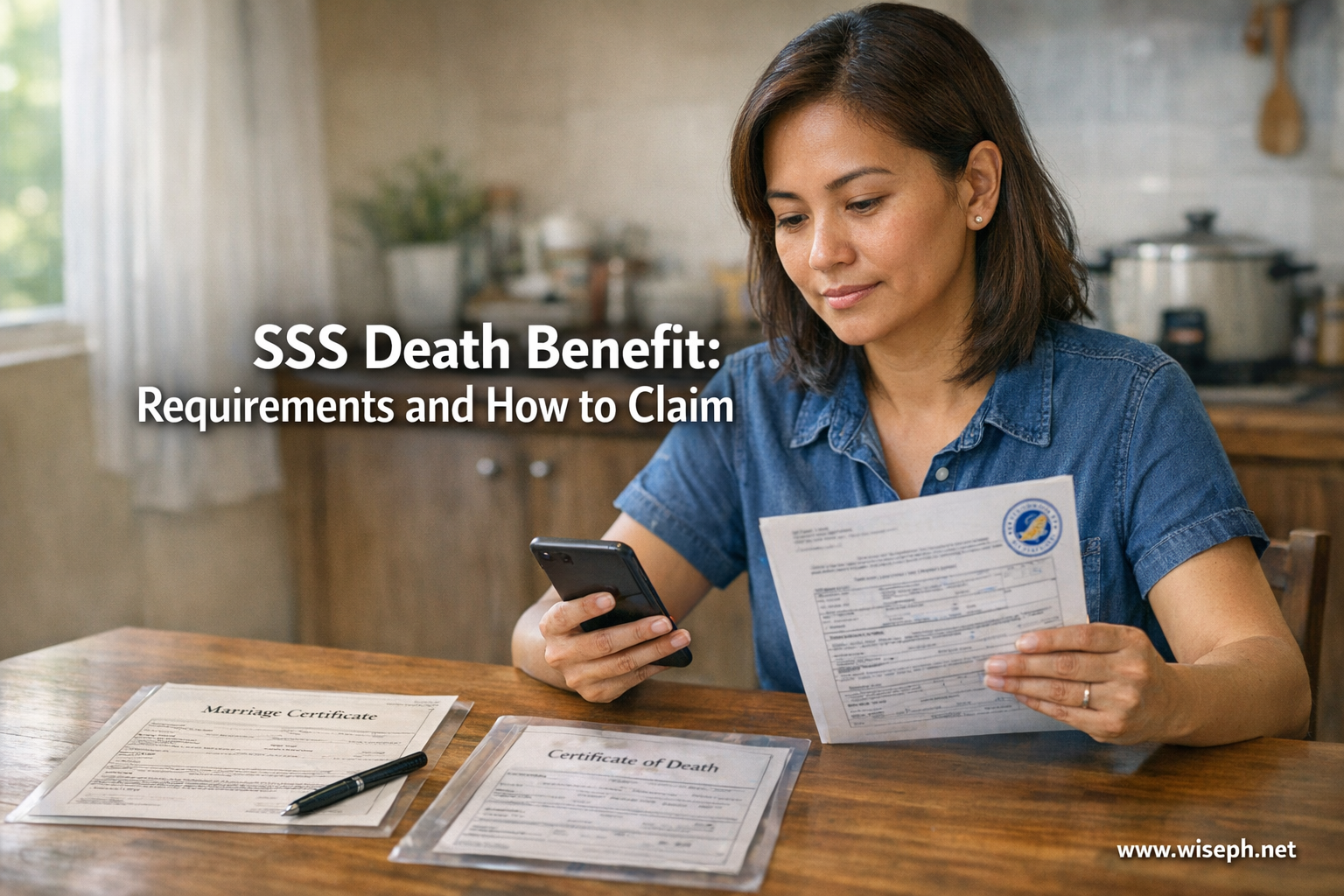
Complete document checklist for the surviving spouse
My neighbor’s wife arrived at the SSS branch with a folder full of papers. The teller still sent her home. A name written slightly differently on one ID than it appeared on the marriage certificate was enough to stop the entire claim. Getting everything right before your first visit matters.
Always required:
- Death Claim Application Form (available at any SSS branch or sss.gov.ph)
- PSA-certified or LCR-registered death certificate of the deceased
- Claimant’s valid photo ID with signature and biometric data
- Proof of disbursement account in the claimant’s own name: UMID card enrolled as ATM, bank passbook or ATM card, bank certificate issued within 3 months, or verified e-wallet account
Required if not in the member’s SSS records:
- PSA-issued marriage certificate
- PSA-issued birth certificate of each dependent child
For specific situations:
| Situation | Additional document needed |
|---|---|
| Marriage happened abroad | Report of Marriage from PH Embassy, or foreign marriage cert with English translation |
| Child born abroad | Report of Birth, or foreign birth cert with English translation |
| Separated in fact | CLD-1.3 Joint Affidavit of two persons attesting to the spouse’s dependency |
| Missing death certificate | PSA/LCR Certificate of Non-Availability plus church burial or cremation records |
| Missing marriage certificate | Non-availability cert plus church marriage proof or affidavits |
| Missing birth certificate | Non-availability cert plus baptismal or school/employment records |
The claim form is the Death Claim Application Form. If the deceased had contributions under multiple social security systems (SSS plus GSIS), use the Death Claim Application Under Portability Law instead. The supporting affidavit, if needed, is the CLD-1.3 Joint Affidavit.
How to file: online vs. over-the-counter
Online filing exists, but the eligibility window is narrow. Most families with children will still end up at a branch.
You can file online if all of these are true:
- You are the surviving legal spouse with your own SSS number and a My.SSS account
- You have a bank account or e-wallet enrolled in the DAEM (Disbursement Account Enrollment Module) under My.SSS
- You have not remarried or entered a live-in relationship
- Your claim does not include dependent children (if kids are involved, you must go OTC)
Over-the-counter filing is required for:
- Claims that include dependent children
- Work-related death requiring EC (Employees’ Compensation) evaluation
- Member’s date of death does not match an existing settled funeral claim
- Irregular or invalid SSS membership coverage of the deceased
Online steps (surviving spouse, no dependent children in claim):
- Log in to My.SSS at sss.gov.ph
- Open the death benefit claim service under E-Services
- Fill in the required details and upload your documents (most people hit a wall here if they haven’t enrolled a disbursement account yet)
- Submit and save your transaction reference number
SSS funeral benefit vs. death benefit: can you claim both?
Yes. They are separate benefits with separate forms. The funeral benefit reimburses whoever paid for the burial, not necessarily the spouse. Amounts depend on the member’s contribution count:
| Contributions paid | Funeral benefit amount |
|---|---|
| 36 or more | ₱20,000 to ₱60,000 (variable) |
| 1 to 35 | ₱12,000 (fixed) |
The death benefit is the survivorship pension or lump sum for primary beneficiaries.
The funeral benefit requires that the official receipt from the funeral parlor is in the claimant’s name. If a sibling or adult child paid and the receipt is under their name, the spouse cannot claim the funeral benefit directly. The claimant needs alternative documentation from the funeral home in that case.
SSS member-claimants can file the funeral benefit online with DAEM enrollment. Non-SSS member claimants must go to a branch.
Four mistakes families make at the SSS branch
My neighbor’s wife made two trips to the SSS branch in the worst week of her life. The second trip was preventable.
1. Name mismatch on documents
Her valid ID had a name slightly different from the name on her marriage certificate. A middle name abbreviated on one document and written in full on another. That was enough. SSS could not process the claim until she returned with matching papers. Check that names are identical across your marriage certificate, valid IDs, and all supporting documents before you walk in.
2. No disbursement account in the claimant’s name
SSS cannot release a benefit without an account registered in the claimant’s own name. If the surviving spouse has no DAEM-enrolled account, the teller sends her home first. Bank verification takes 3 to 5 business days. The deceased’s ATM card cannot be used. Setting up a MySSS RCBC DiskarTech card in advance is one way to avoid this entirely.
The money problems (mistakes 3 and 4)
3. Outstanding loan deductions
SSS deducts any unpaid loan balance from the death benefit before releasing anything. This applies to the SSS Salary Loan, the SSS Calamity Loan, or any other SSS loan the member had open. Principal, accumulated interest, and penalties all count. Families expecting a large payout have walked out with a fraction of it because of an old forgotten loan. The beneficiaries are not personally required to pay the loan; SSS nets it out from the benefit amount. Check the loan balance on My.SSS before assuming you know the payout figure.
4. Official receipt in the wrong name
The funeral benefit follows the receipt. If a relative handled the arrangements and the funeral parlor receipt is in their name, the spouse cannot claim the funeral benefit directly. When handling funeral arrangements for a family member, make sure the receipts are issued in the name of the person who will be filing the claim.
Update your SSS beneficiary records now
This is the one step active members should take today, not after someone passes away.
If your spouse and children are not listed in your SSS records, your family faces exactly what my neighbor’s wife faced: extra trips, extra paperwork, and delays at the worst possible time. SSS does not assume you are married just because you are. The system only knows what you have formally filed.
The form is SSS Form E-4 (Member Data Change Request). Submit it with PSA-certified supporting documents.
Online via My.SSS:
- Log in at sss.gov.ph
- Go to Member Info and select Update Information, then Dependents/Beneficiaries
- Upload scanned PSA documents and submit
- Save your transaction reference number
In person at any SSS branch:
- Download and print two copies of Form E-4
- Fill in your personal details in Section I and your beneficiary information in Section III
- Bring original and photocopied PSA documents plus a valid government ID
- Submit over the counter and keep your stamped copy
Ten minutes on My.SSS today can prevent months of stress for your family later. For a full picture of what your contributions protect across all benefit types, read our guide on why SSS matters. And if you want to understand how contribution records affect every benefit (not just death claims), the SSS sickness benefit guide shows the same pattern.
Check all your SSS benefits and contributions guides in one place to make sure your family is covered for every scenario.
Frequently asked questions
Can the SSS death benefit be claimed if the member had an outstanding loan?
Yes, but the outstanding balance comes out first. SSS deducts principal, interest, and accumulated penalties from the benefit before releasing anything. The family is not personally required to pay the loan. SSS simply reduces the payout by that amount.
What happens to the pension if the surviving spouse remarries?
The monthly survivorship pension stops. Entering a live-in or cohabitation arrangement ends it too, not just a legal remarriage. The dependent children’s allowance continues as long as each child is still under 21, unmarried, and not gainfully employed.
What if the deceased member had no spouse and no children?
Benefits go to secondary beneficiaries: dependent parents first, then any designated beneficiary in the member’s SSS records, then legal heirs. They receive a lump sum, not a monthly pension. At 36+ contributions, that lump sum equals 36 times the computed monthly pension.
How long does it take to receive the benefit after filing?
SSS’ 2025 data: an average of 8.78 days from filing to LOI release. From a complete submission to actual first payment, expect roughly two weeks. Incomplete documents and missing DAEM enrollment are the two most common delays.
Do children need to be listed in the member’s SSS records to claim the dependent’s pension?
No, but having them listed prevents delays. If children are not in the member’s records, the claimant brings PSA birth certificates to prove the relationship. SSS asks for additional documents before processing when records are incomplete.