

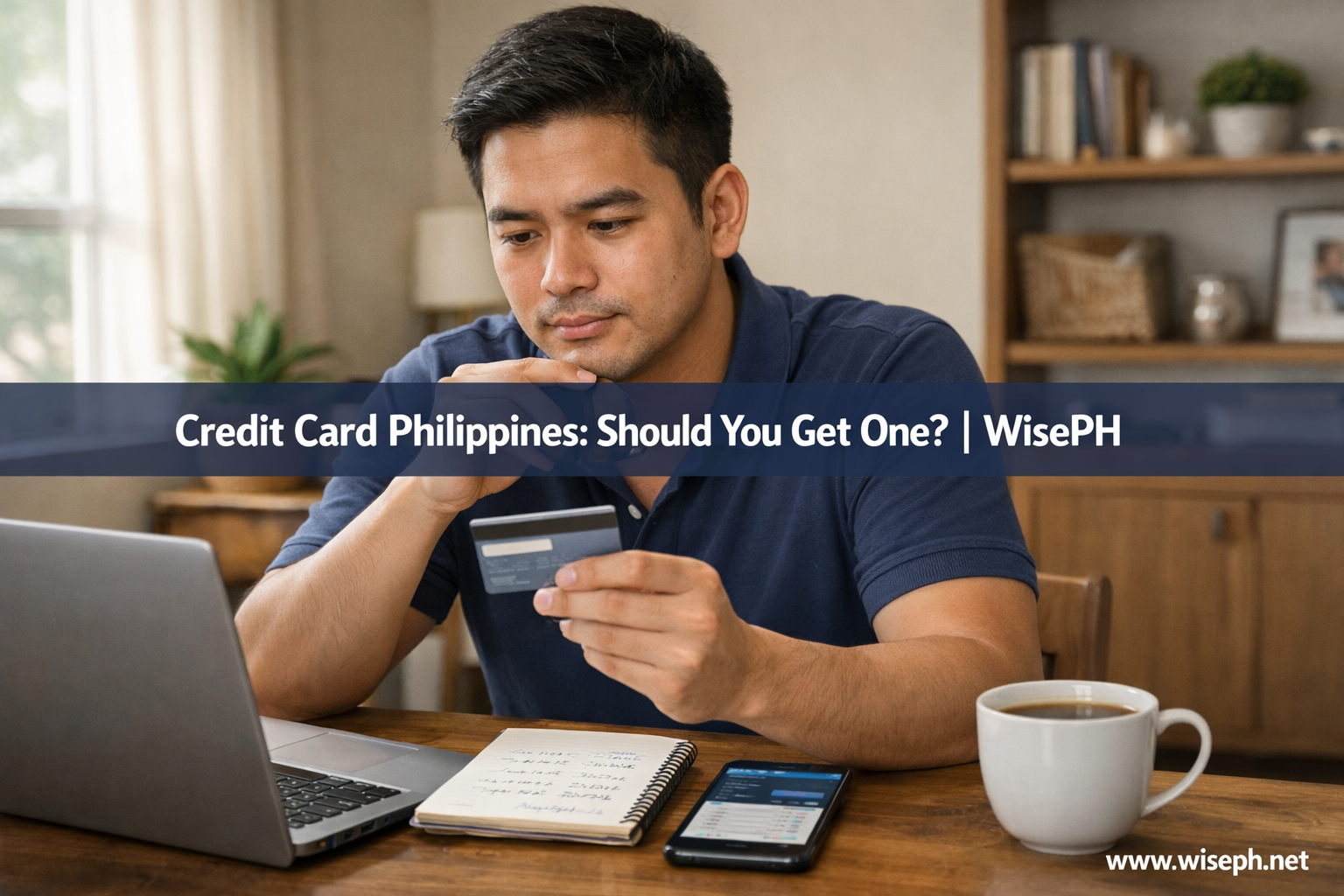
I used to be one of those Filipinos who refused to get a credit card. Every time someone brought it up, I had the same response: “Ayoko, baka mabaon ako sa utang.” I had seen what happened to people around me. I had heard all the horror stories. For years, I just avoided the topic entirely.
Then 2020 happened. I was running my online work and small businesses full-time, client payments were unpredictable, and I finally got my first credit card in the Philippines out of necessity. That decision changed how I manage money. But it also made me understand why so many Filipinos still carry the same fear I had, and why that fear is actually costing some of them.
This is an honest look at the credit card question every beginner in the Philippines eventually faces: where the fear comes from, what it gets right, what it gets wrong, and how to decide for yourself.
Why are Filipinos so scared of credit cards?
The fear is not irrational. It comes from real stories, specific phrases your parents repeated, and watching people you know actually get buried in debt. Most Filipinos grow up hearing messages about money that treat all borrowing as something to be ashamed of.
These are phrases many of us heard growing up:
- “Huwag kang mangutang.” Never borrow money.
- “Kung wala kang pera, wag kang bibili.” If you do not have cash, do not buy it.
- “Credit card? Yan ang daan papunta sa utang na walang katapusan.” That is the road to endless debt.
- “Mga mayayaman lang ang gumagamit niyan.” Only rich people use those.
- “Baka ma-block ang card mo tapos mapahiya ka.” Your card might get declined and you will be embarrassed.
Our parents and grandparents grew up in an era where borrowing meant asking relatives or 5-6 lenders. Debt meant shame. Plastic cards felt like a modern version of the same trap. So they warned us, and we listened.
How one story shapes an entire circle
I had a close friend who got his first credit card in 2018. He was careful at first. Then the pandemic hit in 2020, money got tight, and he started swiping for everything: groceries, bills, small business expenses. He kept telling himself he would pay it off once things stabilized. He started using one card to pay off another. Before long, he had maxed out two cards and was only paying the minimum every month. The interest piled up fast. It took him almost three years to clear the debt, and during that time he borrowed from family just to keep up with payments.
After his story spread through our circle, most of our other friends said the same thing: “See? That is why I will never get one.” One bad example shaped how an entire group saw credit cards for years.
Is a credit card really “utang”?
Technically yes, it is a short-term credit facility. But in practice, if you pay the full balance every month, it functions nothing like the “utang” our parents warned us about. There is no interest, no compounding, and no lender knocking on your door.
The mental shift that helped me most when I got my first card in 2020 was this reframe:
Stop thinking: “I am borrowing ₱10,000. What if I cannot pay?”
Start thinking: “The bank is letting me use ₱10,000 interest-free for up to 45 days. I already have the money in my account. I am just delaying the payment for convenience.”
That single change removed most of the anxiety for me. I stopped feeling like I was accumulating debt every time I swiped. Instead, I was settling a tab I had already budgeted for. Several WisePH readers told me the same thing after making this shift: “Parang may free 30-day loan na walang interest, basta bayaran mo lang on time.”
The fear of “utang” makes sense when debt carries interest you cannot pay back. A fully paid credit card does not carry that risk. Same word, completely different math.
The truth about the 3% monthly interest rate
The number that scares most people is the interest rate, usually 3% to 3.5% per month, which works out to roughly 36% to 42% per year. That number is real and it is high. But it only applies if you carry an unpaid balance past your due date.
If you pay the full statement balance every month before the due date, your effective interest rate is zero percent.
| Scenario | Monthly Spend | Payment | Interest Paid |
|---|---|---|---|
| Pay in full every month | ₱30,000 | ₱30,000 before due date | ₱0 |
| Pay minimum only (Month 1) | ₱30,000 | ₱1,500 (5%) | ₱855 charged on ₱28,500 |
| Pay minimum only (Month 3) | New charges added | Minimum on growing balance | Balance now over ₱33,000+ |
The bank earns nothing from interest when you pay in full. They only make money from merchant fees: a small percentage that stores pay every time you swipe. You get the rewards. The merchant absorbs a small fee. You pay nothing extra.
If you want to see exactly how fast credit card interest compounds on an unpaid balance, try our compound interest calculator with a 3% monthly rate. The numbers move fast.
Signs you are ready and signs you are not
Getting approved for a credit card is easy. Banks want your business. The harder question is whether you are actually prepared to use one without it working against you.
Here are the honest markers I use when someone asks me whether they should apply:
| You are probably ready if… | You are probably not ready if… |
|---|---|
| You have stable or regular income | You live paycheck to paycheck with no buffer |
| You already pay all your bills on time | You regularly pay rent or utilities late |
| You have at least 3 months of emergency savings | You would use the card for emergencies because you have no savings |
| You track your monthly expenses | You do not know where your money goes each month |
| You want it for specific reasons (rewards, cash flow, credit score) | You want it because friends have one or because of FOMO |
| You see the credit limit as a ceiling, not a target | A ₱50,000 limit feels like ₱50,000 you have to spend |
Before I applied in 2020, I asked myself three questions. First: if my income stopped tomorrow, could I still pay the card bill in full from savings? Second: do I have a specific purpose for this card, or do I just want one? Third: am I willing to treat it like a debit card and pay the full amount every single month? If you cannot answer yes to all three, wait.
If you are not ready yet, consider building your financial foundation first. Our post on Pag-IBIG Regular Savings versus MP2 covers two solid options for building that buffer. And if you ever need short-term emergency funds without a credit card, an SSS salary loan is one of the lower-cost alternatives available to members.
What your first credit card for beginners in the Philippines should have
For a true credit card beginner in the Philippines, four features matter more than anything else. Get these right and the card works for you. Skip them and the bank wins.
No annual fee for life (NAFFL)
This is the most important feature for beginners. Some cards charge ₱1,500 to ₱3,000 per year just to hold the card. A NAFFL card removes that fixed cost completely. Cards worth looking at in 2026 include the PNB Ze-Lo Mastercard (often cited as one of the most beginner-friendly NAFFL cards), the UnionBank Rewards card with NAFFL promos, and BPI’s entry-level options with first-year-free terms.
Low starting credit limit
Ask for or accept a low limit: ₱20,000 to ₱50,000. A smaller limit means less temptation and an easier balance to pay in full every month. You can always request a limit increase after 6 to 12 months of good behavior. Starting high is how people get into trouble fast.
Simple cashback or rewards
Skip complicated points systems on your first card. A straightforward 1% to 5% cashback on groceries, dining, or online spend is easier to understand and more useful day-to-day. One WisePH reader earned around ₱8,000 to ₱12,000 worth of cashback and vouchers in her first full year from regular spending alone. She said it felt like getting free money every year, without spending more than she normally would.
Apply for one card only
Do not apply for two or three cards at once, even if you get pre-approved offers. Use one card, master it for 12 months, then decide if a second card with different benefits makes sense for your lifestyle. Multiple cards in your first year is how Dudu’s friend ended up maxing out two of them.
Marketing traps to avoid as a first-timer
Banks are very good at making offers sound better than they are. These are the four traps that catch most beginners:
| The Trap | What They Say | The Reality |
|---|---|---|
| 0% installment offer | “Split into 12 months, zero interest!” | Interest is often baked into the price upfront. After the promo period, the rate can jump. Only use if you can genuinely afford the monthly payment already. |
| High welcome bonus | “Get ₱5,000 cashback on your first ₱20,000 spend!” | The required minimum spend pushes you to overspend just to earn the bonus. Ignore it if the requirement is higher than your normal monthly spending. |
| Pre-approved high limit | “You qualify for a ₱100,000 credit limit!” | A higher limit feels like more room to breathe, but it is also more room to get buried. Start small. |
| “Free” annual fee | “Annual fee waived for the first year!” | Year two charges full price unless you hit a spending requirement. Read the fine print before applying. |
The mistake that turns year one into a debt spiral
Most first-timers are careful in the beginning. They pay in full for two or three months, enjoy the cashback, and feel good about themselves. Then one month something happens: a sale, an emergency, a “sige na, kailangan naman” moment. They decide to pay only the minimum this one time.
That is where it usually starts.
A WisePH reader shared this story last year. He got his first card with a ₱40,000 limit. For four months, he paid in full and enjoyed the cashback. In month five, he spent ₱35,000 on purchases he told himself were important. He started paying only the minimum, around ₱2,000 to ₱3,000 a month. New spending kept coming in. After eight months, his balance had grown to over ₱48,000 because of interest and ongoing charges. He was already in the debt spiral. He told me: “Akala ko kaya ko. Akala ko safe lang kasi may card naman.”
The minimum payment is the most dangerous number on your statement. It is designed to keep you paying interest as long as possible. The moment you stop paying in full, the card stops working for you and starts working for the bank.
My non-negotiable rule since 2020: the moment my statement comes out, I transfer the full amount to my payment account immediately. I treat it as a bill that must be paid 100%, not 5%. That one habit has kept me out of the trap that catches most first-year users.
The benefits most Filipinos are leaving on the table
Because the fear keeps so many people from ever applying, a specific group of Filipinos quietly miss out on three advantages every year.
Cash flow flexibility
This was the benefit that surprised me most in 2020. When client payments were delayed, my card let me cover business expenses (ads, tools, inventory) without borrowing from family or going to a high-interest lender. I paid the full balance when payments came in. For freelancers and small business owners with irregular income, this buffer is genuinely useful. If you are exploring online income streams, our guide on how to make money on Fiverr goes into the irregular-income reality in more detail.
Cashback and rewards on money you spend anyway
You already spend on groceries, fuel, and bills every month. A cashback card turns that existing spending into cash back, without requiring you to spend more. One reader earned ₱8,000 to ₱12,000 worth of cashback and vouchers in her first full year just from normal household spending. That money went straight into her Pag-IBIG MP2 savings.
Credit score building
Many Filipinos discover this benefit only when they need it. Several readers told me they had no idea their responsible card use was building a credit history until they applied for a loan or tried to rent an apartment and got faster approval and better rates because of it. The Credit Information Corporation tracks this, and a clean credit record from even one card used well opens doors years later.
Dudu’s honest message: the tool is neutral, you decide
If you have read this far and you are still hesitant, that is completely fine. The fear is not stupid. It comes from real stories, real cultural programming, and real consequences that you have seen with your own eyes. Our parents drilled “huwag kang mangutang” into us for a reason. Debt genuinely did destroy lives around them.
But here is what I want you to actually walk away knowing.
A credit card does not ruin people. Behavior does. The card is the same whether you end up debt-free or drowning in interest.
What actually determines which side you end up on
The people who get buried in credit card debt are usually those who treat the limit as extra money, pay only the minimum, and use the card to buy things they cannot actually afford. I watched my friend go through exactly that from 2020 to 2023. It was painful to witness.
The people who benefit are those who only spend money they already have, pay the full balance every single month, and use it as a convenience tool, not a lifeline.
If you do not trust yourself yet, do not get one. That is not failure. That is self-awareness, and it is worth more than a ₱12,000 cashback reward. But if you have stable income, pay your bills on time, and are genuinely ready to treat it like a debit card that must be paid back in full every month, then the fear is mostly mental. The tool can actually help you.
Getting a card because your friends have one is how people end up in trouble in month six. Get it only when you are ready. If you are not, wait. And whenever you are ready to put your money to work beyond just day-to-day spending, our guide on how to invest in the Philippine stock market is a good next step.
Frequently asked questions
Do I pay interest on a credit card in the Philippines if I pay in full every month?
No. The 3% to 3.5% monthly interest only applies to balances you carry past the due date. Pay the full statement amount before the due date every month and your interest charge is zero. You pay back exactly what you spent, nothing more.
What is the best credit card for beginners in the Philippines?
For credit card beginners in the Philippines, look for a No Annual Fee for Life (NAFFL) card with a low starting limit and simple cashback. Cards worth checking in 2026 include the PNB Ze-Lo Mastercard, BPI Edge Card, and UnionBank entry-level NAFFL options. Apply for one card only, start with a limit you can pay in full each month, and review your behavior after 12 months before getting a second card.
Is it true that only rich Filipinos benefit from credit cards?
No. Cashback and rewards come from regular everyday spending: groceries, bills, fuel. Not luxury purchases. Anyone with stable income and the discipline to pay in full each month can earn real benefits. One WisePH reader earned ₱8,000 to ₱12,000 in cashback her first year from normal household expenses alone.
What happens if I only pay the minimum amount due?
The unpaid balance gets charged 3% to 3.5% interest per month. That interest is added to your next statement alongside new spending. The balance grows faster than your minimum payments can reduce it. One reader watched a ₱35,000 balance grow past ₱48,000 in eight months from minimum payments alone. Always pay the full statement balance.
I have irregular income as a freelancer. Can I use a credit card responsibly?
Yes, but only if you never spend more than what you already have in your bank account. For freelancers, the most useful function is the 20 to 45 day interest-free buffer when client payments are delayed. Set up a separate account for card payments and transfer the full balance the moment your statement drops. Never use the card to cover income shortfalls you do not have a clear plan to repay.