


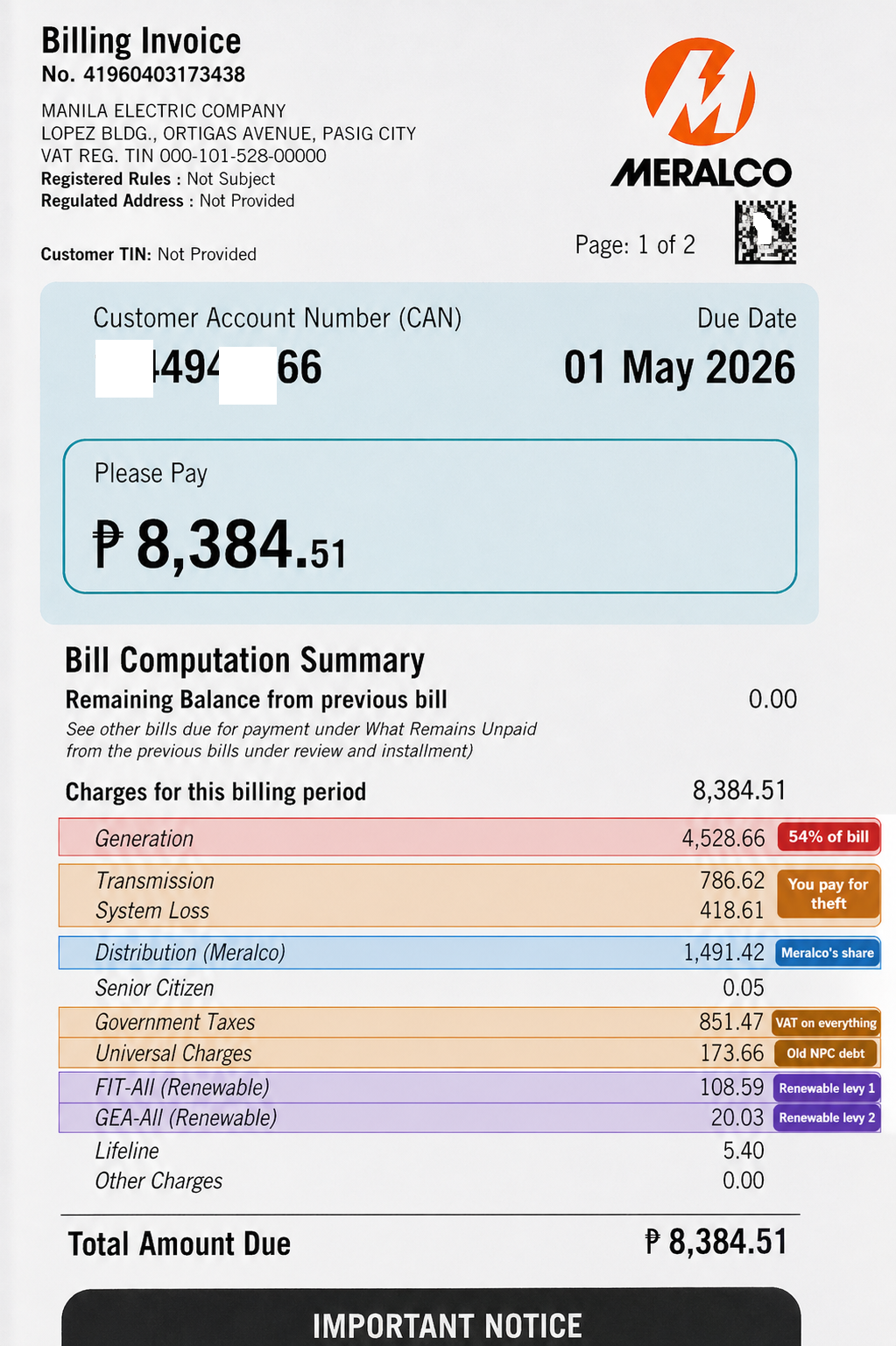
My Meralco bill for April 2026 came in at ₱8,384.51 for 540 kWh. I didn’t run the aircon more than usual. Nothing changed on my end. The bill just came in ₱1,357 higher than what the same 540 kWh would have cost me a year ago.
I went through every line on that bill. Here is what each charge actually means, where the money goes, and why nobody explains this in plain language to ordinary customers.
The same pressure behind this bill is what’s also been driving the oil price hike in the Philippines this 2026, with costs moving up and accountability staying vague.
What is the Meralco generation charge?
The generation charge is what Meralco pays to buy electricity from power producers. It is not Meralco’s profit. It goes to gas plants, coal plants, and suppliers in the Wholesale Electricity Spot Market (WESM).
For April 2026, the generation charge is ₱8.3864 per kWh, up from ₱7.8607 in March. That single line item is 54% of my entire bill.
| Charge | April 2026 amount | Per kWh |
|---|---|---|
| Generation charge | ₱4,528.66 | ₱8.39 |
| Distribution (Meralco’s cut) | ₱1,491.42 | ₱2.76 |
| Government taxes (VAT) | ₱851.47 | ₱1.58 |
| System loss | ₱418.61 | ₱0.78 |
| Universal charges | ₱173.66 | ₱0.32 |
| FiT-All + GEA-All | ₱128.62 | ₱0.24 |
Meralco’s distribution charge has not moved since 2022. It is ERC-regulated and stable. Everything moving on your bill is sitting on top of it.
Why did the April 2026 Meralco bill spike so suddenly?
Two things hit at the same time: a weaker peso and a tighter Luzon grid.
The exchange rate moved to ₱60.748 per USD in March, up more than ₱3 from the previous month. Around 99% of the costs at the First Gas Sta. Rita and San Lorenzo plants are dollar-denominated. When the peso drops, those costs rise automatically, and the increase passes straight to your bill without delay.
At the same time, seasonal demand in Luzon jumped by an average of 579 MW. That tightened spot market supply and pushed WESM prices up. The latest oil price update in the Philippines tells the same story; fuel costs are moving in one direction. When demand is high and fuel is expensive, generation costs follow.
The result: generation went up ₱0.5257 per kWh from March to April. For a 540 kWh household, that single factor added roughly ₱284 to the bill before taxes. According to Meralco’s official April 2026 advisory, this adjustment affects all residential customers in its franchise area.
The full breakdown: what every charge on your bill actually means
Generation charge: ₱4,528.66. The cost of buying power from producers. It moves the most from month to month and has the least direct accountability to consumers. Meralco does not set this number; the market and the peso do.
Distribution charge: ₱1,491.42. Meralco’s actual revenue. This covers the poles, wires, transformers, and labor that deliver electricity to your home. ERC-regulated and flat since 2022.
System loss: ₱418.61. You are paying for electricity that never reached you. Stolen through illegal connections, lost to meter tampering, taken through jumpers on distribution lines. Republic Act 7832 allows Meralco to pass this cost directly to paying customers. You didn’t steal anything. You still pay for it.
Universal charges: ₱173.66. Part of this covers the National Power Corporation’s old debts, specifically obligations from decisions made decades ago, before most working Filipinos started paying their own bills. These charges have no published end date.
Government taxes: ₱851.47. The 12% VAT. It applies to your total charges, not just what you consumed. If you are already watching every peso through your 2026 BIR 1701A annual ITR, this stacking effect is worth understanding; Meralco VAT is one of the least-discussed layers of your total tax burden.
FiT-All + GEA-All: ₱128.62 combined. Two renewable energy levies, running simultaneously on the same bill. FiT-All funds older solar, wind, and hydro projects under the Feed-in Tariff system. GEA-All funds newer ones. Neither is optional. Both are government-mandated.
You are paying 12% VAT on stolen electricity and old government debt
This is the part most coverage skips.
The 12% VAT on your Meralco bill applies to your total charges, not just the energy you consumed. So yes: you are paying tax on stolen electricity. On a government debt that was already old before you started working. On a renewable energy program that added itself to your bill in February 2026 with no announcement most customers ever saw.
None of this is illegal. Every layer has a law behind it. But legal and fair are not the same thing.
The middle class absorbs the full impact. We don’t qualify for lifeline rates. No 4Ps either. We pay full VAT, fund lifeline subsidies through cross-subsidy loading, and absorb pass-through costs that were never ours to carry. Every month. Without relief.
What is GEA-All, and why did it quietly appear on your bill?
GEA-All is the Green Energy Auction Allowance. The ERC approved it at ₱0.0371 per kWh. It started appearing as a separate line item on Meralco bills from February 2026.
| Levy | What it funds | Rate |
|---|---|---|
| FiT-All | Older RE projects under the Feed-in Tariff system | Varies monthly |
| GEA-All | New RE projects under the Green Energy Auction Program | ₱0.0371 per kWh |
The ERC’s position is that competitive bidding for renewable energy contracts should bring generation costs down over time. Maybe. But right now there is no cap, no end date, and no plain-language notice that this charge was being added to bills starting February 2026. Most customers only found out when it appeared on the bill.
Some energy analysts argue the Philippines should seriously explore nuclear power as a longer-term answer to dollar-denominated supply contracts and volatile fossil fuel prices. Given what these bills are showing us, that debate is worth having.
Why your rate is higher than the number Meralco announces
Meralco’s published April 2026 rate is ₱14.3496 per kWh. My effective rate is ₱15.43 per kWh. That is a gap of ₱1.08 per kWh, roughly ₱583 extra on a 540 kWh bill.
The published rate is benchmarked for a household consuming 200 kWh per month. At 540 kWh, I am in a higher consumption tier. Higher-consumption households carry a cross-subsidy built into the rate structure. Lifeline customers consuming 100 kWh or less pay a subsidized rate, and the cost of that discount is distributed across consumers using more than the threshold.
So the more electricity you use above the lifeline threshold, the more you fund others’ subsidized rate. Most people only notice this gap when they compare the Meralco announcement to their actual bill.
What actually needs to change
The generation charge needs a hard review trigger. Right now, Meralco files monthly adjustments and they pass automatically. No escalation mechanism exists when a single line item crosses 45% of the total bill. That needs to change, and it does not require new legislation, just a stricter ERC standing order.
System loss pass-through is the fight worth having. We are one of the few markets where a utility can transfer theft costs to paying customers with no statutory cap. Republic Act 7832 was written in 1994. Electricity theft exists in every country. Most utilities in other markets absorb that loss or face hard limits on pass-through amounts. We should demand the same standard here.
FiT-All and GEA-All are two separate charges doing the same job. Both fund renewable energy. Both are mandatory. Neither has a sunset clause or a defined end date. Running them in parallel, with no unified accounting and no cap, is not a clean energy strategy for consumers. It is two revenue streams dressed as one policy goal.
What you can do right now
Read the breakdown every month. Not just the total. Look at which line items moved and by how much. The generation charge and system loss are the two most volatile. If either spikes, you now know the language to use when you ask Meralco about it.
Filing a formal inquiry with ERC is something most people skip because it feels pointless. It is not. One inquiry creates documentation. Thousands of them create a political problem for the regulator. The ERC contact process is not complicated; you can do it online with your bill as supporting documentation.
Understanding why SSS matters to your financial safety net is part of the bigger picture here. Rising utility costs put pressure on every household budget, and knowing your benefits and protections matters more when fixed costs keep climbing.
The bills are not going to fix themselves. But what you do with the money you still have is something you can control. Opening an MP2 account is one of the better moves available to middle-class Filipinos right now: government-backed, tax-free dividends, no lock-in fees. Run the MP2 calculator to see what your specific monthly amount looks like over five years.
The compound interest calculator is worth bookmarking too. Even ₱500 a month, placed consistently, adds up faster than most people expect. And if you are still paying Meralco the slow way, GCash handles bill payment with reminders built in, one less thing to scramble on due date.
Stay on top of what is changing in your wallet. The WisePH current events page covers utility rates, cost of living, and policy updates that affect ordinary Filipino households every month.
Frequently asked questions
Why is Meralco’s generation charge so high in April 2026?
The generation charge rose to ₱8.3864 per kWh because the peso weakened to ₱60.748 per USD in March 2026, raising the cost of dollar-denominated supply contracts. At the same time, seasonal demand in Luzon jumped by 579 MW on average, pushing WESM spot prices higher. Both factors hit in the same billing cycle.
What is GEA-All on my Meralco bill?
GEA-All stands for Green Energy Auction Allowance. The ERC approved it at ₱0.0371 per kWh, and it first appeared as a separate line item in February 2026. It funds new renewable energy projects under the Green Energy Auction Program, separate from FiT-All, which funds an earlier generation of RE projects. Both are mandatory. Both run simultaneously.
Is the system loss charge on my Meralco bill legal?
Yes. Republic Act 7832 allows Meralco to pass electricity theft and technical losses to paying customers. It is legal and has been in place for decades. Consumer groups have long argued the distribution utility should absorb this cost or face a hard statutory cap; neither has happened.
Why is my effective rate higher than the number Meralco announces?
Meralco’s published rate is calculated at 200 kWh monthly consumption. At 540 kWh, you are in a higher tier that carries cross-subsidy loading for lifeline customers consuming 100 kWh or less. At 540 kWh in April 2026, that difference is roughly ₱1.08 per kWh above the published base rate, or about ₱583 on the total bill.
How do I file a complaint with ERC about my electricity bill?
Contact the Energy Regulatory Commission through their official website or phone lines. Document the specific charge you are questioning, the billing period, and the exact peso amount. Attach your Meralco bill as evidence. A formal inquiry forces documentation on the ERC’s end. According to the Philippine News Agency, the ERC has been monitoring the April 2026 rate adjustments; your inquiry adds to the public record.