


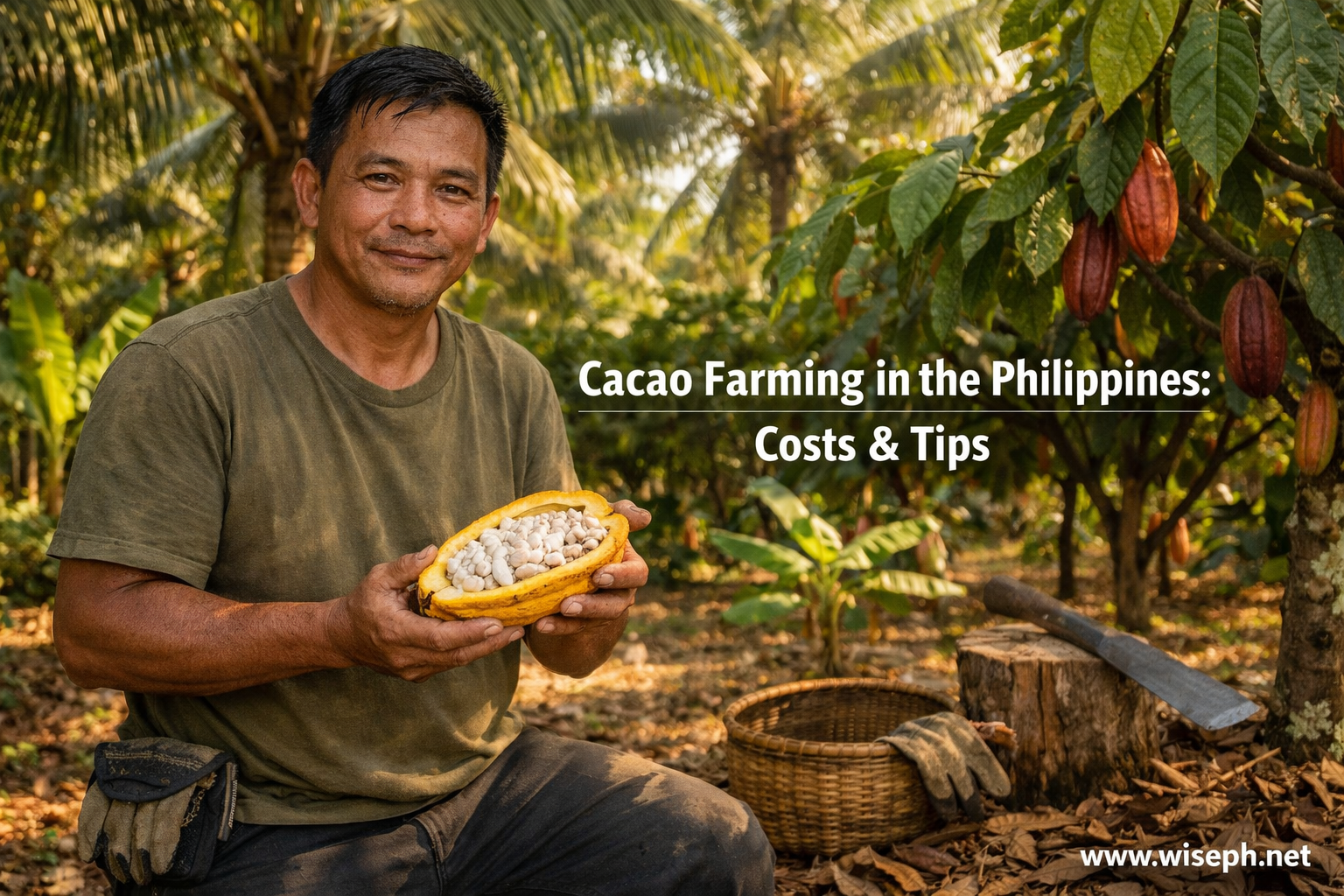
Cacao farming in the Philippines is getting serious attention. From Davao de Oro to Laguna, demand from local chocolatiers and international bean-to-bar buyers is growing steadily. Some smallholders are earning ₱300/kg or more for well-fermented Philippine beans. For anyone with a hectare of land and mature coconut trees already growing on it, the crop looks like a strong bet.
Most farms don’t get close to those numbers, though.
National average cacao yield sits at roughly 0.3-0.5 MT of dry beans per hectare, far below the 1.5-2.5 MT achievable on well-managed farms. Most smallholders sell at ₱80-150 per kg through middlemen when ₱200-400/kg is within reach for quality beans. Consistent pest management and post-harvest quality are what separate ₱80/kg farms from ₱300/kg farms. Those are also the two areas most guides cover least.
Why most Philippine cacao farms earn less than they should
Most smallholder farms earn commodity prices because two problems compound each other. Philippine cacao industry data from PCAF shows that uncontrolled cacao pod borer infestations cause 30-50%+ yield losses on farms without active management. However, even when pods survive, poor fermentation and drying at post-harvest downgrade the remaining beans at the point of sale.
Stressed, poorly maintained trees are also more vulnerable to cacao pod borer and black pod rot. These problems feed each other. A farm with weak pruning, inconsistent shade management, and no sleeving program ends up with lower volume and lower price per kilogram, a squeeze that holds most smallholders far below what the land could earn.
However, the gaps are bridgeable. Farms in Davao de Oro and similar Mindanao areas that apply consistent pest management and basic fermentation practices routinely reach 1-1.5 MT/ha and sell at ₱200/kg or above. The knowledge and tools exist; the hard part is applying them consistently over the 4-7 years the crop needs to reach full production.
Which cacao variety is right for your land?
For most new Philippine farmers, a mix of 60-70% UF 18 and 30-40% BR 25 is the practical starting point. Both are NSIC-approved Trinitario-type hybrids proven in Philippine conditions and widely available from DA-accredited nurseries. UF 18 offers bigger beans (around 34 per pod), reliable volume, and easier batch processing for commodity or coop-grade markets. BR 25, however, has more fine-flavor potential, with floral, orange blossom, and berry notes when properly fermented. So if your goal is specialty buyers at ₱300-400+/kg, lean toward BR 25 in your starting mix.
However, pest resistance differences between UF 18 and BR 25 are minor. Neither resists cacao pod borer meaningfully better than the other, and both require full CPB management including sleeving, sanitation, and pruning. So source only accredited grafted seedlings from DA or SUC nurseries. Unaccredited planting material risks disease carry-over and poor genetic performance, with no way to recover the 2-3 years of growth lost from a failed establishment.
PBC 123 rounds out the top three NSIC-approved clones worth knowing. It is another high-yielding Trinitario hybrid with good bean size and adaptability, similar to UF 18 in how it sells. If your local DA office recommends it for your specific area, it is a safe third option alongside the UF 18 and BR 25 mix.
What it actually costs to start a 1-hectare cacao farm
Starting cacao farming in the Philippines on 1 hectare under mature coconuts costs ₱80,000-140,000 through Year 1. That is cheaper than a bare-land setup, because shade is already in place and coconuts generate income during the establishment period. Meaningful cacao income begins around Year 4-5. Full production typically comes between Year 5 and Year 7.
| Year | Main activities | Estimated cost |
|---|---|---|
| Year 1 | Land prep, 600-800 seedlings, planting, intercrops (banana, vegetables), basic post-harvest setup | ₱80,000-140,000 |
| Year 2 | Fertilizer, weeding, pruning, sleeving and sanitation, intercrop maintenance | ₱35,000-65,000 |
| Year 3 | Maintenance plus light first cacao harvest | ₱40,000-70,000 net |
| Year 4-5 | Full maintenance; meaningful cacao income begins alongside coconuts | ₱60,000-80,000 annually |
Intercropping with banana and vegetables can offset 30-60% of Year 1-2 costs. Most experienced Davao farmers treat intercrops as non-negotiable: cacao alone cannot carry the early years financially. Bananas start yielding in 8-12 months and often cover most maintenance costs while cacao trees establish.
Cacao’s multi-year return timeline is similar to other Philippine tree crops. The agarwood farming guide covers a comparable long-horizon planting logic for landowners thinking in years rather than seasons. For farmers also considering coffee on nearby land, the coffee farming guide breaks down the yield timeline and startup costs for side-by-side comparison.
The pest that determines whether you profit: cacao pod borer
Cacao pod borer (CPB) is the single biggest profit threat on Philippine cacao farms. The moth lays eggs on developing pods; larvae bore inside, feed on the beans, and cause 30-50%+ crop losses per season when not actively managed. On farms in Davao de Oro and similar Mindanao areas, CPB is not a seasonal issue. It is a year-round pressure. Miss one management cycle and infestation spikes within weeks.
What sleeving looks like on the ground
Sleeving is the most effective non-chemical CPB barrier available to smallholders. Farmers sleeve pods at around 8-10 cm long (roughly 70-100 days after pollination). Slip a thin plastic bag (about 30 x 15 cm, 0.02 mm thick) over the pod and tie or staple the open end securely around the stalk. The sleeve stays on until harvest, 4-6 months later. Done correctly, infestation rates drop from 60%+ to under 10-15% on sleeved pods.
Sleeving works best alongside three other practices. First, weekly rampasan harvesting picks all ripe pods to break the pest life cycle. Second, aggressive sanitation chops and buries infested husks far from the farm. Third, regular pruning opens the canopy for sunlight and airflow, since CPB is less active in well-lit, airy conditions. Good tree structure does real work between sleeving cycles and brings down how much sleeving you need over time.
Cost and realistic trade-offs
Full sleeving on a 1-hectare farm runs ₱15,000-50,000 per season in combined labor and materials. Plastic sleeves cost ₱1-3 each, and with 4,000-20,000+ pods per hectare depending on yield and tree density, material costs add up fast. Labor is the heavier burden: one person can sleeve 50-100+ pods per hour once practiced, but scouting canopies, reaching into taller trees, and tying sleeves properly takes time. Family farms with limited help during peak periods are most vulnerable to skipping cycles.
Many farmers combine methods rather than relying on sleeving alone. Pheromone traps (an emerging option in Mindanao), biocontrol using Beauveria bassiana, and prioritizing sanitation and pruning can reduce dependence on plastic materials. In the end, full sleeving is expensive in labor and materials, but losing 30-50% of the crop costs more.
The post-harvest gap that kills farmgate prices
Poor fermentation is the most common reason well-grown Philippine cacao earns ₱80-100/kg instead of ₱200+/kg. The problem usually starts with volume. Small farms harvest in batches too small for proper heat buildup. A family gathering 5-10 kg of wet beans at a time is well below the 25-50 kg needed for adequate temperature development in a standard wooden fermentation box. Without enough mass, fermentation stays incomplete and beans remain mostly purple and astringent inside when you cut them open.
Bad fermentation has a clear fingerprint. Under-fermented beans cut open show mostly purple or slate interiors with no chocolate development. Over-fermented batches smell vinegary and taste sour. Moldy or earthy off-flavors appear when beans dry on the ground and pick up soil contamination or rewetting from rain. Buyers penalize every one: consolidators pay ₱80-100/kg for defective lots, and quality buyers reject them outright.
The minimum viable setup
A basic fermentation and drying setup costs under ₱25,000 built from local materials. The core tool is a wooden fermentation box (50-100 kg capacity, food-grade untreated wood with drainage holes at the bottom). Line it with fresh banana leaves and cover with jute sacks to hold heat at 45-50°C. Turn beans 2-3 times during the 5-7 day fermentation period for aeration. Verify progress with a simple cut test: slice 10-20 beans, and well-fermented beans should show mostly brown interiors with no purple.
| Item | Why it matters | Estimated cost |
|---|---|---|
| Wooden fermentation box (DIY) | Holds heat for proper fermentation; drainage holes prevent souring | ₱2,000-8,000 |
| Banana leaves and jute sacks | Insulate the box to maintain 45-50°C; free or very cheap | ₱0-500 |
| Raised drying beds (DIY bamboo plus mesh) | Off-ground drying prevents mold and contamination | ₱5,000-15,000 |
| Digital moisture meter | Confirms 7-8% target moisture before storage | ₱1,000-2,000 |
| Total | Under ₱25,000 |
For farms harvesting very small batches, recent Philippine research shows that mixing 3 kg of wet beans with 4 kg of fresh cacao pod husks achieves comparable fermentation temperature and quality to larger batches. As a result, even the smallest farm can ferment properly without waiting to pool volume through a coop.
Ground drying on tarps leads to mold, soil contamination, and uneven moisture. So avoid it entirely, even as a temporary measure. The raised bed cost is low enough that there is no good reason to skip it.
The coconut-cacao system most Davao farmers swear by
Cacao under mature coconuts is the safest way into cacao farming for Philippine smallholders who already have coconut land. Coconut-cacao also dominates across Davao de Oro and much of Mindanao because it reduces risk at every stage. Coconuts provide shade during cacao’s vulnerable establishment period, generate steady income from nuts and copra throughout, and absorb the financial pressure of the years when cacao is not yet producing.
DA-ATI coconut-cacao intercropping guidance recommends planting cacao 2-3 m from coconut trunks under palms that are 25 years or older. These mature palms let through the 30-50% filtered light that cacao naturally prefers as an understory tree. Space cacao in a triangular pattern at 600-800 trees per hectare depending on coconut density. As cacao trees mature, prune lower coconut fronds to regulate light. Too much shade from young or dense palms slows cacao growth; too little stresses young trees during establishment.
Income dynamics in the early years
Coconuts continue producing throughout the cacao establishment period, providing steady cash from nuts or copra while cacao is still years from meaningful harvest. Banana planted as a third layer starts yielding in 8-12 months and often covers a large portion of Year 1-2 maintenance costs. Many Davao farmers sum it up simply: “Coconuts pay the bills. Cacao builds the future.”
By Year 4-5, combined revenue from coconuts, cacao, and intercrops on well-managed farms consistently outperforms coconut monocrop alone. Research on Philippine coconut-cacao systems shows annual net farm income of ₱50,000-60,000+ per hectare once both crops reach full production, compared to lower returns from coconut alone. So the early cash burden is much smaller than it would be starting cacao from bare land.
For farms with water access, hito (catfish) farming adds another income layer alongside the tree system, and diluted pond water can double as organic fertilizer for nearby trees. The chicken egg business also works well on or near the same land, providing steady weekly income that does not depend on tree crop cycles. For farms exploring other high-value intercrops, the calamansi farming guide covers a fruit crop suited to Philippine agroforestry setups. For farms with water sources nearby, the crayfish farming guide is also worth reading.
How to sell for ₱150-400/kg instead of ₱80/kg
Most Philippine cacao smallholders sell at ₱80-150/kg because they sell individually, in small inconsistent volumes, with variable quality. Moving to ₱150-250/kg (coop-grade quality beans) or ₱250-400+/kg (specialty or fine-flavor) requires two things working together: consistently well-fermented and dried beans, and organized selling through a cooperative or cluster.
| Price tier | Price range | Typical buyer | What it requires |
|---|---|---|---|
| Commodity | ₱80-150/kg | Local consolidators, middlemen | Dried beans, any quality; sold individually in small lots |
| Quality/coop-grade | ₱150-250/kg | Processors, local chocolate makers | Proper fermentation, good drying, coop or cluster aggregation |
| Specialty/fine flavor | ₱250-400+/kg | Specialty buyers, bean-to-bar exporters | Excellent fermentation, traceability records, specific clones, volume consistency |
Fix post-harvest quality first; no cooperative compensates for poor fermentation. Then join or form a coop or cluster for volume aggregation, shared processing facilities, and market access. Build basic traceability records (harvest date, variety, fermentation method, drying duration) in a simple notebook. After that, approach local processors and specialty buyers with sample lots before targeting exporters. Local buyers give you price feedback and room to improve before committing to larger volume contracts.
The full range of agri-business opportunities in the Philippines on WisePH puts cacao returns in context alongside other land-based income options at different investment scales.
What government support actually delivers
Government support for Philippine cacao farmers can help, but it works best when you are already organized and making progress on your own. The farmers who benefit most in Davao and similar regions are almost always those working through coops or clusters rather than applying as individuals.
DA-HVCDP seedling distribution gives you accredited UF 18 and BR 25 hybrids, sometimes free or subsidized for organized groups. GAP and post-harvest training through ATI and state universities builds on that. Coop and cluster formation support then unlocks Landbank credit, PCIC crop insurance, and access to shared processing infrastructure. Local DA technicians who know your area are worth getting to know as soon as you have a registered group.
However, individual grant and subsidy applications mostly waste time for small farmers. These are heavy on paperwork (land titles, project proposals, barangay certifications) and take months or years to process. They also often result in late seedlings of uncertain quality with no follow-up training. So in practice, start at your municipal or provincial DA office rather than the national level. Ask specifically about current HVCDP cacao activities and active clusters in your barangay. Join or form a group before applying for anything else.
Your 12-month first-year action plan
Months 1-2: prepare and organize (₱5,000-12,000)
Visit your local DA office or cacao coop and request a soil test and site assessment. Ask about current HVCDP seedling programs and the next available GAP and post-harvest training schedule. Join or help form a local cluster or coop immediately. Coop membership opens doors to subsidized seedlings, ATI training, and shared processing that solo applicants rarely get. Also order accredited grafted seedlings (600-800 plants plus a 10% buffer) from a reliable nursery early, since good material books fast during planting season. At the same time, plant temporary intercrops (banana suckers, vegetables, or ginger) for early cash flow and soil cover.
Months 3-4: planting season (₱40,000-70,000)
Plant cacao at the start of consistent rainy season. Place seedlings 2-3 m from coconut trunks in a triangular pattern. Stake and mulch each plant using coconut leaves or organic material. Plant banana at the same time for middle-layer shade and income from Month 8-12. Apply initial basal fertilizer based on soil test results. Build your basic post-harvest setup now too: fermentation box and raised drying beds. It should be ready well before the first harvest arrives 18-24 months later. Budget for a 10% seedling buffer to replant any gaps.
Months 5-8: early establishment (₱15,000-30,000)
Weed manually around each young tree and maintain mulch to suppress weeds and retain moisture. Prune basal suckers and low drooping branches early to build a strong, open tree structure. Poor pruning in Year 1 causes problems in every year that follows. Scout for pests regularly, even before pods form. Apply fertilizer in split doses and track all applications in a notebook. Harvest and sell intercrops aggressively to offset input costs. Take any follow-up GAP or CPB training sessions your coop or DA office offers during this period.
Months 9-12: consolidate and review (₱10,000-25,000)
Regulate light by pruning lower coconut fronds if the canopy is becoming too dense for young cacao below. Apply follow-up fertilizer and monitor for early signs of black pod rot, especially during humid periods. Harvest intercrops for year-end income. Then do a full assessment at Month 12: tree survival rate, growth health, and any gaps to replant. Plan Year 2 with a full CPB strategy (sleeving materials budgeted before the first pods appear) and heavier fertilization based on Year 1 observations. Also line up coop involvement for shared post-harvest batching.
The failure pattern most cacao guides never mention
You can do most things right and still lose the farm’s earning potential by Year 6. The quiet failure pattern I see most often in Davao-area smallholder cacao is the labor exhaustion trap. It does not look like a disaster: no typhoon, no total crop wipe-out. It is a slow decline that hits farmers who did almost everything correctly during establishment.
The pattern starts around Years 4-7, right when production should be ramping up. These farmers planted good hybrid seedlings, intercropped with coconut and banana, attended training, and joined a cooperative. The first few years feel manageable. Then Year 4 or 5 arrives. The real weight of cacao farming shows itself: CPB and black pod rot never fully go away. You have to scout and sleeve hundreds to thousands of pods every season. Miss one or two cycles during a busy harvest period or when family help is short and infestation spikes. Sanitation must be relentless in humid Davao-type weather, because a single neglected infested pod is a breeding site for the next cycle.
What the labor exhaustion trap looks like in practice
Labor demand is constant and physically tiring: climbing, reaching into canopies, tying sleeves, turning fermentation boxes, monitoring drying beds. Family members age. Kids move to cities for easier work. Hiring reliable workers becomes expensive or unavailable in many areas. So the farmer starts cutting corners: sleeving only part of the trees, skipping some sanitation rounds, pruning less thoroughly. Yields drop, pest pressure builds, quality slips, and buyers pay less. When that happens year after year, it gets hard to stay motivated. The cacao portion of the farm quietly becomes neglected while easier crops take over more of the land.
The farms that survive share a pattern. They diversified income from the start so coconuts and bananas covered the bills while cacao was built. Cooperative membership was the second factor: shared knowledge, collective processing, and occasional labor support made a real difference. They also planned for the labor reality from the beginning, not just the planting phase. Plan your available labor as carefully as your soil test, and build your coop relationship before you need it, not after the problems start.
Frequently asked questions about cacao farming in the Philippines
How profitable is cacao farming in the Philippines?
A well-managed 1-hectare coconut-cacao farm can generate ₱50,000-60,000+ net annual income once both crops are in full production, typically at Year 5-7. That number depends on post-harvest quality and whether you sell through a cooperative, though. Commodity prices (₱80-150/kg) and quality prices (₱150-400+/kg) are both real outcomes on Philippine farms, and the difference between them is almost entirely post-harvest management.
Which cacao variety is best for beginners in the Philippines?
A 60-70% UF 18 and 30-40% BR 25 mix is the safest starting combination. UF 18 gives you reliable volume with bigger beans and easier batch processing. BR 25 adds fine-flavor potential for specialty buyers. Both are proven Trinitario-type hybrids available from DA-accredited nurseries. Source only accredited grafted seedlings. PBC 123 is also a solid high-yield option if your local DA recommends it for your area.
How many years before a cacao tree produces in the Philippines?
First pods can appear as early as 18-24 months after planting. A light but sellable harvest typically starts at Year 3. Then meaningful, reliable cacao income begins around Year 4-5 with consistent pest management and proper pruning. Full production comes between Year 5 and Year 7. Healthy trees produce well for 20-30 years.
What is the biggest mistake new cacao farmers make in the Philippines?
The biggest mistake is underestimating cacao pod borer management and post-harvest fermentation. Most low farmgate prices come from CPB losses and poorly fermented beans, not from bad land or the wrong variety. Many new farmers focus on the planting phase but do not budget the labor and materials for consistent weekly sleeving, rampasan harvesting, and sanitation. The second most common mistake is fermenting in batches too small for proper heat buildup, so fix your post-harvest volume problem before anything else.
Can I start cacao farming in the Philippines with 1 hectare?
Yes, and 1 hectare under mature coconuts is the recommended starting scale. Startup costs stay manageable at ₱80,000-140,000 through Year 1, and the scale lets you learn pest management and fermentation before expanding. Most successful smallholders in Davao start at 0.5-2 hectares, join a cooperative early, master post-harvest quality, and grow from there. The coconuts and intercrops provide income while cacao matures.