


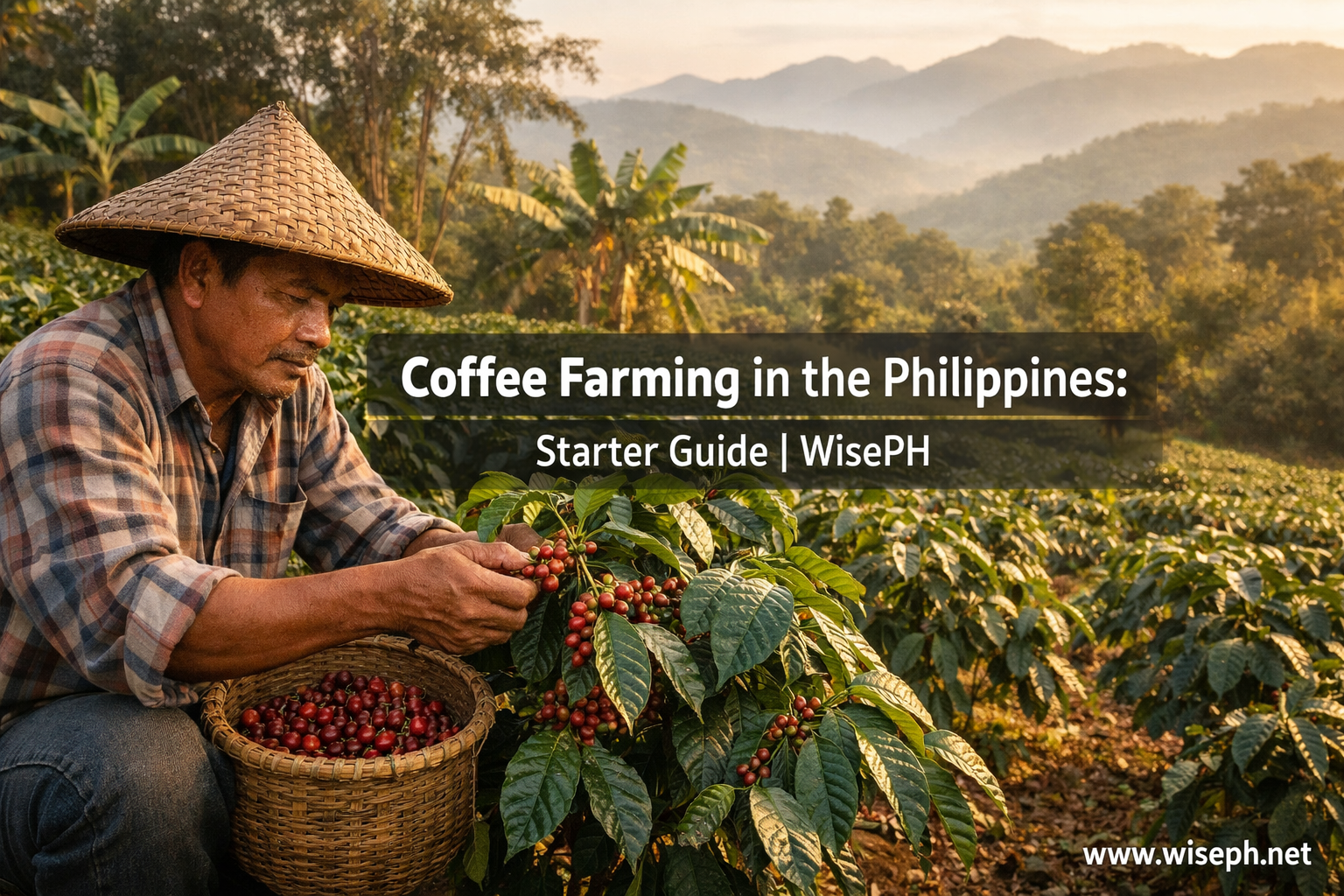
Coffee farming in the Philippines is getting more attention than it has in decades. New highland origin stories. Specialty roasters sourcing directly from Benguet and Sagada. Rising farmgate prices for quality Robusta in Sultan Kudarat and Bukidnon. On paper, the opportunity looks solid for anyone with a hectare of land and some starting capital.
The reality is more complicated.
The national average yield sits around 0.5 MT of green coffee beans per hectare, less than half the 1-2 MT achievable with proper management. Most smallholders earn commodity prices because one thing gets ignored: everything that happens after the cherry is picked.
Why most Philippine coffee farms earn less than they should
The most common misconception about coffee farming in the Philippines is that location and variety determine success. However, post-harvest processing is where most value is won or lost. The root problems also start much earlier, long before the cherry is harvested.
The farms earning the least are typically dealing with a combination of aging trees that were never rejuvenated, inconsistent pruning, and depleted soil nutrition. These three issues reinforce each other. Fixing just one rarely improves yield.
The stumping fix most farmers skip
Many Philippine farms still have trees that are 15-30 years old and have never been properly rejuvenated. Coffee trees produce far less after 10-12 years without a reset. The fix is stumping: cutting main stems back to about 30-40 cm above ground after harvest, then managing the new suckers. This restarts vigorous growth and can dramatically boost output on neglected farms. Even good fertilization gives diminishing returns on an exhausted tree structure.
Stumping is widely covered in the DA Coffee Industry Roadmap and in extension training, yet most farming articles and promotions never mention it. If you have older trees on your land, this is the most effective step you can take before spending on anything else.
Pruning, soil health, and why pests pile on
Poor pruning leaves canopies overcrowded and shaded inside, so fewer flowers form and cherries grow smaller. The same problem repeats every season because the underlying structure was never corrected. Inadequate fertilization on slopes that have been losing topsoil for years makes it worse. Coffee is a heavy feeder and most smallholder soils cannot supply what the tree needs without supplementation.
Coffee berry borer and leaf rust make all of this worse. Weak, stressed trees are far more vulnerable to both. So reactive spraying works less well than the cultural practices (better airflow through proper pruning and healthier soil) that prevent pest pressure from building.
BusinessWorld reports that coffee production in the Philippines is persistently hampered by the small scale of most growers and their limited access to proper post-harvest facilities and technical knowledge. However, the yield gap is bridgeable; many individual well-managed farms already hit 1-1.5 MT/ha when these basics are done consistently.
Which coffee variety is right for your land?
For most new Philippine farmers, Robusta is the practical starting point. It tolerates lower elevations, yields more consistently, resists pests better, and is more forgiving during the learning years. Current farmgate prices run around ₱200-400 per kg of green beans, with demand strong from local processors and blenders.
However, choose Arabica only if your land genuinely sits above 900 masl with consistent rainfall or irrigation, well-drained volcanic or loamy soil, and average temperatures of 15-24°C. Benguet, Sagada, Kalinga, and the higher parts of Davao and Cotabato have the right conditions. Pushing Arabica onto unsuitable lowland gives you the difficulty without the premium.
Liberica (Barako) also deserves more consideration than it usually gets. It is more climate-resilient and adaptable than Arabica, thrives at transitional elevations, and commands a niche premium from buyers who want authentic Philippine heritage coffee. Many profitable farms grow more than one variety. So let your actual site conditions decide, not the hype around any single origin story.
What it actually costs to start a 1-hectare coffee farm
Starting coffee farming in the Philippines on 1 hectare realistically costs ₱150,000-200,000 through the first three years. Year 1 carries the heaviest outlay. Meaningful income typically starts around Year 4 for well-managed farms, with full production at Year 5-7.
| Year | Main activities | Estimated cost |
|---|---|---|
| Year 1 | Land prep, ~1,000 seedlings, planting, shade trees, intercrops, basic post-harvest setup | ₱100,000-160,000 (Robusta) / ₱140,000-220,000 (Arabica) |
| Year 2 | Fertilizer, weeding, pruning, pest monitoring | ₱40,000-70,000 |
| Year 3 | Maintenance plus light first harvest | ₱45,000-75,000 net outlay |
| Year 4-5 | Full maintenance; meaningful income begins | ₱50,000-90,000 annually |
Intercropping with bananas or vegetables can also offset 30-60% of Year 1-2 costs. Most experienced farmers treat intercrops as non-negotiable. Coffee alone cannot carry the early years financially, so intercrops generate cash while trees mature and improve soil health at the same time.
The long-horizon nature of coffee farming is similar to other high-value Philippine tree crops. The agarwood farming guide walks through a comparable investment timeline for landowners who think in years rather than seasons.
The post-harvest gap that kills farmgate prices
Bad post-harvest on a typical small Philippine coffee farm follows a predictable pattern. A family strip-picks everything at once: ripe red cherries mixed with green unripe ones, overripe, and damaged fruit, all going into the same sack. The load goes to the nearest consolidator the same day. Sorting is minimal. Drying happens on cheap tarps on the ground, where cherries get rewet by evening dew or rain, pick up soil contamination, and dry unevenly.
As a result, you get SCAA defect class 4-5 coffee with high defects, earthy or moldy off-flavors, and moisture above 13%. Mold risk is real, including ochratoxin A contamination that can disqualify entire lots from quality buyers. The consolidator sets the price, and it is low. Many smallholders end up selling wet cherries or poorly processed parchment at a discount because they have no choice once that process goes wrong.
This is common during peak season when post-harvest happens in a rush with limited equipment, knowledge, and labor. However, the fix does not require a full wet mill or expensive machinery. It requires three changes: selective picking of only fully ripe cherries, basic raised-bed drying off the ground, and a moisture meter to confirm the 10-12% target before storage.
How to set up basic post-harvest for under ₱15,000
A new farmer can produce quality coffee with under ₱15,000 in equipment if they learn the process properly first. The three highest-impact steps are selective harvesting (only ripe red cherries), sorted pre-processing (float test to remove damaged or unripe fruit), and controlled drying on raised beds.
| Item | Why it matters | Estimated cost |
|---|---|---|
| Sorting table plus clean tarps | Separates ripe from unripe; float test removes defects | ₱1,000-3,000 |
| Manual rubber-bib pulper | Removes cherry skin for washed process; ~40-50 kg per hour | ₱3,000-8,000 |
| Raised drying beds (DIY bamboo plus mesh) | Even airflow; off-ground contact; rain cover at night | ₱2,000-5,000 |
| Digital moisture meter | Confirms 10-12% target before bagging | ₱1,000-2,000 |
| Hermetic storage bags | Stabilizes green beans; prevents moisture reabsorption | ₱500-1,000 |
| Total | ₱7,500-19,000 |
If water is scarce, start with natural process, with whole cherry dried on raised beds without pulping. It is forgiving and produces solid results with Robusta. Washed process gives cleaner cups but needs careful fermentation control: 12-48 hours depending on temperature, monitored by smell and feel in clean plastic drums.
However, training beats equipment at the start. DA-ATI, Benguet State University, Sultan Kudarat State University, and local cooperatives run low-cost or free post-harvest sessions. Attend at least one before spending on equipment. What you learn there will help you avoid the expensive mistakes.
The realistic path to better prices
Better farmgate prices come from two things working together: consistent quality and organized selling. Fixing your post-harvest gets you the quality. Joining a cooperative gets you the selling power.
However, individual smallholders with small, inconsistent lots struggle to access quality buyers directly. Buyers want reliable volume, traceability, and consistent quality, and cooperatives help deliver all three. Programs like PhilCAFE (Philippine Coffee Advancement and Farm Enterprise), which was supported by ACDI/VOCA, helped organized cooperatives sell directly to international buyers in the US, Europe, and Asia. Look for active successor programs and DA-linked cluster initiatives in your region.
Fix farm practices first; no cooperative compensates for low-quality beans. Then join an active local coop or cluster. Get consistent with traceability: farm lot, variety, elevation, process method, harvest date. A simple notebook is enough to start. Then approach local specialty roasters or cafes with sample bags before trying exporters. Local buyers are the easier entry point and give you feedback to improve.
WisePH covers the full range of agri-business opportunities in the Philippines if you want a bigger picture of what else is viable alongside coffee.
How shade trees and intercropping protect your investment
Planting shade trees and companion crops alongside coffee (agroforestry) is one of the most cost-effective ways to protect a new farm against climate risk. Research on small farms in the Mt. Hamiguitan buffer zone in Davao Oriental confirms that shade tree systems reduce heat stress, retain soil moisture, and improve soil fertility through nitrogen fixation and leaf litter decomposition. The same system that buffers climate risk also generates income during the years coffee trees are maturing.
The layered system that works best on Philippine coffee farms is straightforward to establish. Ipil-ipil (Leucaena) or other nitrogen-fixing legumes occupy the upper shade layer and improve soil fertility as leaves fall and decompose. Bananas sit in the middle layer and start generating income from Year 1-2. Meanwhile, coffee fills the main growing layer. Ground cover crops, vegetables, or legumes then reduce weed competition and add short-term income from the floor.
Many Filipino farmers also raise chickens on or near their farm for a reliable income layer that does not depend on coffee prices. The chicken egg business guide covers how smallholders set up laying operations alongside long-maturing tree crops. For farms with water access, hito (catfish) farming is another income layer worth exploring since diluted pond water doubles as organic fertilizer for trees.
So the farms that weather typhoons, droughts, and price drops are almost always the ones with diversified systems. Coffee monoculture gives you more to lose and less to fall back on.
What government support actually delivers
Government support for coffee farming in the Philippines can help, but it works best when you are already making progress on your own. The farmers who get the most from it are usually those already improving their operations and working in organized groups.
The most useful programs are the free or low-cost Good Agricultural Practices training through DA-ATI and state universities like Benguet State University and Sultan Kudarat State University. Cooperative and cluster formation support also matters: it opens access to subsidized seedlings, shared processing equipment, Landbank credit, and PCIC crop insurance. Local DA technicians who know your specific area can give you targeted guidance on whatever programs are currently active.
However, what mostly wastes time for individual smallholders is direct grant or subsidy applications. These are heavy on documentation: land titles, barangay certifications, and project proposals, and they can take months or years to process with uncertain results for those applying alone. Market linkage promises without quality backing are also common. Buyers want consistent volume and quality, not introductions to low-grade lots.
In practice, start at your municipal or provincial DA office rather than the national level. Ask specifically about current coffee training schedules and any active clusters in your barangay or municipality. Join or form a cluster before applying for anything else. Prepare basic documents in advance: valid ID, proof of land ownership or tenancy, and barangay certification. Then network with farmers who have actually accessed support. They will save you months of misdirected paperwork.
Your 12-month first-year action plan
Month 1: verify, learn, and organize (₱5,000-10,000)
Visit your municipal DA office. Get a soil test and site assessment. Confirm suitability and the recommended variety or clone for your elevation and soil type. Then enroll in the next available GAP, pruning, and post-harvest training session through ATI or your nearest state university. Talk to existing coffee farmers in your barangay and join or help form a local cluster or cooperative. Source seedlings from accredited DA or SUC nurseries and order early, since good material goes fast during planting season.
Months 2-3: prepare and plant (₱60,000-100,000)
First, clear land and install simple contour lines or basic terracing on slopes for erosion control. Plant shade trees (ipil-ipil) and intercrops (banana, vegetables) at the same time as coffee. Time planting to the start of consistent rainy season. Also build raised drying beds and buy a basic digital moisture meter. Budget for 10% extra seedlings as a replanting buffer. Avoid the steepest, most exposed slopes where typhoon and landslide risk is highest.
Months 4-12: maintain and build (₱40,000-70,000)
Then weed regularly, manually where possible. Apply fertilizer based on your soil test results rather than guessing. Monitor for coffee berry borer and leaf rust and respond with integrated pest management, cultural controls first. Prune young trees for good structural shape. Harvest and sell intercrops and use proceeds to fund ongoing inputs. Track every expense and sale in a notebook. Also stay active in your cluster and attend follow-up training sessions. By Month 12, assess tree survival rate and plan Year 2 pruning, fertilization, and gap-filling.
For additional income streams that work well alongside coffee, the calamansi farming guide covers a high-value fruit crop suited to Philippine conditions, and the crayfish farming guide is worth reading for farms with water access.
The one scenario that catches even prepared farmers off guard
You can do everything right (proper shade management, consistent pruning, healthy soil, selective picking, careful drying on raised beds, cooperative membership) and still lose years of work in a single season. Coffee farming in the Philippines rewards consistent good practice, but it cannot fully protect you from what happens outside your control.
The scenario I see most often is a strong typhoon on a highland slope, or back-to-back dry spells hitting during the flowering period. I have seen farmers in Cordillera and parts of Mindanao who followed every good practice and still spent two to three years recovering after a major weather event. Some came back to find uprooted trees, landslides on steep sites, destroyed drying infrastructure, and disrupted flowering in the trees that survived. Many were carrying establishment debt from Years 1-3 and had limited insurance coverage to fall back on.
However, the farmers who recovered had kept diversified income from intercrops, stayed active in a cooperative for shared knowledge and occasional resources, and held a financial buffer they never touched during normal years. Climate change is also making these events more frequent. Rising temperatures are already pushing suitable Arabica zones higher up the mountain and adding stress to traditional growing areas.
So coffee farming is not too risky. But good agronomy alone is not enough. Keep that ₱20,000-30,000 emergency reserve from your starting budget. Diversify your income from Year 1. Get into a cooperative before you need it. The ones who came back were the ones who had treated risk management as seriously as agronomy.
Frequently asked questions about coffee farming in the Philippines
How profitable is coffee farming in the Philippines?
A well-managed 1-hectare farm can generate gross revenue of ₱150,000-400,000 or more annually once at full production between Year 5 and Year 7. However, net profit depends on operating costs, whether you sell through a cooperative or spot trader, and your post-harvest quality. Most farms take 4-6 years to reach a positive return on the initial investment.
Which coffee variety is best for beginners in the Philippines?
Robusta is the safest starting variety for most new farmers. It tolerates elevations below 1,200 masl, yields 1-2 MT per hectare with proper management, resists pests better than Arabica, and is forgiving on beginner-level management. Choose Arabica only if your land genuinely sits above 900 masl with temperatures averaging 15-24°C and good drainage.
How many years before a Philippine coffee plant produces?
Trees start producing small amounts of cherries at the end of Year 2 or beginning of Year 3. Then meaningful, sellable harvest begins around Year 3-4. Full production typically comes between Year 5 and Year 7 with proper pruning, fertilization, and rejuvenation cycles. Well-maintained trees can also produce for 15-30 years.
What is the biggest mistake new coffee farmers make in the Philippines?
The biggest mistake is focusing on the growing side while neglecting post-harvest processing. Most low farmgate prices come from strip-picking, ground drying, and inconsistent moisture control before storage. In fact, a well-processed Robusta lot earns more than a poorly processed Arabica lot from a famous region. So fix the post-harvest process before spending on anything else.
Can I start coffee farming in the Philippines with 1 hectare?
Yes. One hectare is a practical starting scale. Startup costs stay manageable at ₱150,000-200,000 through Year 3, and the scale lets you learn before expanding. Most successful smallholders start at 0.5-2 hectares, master their post-harvest and market access, and grow from there.